9709 P12 - Jun 2023 - Q10
643
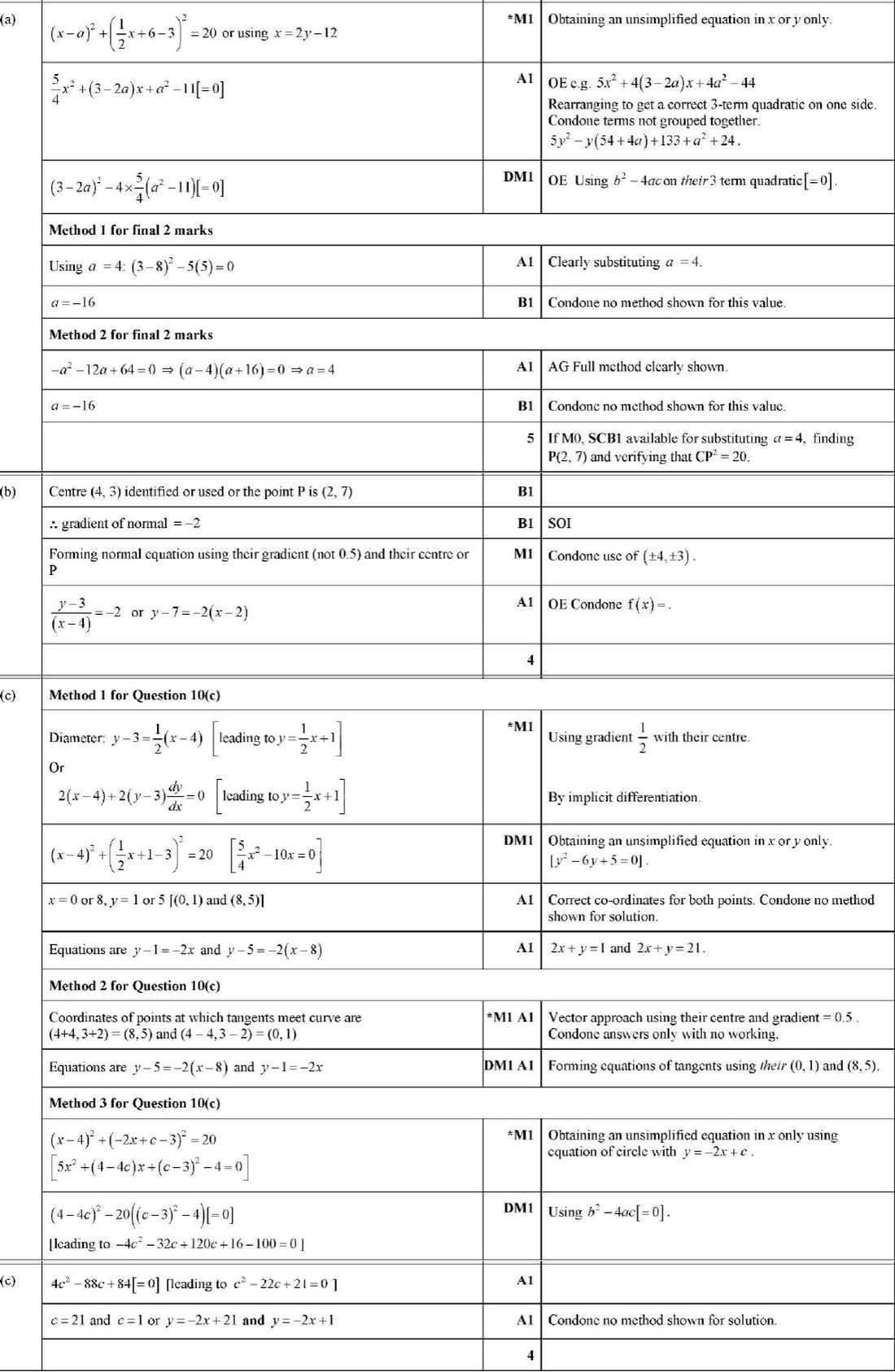
The equation of a circle is \((x-a)^2 + (y-3)^2 = 20\). The line \(y = \frac{1}{2}x + 6\) is a tangent to the circle at the point \(P\).
(a) Show that one possible value of \(a\) is 4 and find the other possible value.
(b) For \(a = 4\), find the equation of the normal to the circle at \(P\).
(c) For \(a = 4\), find the equations of the two tangents to the circle which are parallel to the normal found in (b).