Answer:
Either
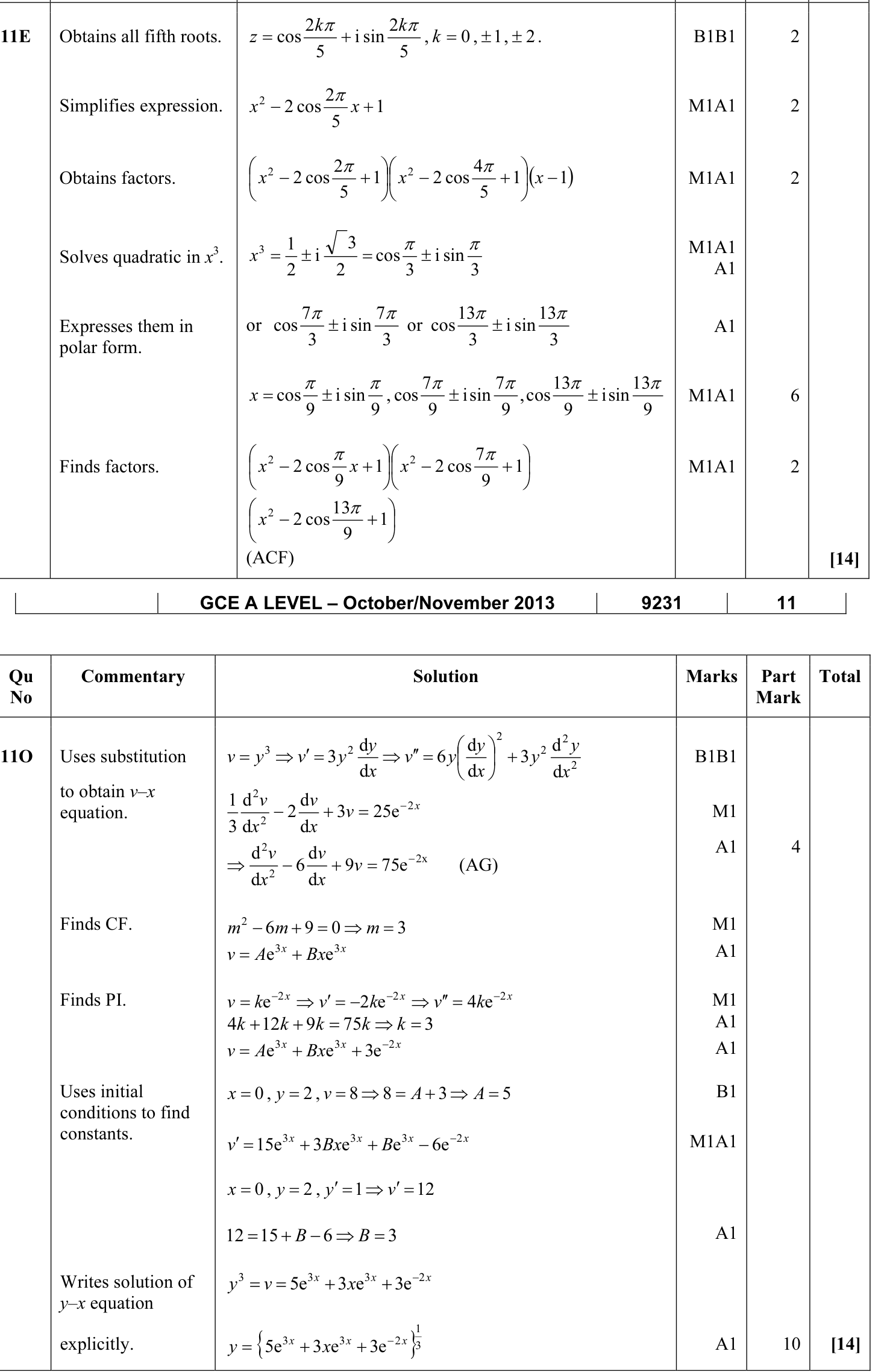
The fifth roots of unity are the five complex numbers of the form \(\cos \theta + i\sin \theta\) with \(\theta = \frac{2k\pi}{5}\) for \(k=0,\pm 1,\pm 2\). So they are
\(1,\ \cos \frac{2\pi}{5}+i\sin \frac{2\pi}{5},\ \cos \frac{2\pi}{5}-i\sin \frac{2\pi}{5},\ \cos \frac{4\pi}{5}+i\sin \frac{4\pi}{5},\ \cos \frac{4\pi}{5}-i\sin \frac{4\pi}{5}\).
\(\left(x-\left[\cos \frac{2\pi}{5}+i\sin \frac{2\pi}{5}\right]\right)\left(x-\left[\cos \frac{2\pi}{5}-i\sin \frac{2\pi}{5}\right]\right)=x^2-2\cos \frac{2\pi}{5}\,x+1.\)
Hence the real factors of \(x^5-1\) are
\((x-1)\left(x^2-2\cos \frac{2\pi}{5}\,x+1\right)\left(x^2-2\cos \frac{4\pi}{5}\,x+1\right).\)
For \(x^6-x^3+1=0\), let \(u=x^3\). Then \(u^2-u+1=0\), so
\(u=\frac12 \pm \frac{\sqrt3}{2}i = \cos \frac{\pi}{3} \pm i\sin \frac{\pi}{3}.\)
Taking cube roots gives the six roots as three conjugate pairs:
\(x=\cos \frac{\pi}{9} \pm i\sin \frac{\pi}{9},\\quad x=\cos \frac{7\pi}{9} \pm i\sin \frac{7\pi}{9},\\quad x=\cos \frac{13\pi}{9} \pm i\sin \frac{13\pi}{9}.\)
Therefore the real factors of \(x^6-x^3+1\) are
\(\left(x^2-2\cos \frac{\pi}{9}\,x+1\right)\left(x^2-2\cos \frac{7\pi}{9}\,x+1\right)\left(x^2-2\cos \frac{13\pi}{9}\,x+1\right).\)
Or
Let \(v=y^3\). Then
\(v' = 3y^2\frac{dy}{dx}\) and \(v''=6y\left(\frac{dy}{dx}\right)^2+3y^2\frac{d^2y}{dx^2}\).
Substituting into the given equation gives
\(v''-6v'+9v=75e^{-2x}.\)
Solve the linear equation for \(v\):
The complementary equation is \(m^2-6m+9=0\), so \(m=3\) twice. Hence
\(v_c=Ae^{3x}+Bxe^{3x}.\)
For a particular solution, try \(v=ke^{-2x}\). Substitution gives
\(4k+12k+9k=75\), so \(25k=75\) and \(k=3\).
Thus
\(v=Ae^{3x}+Bxe^{3x}+3e^{-2x}.\)
Use the initial conditions. When \(x=0\), \(y=2\), so \(v=2^3=8\). Hence
\(A+3=8\), so \(A=5\).
Also \(\frac{dy}{dx}=1\) when \(x=0\), so
\(v'=3y^2\frac{dy}{dx}=3\cdot 2^2\cdot 1=12\).
Differentiate the expression for \(v\):
\(v' = 3Ae^{3x}+B e^{3x}+3Bxe^{3x}-6e^{-2x}.\)
At \(x=0\), this gives
\(12=3A+B-6=15+B-6\), so \(B=3\).
Therefore \(v=5e^{3x}+3xe^{3x}+3e^{-2x}\), and since \(v=y^3\), the particular solution is
\(y=\left(5e^{3x}+3xe^{3x}+3e^{-2x}\right)^{1/3}.\)
Either
The fifth roots of unity satisfy \(z^5=1\), so they are
\(z=\cos \frac{2k\pi}{5}+i\sin \frac{2k\pi}{5}\), for \(k=0,\pm1,\pm2\).
Hence the roots are \(1\), \(\cos \frac{2\pi}{5}\pm i\sin \frac{2\pi}{5}\), and \(\cos \frac{4\pi}{5}\pm i\sin \frac{4\pi}{5}\).
Now
\(\left(x-\left[\cos \frac{2\pi}{5}+i\sin \frac{2\pi}{5}\right]\right)\left(x-\left[\cos \frac{2\pi}{5}-i\sin \frac{2\pi}{5}\right]\right)\)
\(=x^2-2\cos \frac{2\pi}{5}\,x+\cos^2\frac{2\pi}{5}+\sin^2\frac{2\pi}{5}\)
\(=x^2-2\cos \frac{2\pi}{5}\,x+1.\)
Similarly, the other conjugate pair gives \(x^2-2\cos \frac{4\pi}{5}\,x+1\). Therefore
\(x^5-1=(x-1)\left(x^2-2\cos \frac{2\pi}{5}\,x+1\right)\left(x^2-2\cos \frac{4\pi}{5}\,x+1\right).\)
For \(x^6-x^3+1=0\), let \(u=x^3\). Then
\(u^2-u+1=0.\)
So
\(u=\frac{1\pm i\sqrt3}{2}=\cos \frac{\pi}{3}\pm i\sin \frac{\pi}{3}.\)
Thus \(x^3\) is one of these two complex numbers. Writing them in polar form, the cube roots are found by dividing the arguments by 3 and adding multiples of \(\frac{2\pi}{3}\). This gives the six roots
\(x=\cos \frac{\pi}{9}\pm i\sin \frac{\pi}{9},\)
\(x=\cos \frac{7\pi}{9}\pm i\sin \frac{7\pi}{9},\)
\(x=\cos \frac{13\pi}{9}\pm i\sin \frac{13\pi}{9}.\)
Hence the real quadratic factors are
\(\left(x^2-2\cos \frac{\pi}{9}\,x+1\right)\left(x^2-2\cos \frac{7\pi}{9}\,x+1\right)\left(x^2-2\cos \frac{13\pi}{9}\,x+1\right).\)
Or
Let \(v=y^3\). Then
\(v'=3y^2\frac{dy}{dx}\)
and
\(v''=6y\left(\frac{dy}{dx}\right)^2+3y^2\frac{d^2y}{dx^2}.\)
Multiply the given differential equation by 3 and substitute these expressions:
\(3y^2\frac{d^2y}{dx^2}-18y^2\frac{dy}{dx}+6y\left(\frac{dy}{dx}\right)^2+9y^3=75e^{-2x}.\)
The first and third terms are exactly \(v''\), the second term is \(6v'\), and the last term is \(9v\). So
\(v''-6v'+9v=75e^{-2x}.\)
Now solve this linear equation. The auxiliary equation is
\(m^2-6m+9=0\), so \(m=3\) is a repeated root. Therefore
\(v=Ae^{3x}+Bxe^{3x}+v_p.\)
Try \(v_p=ke^{-2x}\). Then
\(v_p'=-2ke^{-2x},\\quad v_p''=4ke^{-2x}.\)
Substitute into the equation:
\(4k-6(-2k)+9k=75\)
\(\Rightarrow 4k+12k+9k=75\)
\(\Rightarrow 25k=75\)
\(\Rightarrow k=3.\)
So
\(v=Ae^{3x}+Bxe^{3x}+3e^{-2x}.\)
Use \(y(0)=2\). Then \(v(0)=2^3=8\), so
\(A+3=8\\Rightarrow A=5.\)
Also \(\frac{dy}{dx}=1\) when \(x=0\). Since \(v'=3y^2y'\),
\(v'(0)=3\cdot 2^2\cdot 1=12.\)
Differentiate \(v\):
\(v'=3Ae^{3x}+Be^{3x}+3Bxe^{3x}-6e^{-2x}.\)
At \(x=0\), this becomes
\(12=3A+B-6.\)
With \(A=5\),
\(12=15+B-6=9+B,\)
so \(B=3.\)
Hence
\(v=5e^{3x}+3xe^{3x}+3e^{-2x}.\)
Since \(v=y^3\), the required solution is
\(y=\left(5e^{3x}+3xe^{3x}+3e^{-2x}\right)^{1/3}.\)