Browsing as Guest. Progress, bookmarks and attempts are disabled.
Log in to track your work.
Nov 2023 p11 q11
641
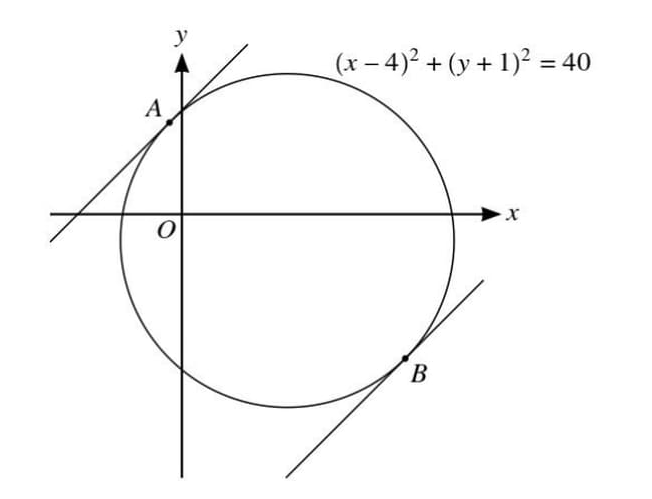
The diagram shows the circle with equation \((x-4)^2 + (y+1)^2 = 40\). Parallel tangents, each with gradient 1, touch the circle at points \(A\) and \(B\).
(a) Find the equation of the line \(AB\), giving the answer in the form \(y = mx + c\).
(b) Find the coordinates of \(A\), giving each coordinate in surd form.
(c) Find the equation of the tangent at \(A\), giving the answer in the form \(y = mx + c\), where \(c\) is in surd form.
Solution
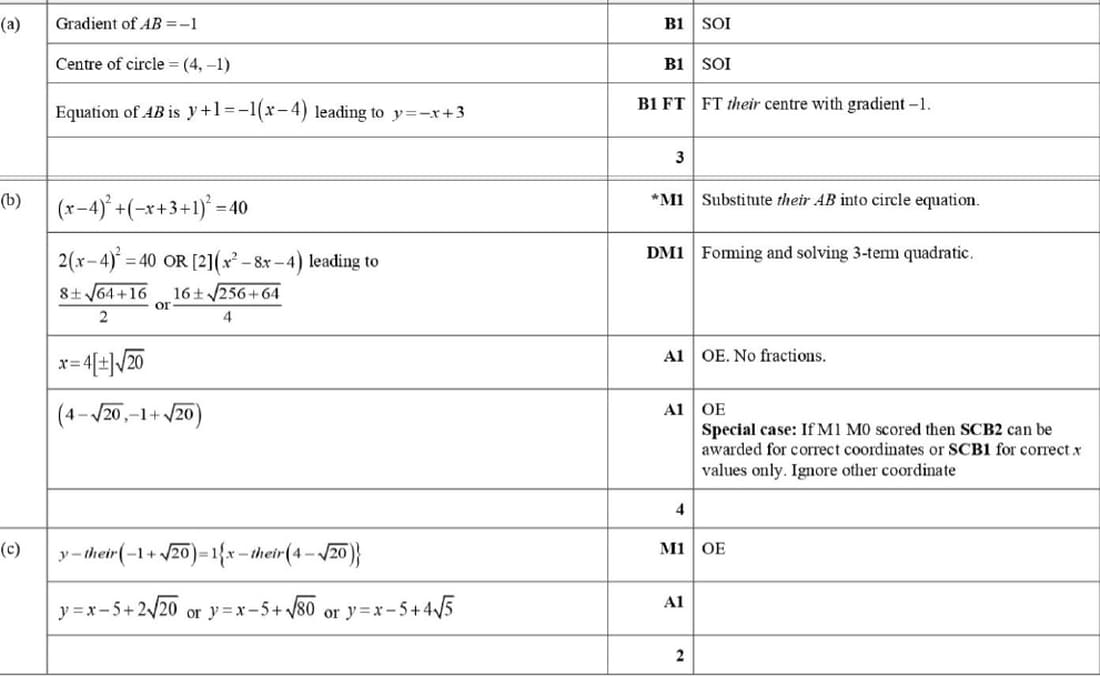
(a) The gradient of \(AB\) is \(-1\) because the tangents have gradient 1 and are perpendicular to the radius. The center of the circle is \((4, -1)\). Using the point-slope form, the equation of \(AB\) is \(y + 1 = -1(x - 4)\), which simplifies to \(y = -x + 3\).
(b) Substitute \(y = -x + 3\) into the circle equation \((x-4)^2 + (y+1)^2 = 40\):
\((x-4)^2 + (-x+3+1)^2 = 40\)
\(2(x-4)^2 = 40\) or \((x-4)^2 = 20\)
\(x = 4 \pm \sqrt{20}\)
Coordinates of \(A\) are \((4 - \sqrt{20}, -1 + \sqrt{20})\).
(c) The equation of the tangent at \(A\) is found using the point \((4 - \sqrt{20}, -1 + \sqrt{20})\) and gradient 1: