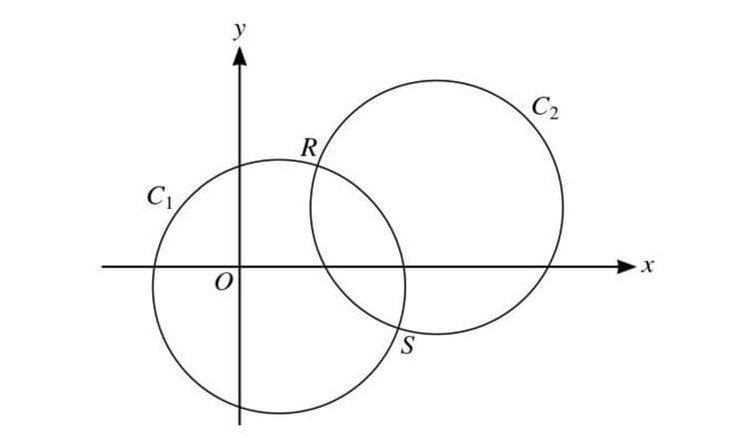
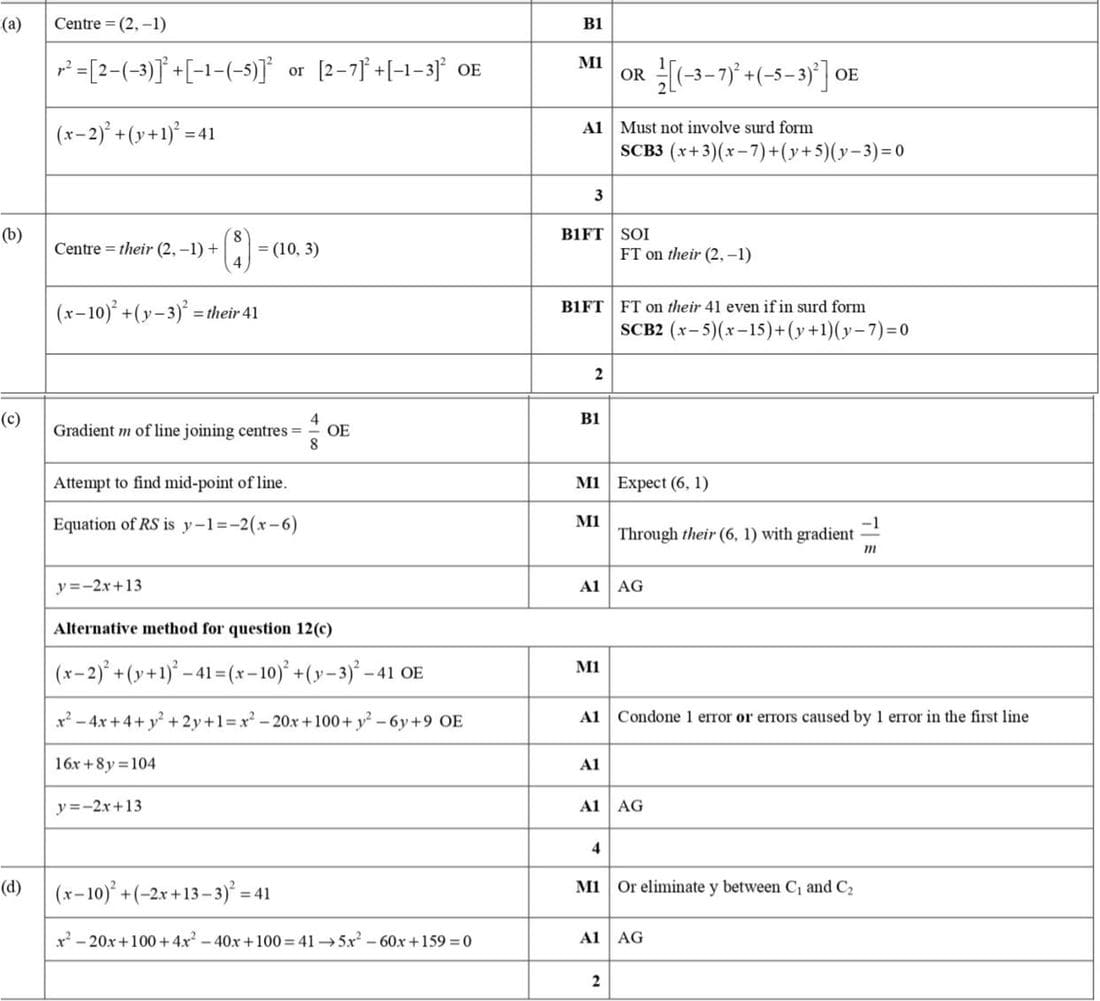
(a) The center of circle \(C_1\) is the midpoint of the diameter with end-points \((-3, -5)\) and \((7, 3)\). The midpoint is \(\left( \frac{-3+7}{2}, \frac{-5+3}{2} \right) = (2, -1)\).
The radius \(r\) is half the distance between the end-points: \(r = \frac{1}{2} \sqrt{(-3-7)^2 + (-5-3)^2} = \frac{1}{2} \sqrt{100 + 64} = \frac{1}{2} \times 12 = 6\).
The equation of circle \(C_1\) is \((x-2)^2 + (y+1)^2 = 41\).
(b) Circle \(C_2\) is obtained by translating \(C_1\) by \(\begin{pmatrix} 8 \\ 4 \end{pmatrix}\). The center of \(C_2\) is \((2+8, -1+4) = (10, 3)\).
The equation of circle \(C_2\) is \((x-10)^2 + (y-3)^2 = 41\).
(c) The gradient \(m\) of the line joining the centers \((2, -1)\) and \((10, 3)\) is \(m = \frac{3 - (-1)}{10 - 2} = \frac{4}{8} = \frac{1}{2}\).
The line \(RS\) is perpendicular to this line, so its gradient is \(-2\). Using the midpoint \((6, 1)\), the equation of \(RS\) is \(y - 1 = -2(x - 6)\), which simplifies to \(y = -2x + 13\).
(d) Substitute \(y = -2x + 13\) into the equation of \(C_1\): \((x-2)^2 + (-2x+13+1)^2 = 41\).
Expanding and simplifying gives \(x^2 - 4x + 4 + 4x^2 - 40x + 100 = 41\).
This simplifies to \(5x^2 - 60x + 159 = 0\).