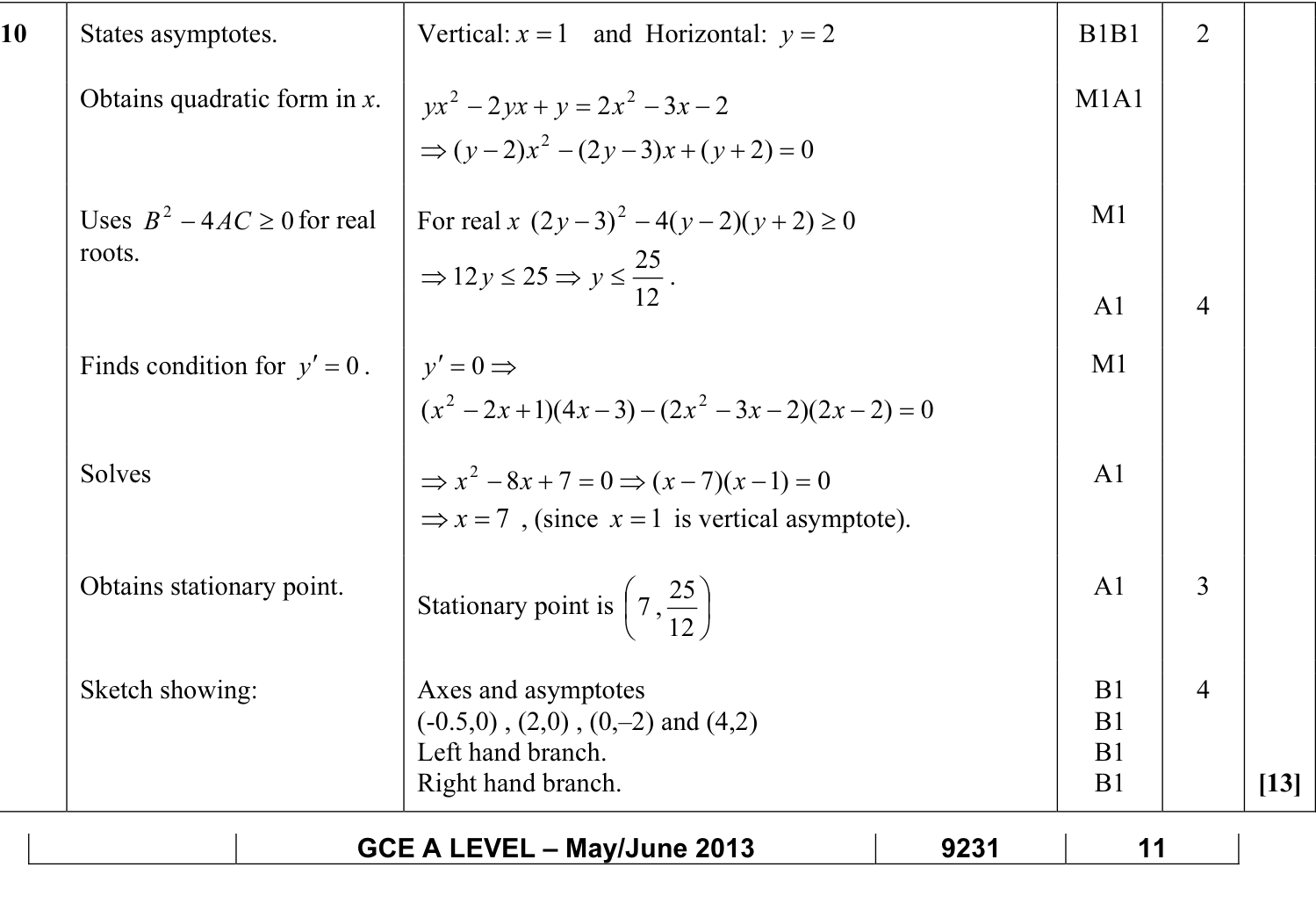
Answer: (a) The asymptotes are \(x=1\) and \(y=2\).
(b) For all points on \(C\), \(y\le \frac{25}{12}\).
(c) The stationary point is \(\left(7,\frac{25}{12}\right)\).
(d) The curve meets the coordinate axes at \(\left(-\frac12,0\right)\), \((2,0)\) and \((0,-2)\). It meets the horizontal asymptote \(y=2\) at \((4,2)\), and has vertical asymptote \(x=1\).
Given \(y=\dfrac{2x^{2}-3x-2}{x^{2}-2x+1}\).
Asymptotes
Since \(x^{2}-2x+1=(x-1)^2\), the denominator is zero when \(x=1\), so there is a vertical asymptote \(x=1\).
The numerator and denominator have the same degree, so the horizontal asymptote is the ratio of the leading coefficients. Hence \(y=2\).
Showing that \(y\le \frac{25}{12}\)
Rearrange to form a quadratic in \(x\):
\(y(x^2-2x+1)=2x^2-3x-2\)
so
\(yx^2-2yx+y=2x^2-3x-2\),
hence
\((y-2)x^2-(2y-3)x+(y+2)=0\).
For points on the curve, this quadratic must have real roots in \(x\), so its discriminant is non-negative:
\((2y-3)^2-4(y-2)(y+2)\ge 0\).
Expanding:
\(4y^2-12y+9-4(y^2-4)\ge 0\)
\(4y^2-12y+9-4y^2+16\ge 0\)
\(25-12y\ge 0\).
Therefore \(12y\le 25\), so \(y\le \frac{25}{12}\).
Stationary points
Differentiate using the quotient rule:
\(y' = \dfrac{(x^2-2x+1)(4x-3)-(2x^2-3x-2)(2x-2)}{(x^2-2x+1)^2}\).
For a stationary point, \(y'=0\), so
\((x^2-2x+1)(4x-3)-(2x^2-3x-2)(2x-2)=0\).
Simplifying gives
\(x^2-8x+7=0\)
so
\((x-7)(x-1)=0\).
Thus \(x=7\) or \(x=1\), but \(x=1\) is not on the curve since it is a vertical asymptote. So \(x=7\).
Now substitute into the equation of the curve:
\(y=\dfrac{2(7)^2-3(7)-2}{(7)^2-2(7)+1}=\dfrac{98-21-2}{49-14+1}=\dfrac{75}{36}=\dfrac{25}{12}\).
So the stationary point is \(\left(7,\frac{25}{12}\right)\).
Points needed for the sketch
To find the intersections with the coordinate axes:
For the \(x\)-axis, set \(y=0\):
\(2x^2-3x-2=0\)
\((2x+1)(x-2)=0\),
so the intercepts are \(\left(-\frac12,0\right)\) and \((2,0)\).
For the \(y\)-axis, set \(x=0\):
\(y=\dfrac{-2}{1}=-2\),
so the intercept is \((0,-2)\).
To find where the curve meets the horizontal asymptote \(y=2\), solve
\(\dfrac{2x^2-3x-2}{x^2-2x+1}=2\).
Then
\(2x^2-3x-2=2x^2-4x+2\),
so
\(x=4\).
Hence the curve meets the asymptote \(y=2\) at \((4,2)\).
The sketch therefore has a left-hand branch for \(x\lt 1\), passing through \(\left(-\frac12,0\right)\) and \((0,-2)\), approaching \(y=2\) as \(x\to -\infty\), and falling to \(-\infty\) as \(x\to 1^-\).
For \(x\gt 1\), the right-hand branch comes down from \(+\infty\) as \(x\to 1^+\), passes through \((2,0)\) and \((4,2)\), reaches the stationary point \(\left(7,\frac{25}{12}\right)\), and then approaches \(y=2\) from above as \(x\to \infty\).