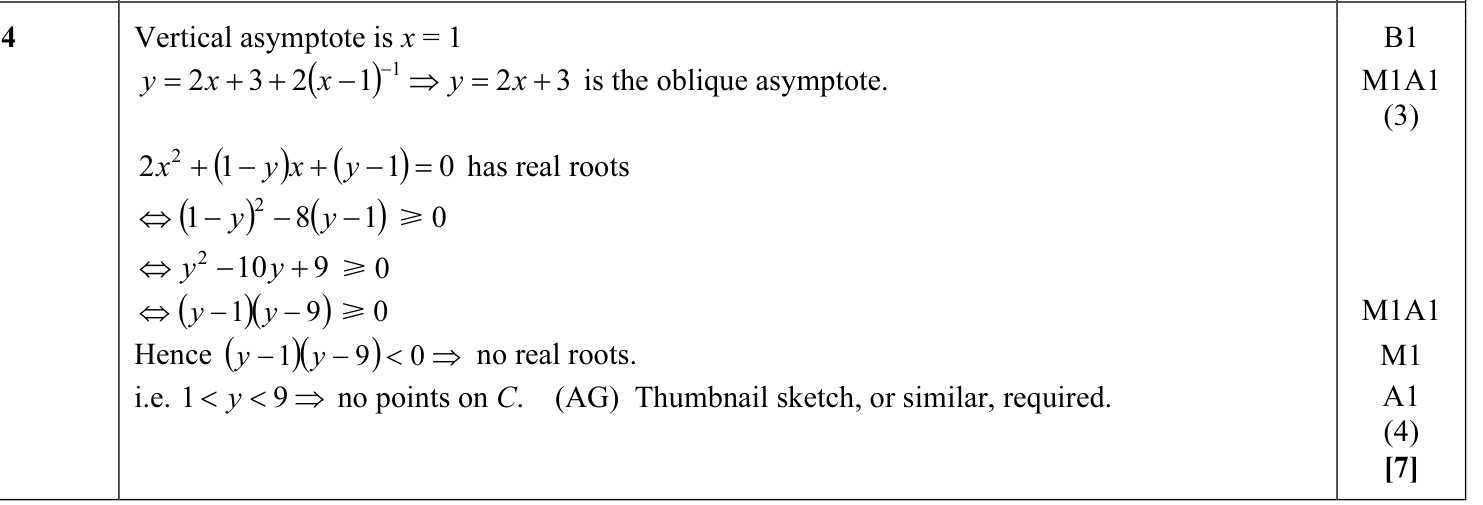
Answer: The asymptotes are \(x=1\) and \(y=2x+3\).
Also, there is no point on \(C\) for which \(1\lt y\lt 9\).
Given
\(y=\dfrac{2x^2+x-1}{x-1}\).
Since the denominator is zero when \(x=1\), there is a vertical asymptote at
\(x=1\).
Now divide \(2x^2+x-1\) by \(x-1\):
\(2x^2+x-1=(x-1)(2x+3)+2\).
So
\(y=2x+3+\dfrac{2}{x-1}\).
As \(x\to \pm\infty\), the term \(\dfrac{2}{x-1}\to 0\), so the oblique asymptote is
\(y=2x+3\).
To show there is no point with \(1\lt y\lt 9\), rearrange the equation as a quadratic in \(x\):
\(y(x-1)=2x^2+x-1\)
\(2x^2+(1-y)x+(y-1)=0\).
For a point on the curve to exist, this quadratic must have a real root, so its discriminant must satisfy
\((1-y)^2-4(2)(y-1)\ge 0\).
Thus
\((1-y)^2-8(y-1)\ge 0\).
Expanding,
\(y^2-10y+9\ge 0\),
so
\((y-1)(y-9)\ge 0\).
Hence real points occur only when \(y\le 1\) or \(y\ge 9\).
Therefore there is no point on \(C\) for which \(1\lt y\lt 9\).