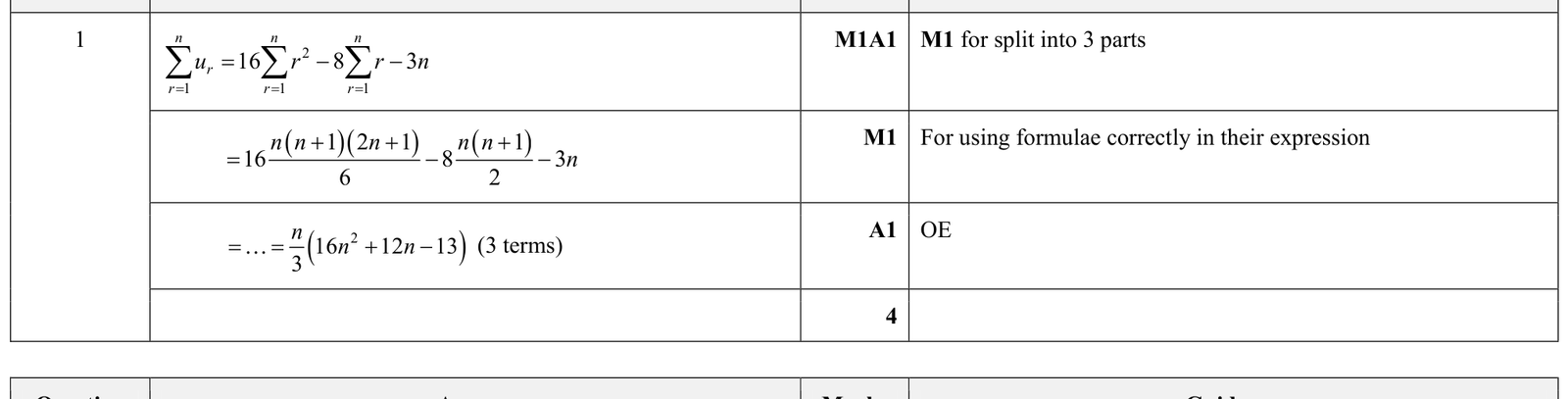
Answer: \(\displaystyle \sum_{r=1}^{n}(4r-3)(4r+1)=\frac{n}{3}(16n^{2}+12n-13)\).
First expand the bracket:
\((4r-3)(4r+1)=16r^{2}+4r-12r-3=16r^{2}-8r-3\).
So
\(\displaystyle \sum_{r=1}^{n}(4r-3)(4r+1)=\sum_{r=1}^{n}(16r^{2}-8r-3)\).
Split the sum into separate parts:
\(\displaystyle =16\sum_{r=1}^{n}r^{2}-8\sum_{r=1}^{n}r-3\sum_{r=1}^{n}1\).
Using the standard formulae
\(\displaystyle \sum_{r=1}^{n}r^{2}=\frac{n(n+1)(2n+1)}{6}\), \(\displaystyle \sum_{r=1}^{n}r=\frac{n(n+1)}{2}\), and \(\displaystyle \sum_{r=1}^{n}1=n\),
we get
\(\displaystyle =16\cdot \frac{n(n+1)(2n+1)}{6}-8\cdot \frac{n(n+1)}{2}-3n\).
Simplify:
\(\displaystyle =\frac{8}{3}n(n+1)(2n+1)-4n(n+1)-3n\).
Expanding and collecting terms gives
\(\displaystyle =\frac{n}{3}(16n^{2}+12n-13)\).