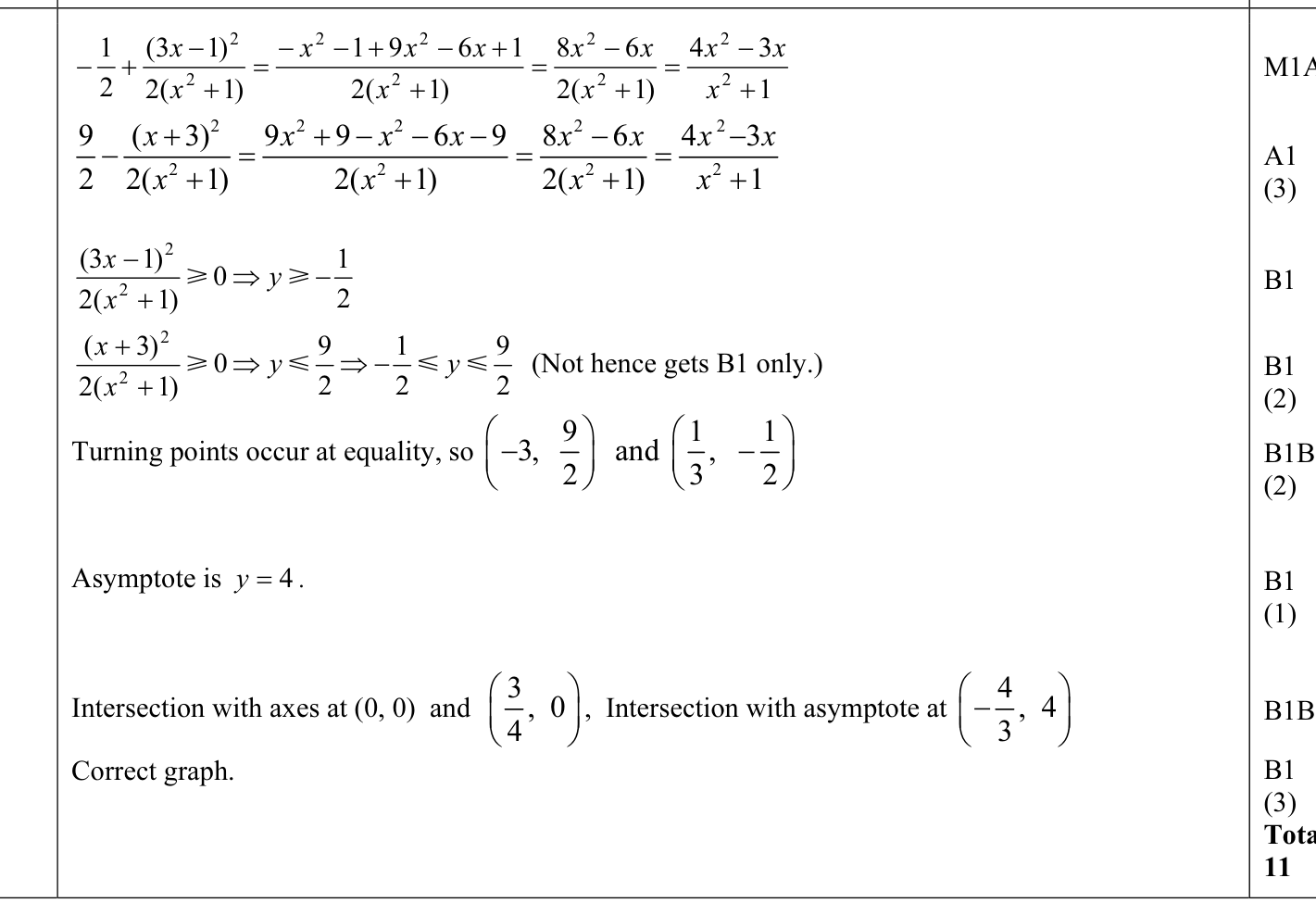
Answer: \(-\frac12\leqslant y\leqslant\frac92\).
The turning points are \(\left(-3,\frac92\right)\) and \(\left(\frac13,-\frac12\right)\). The asymptote is \(y=4\).
The curve intersects the coordinate axes at \((0,0)\) and \(\left(\frac34,0\right)\), and intersects the asymptote at \(\left(-\frac43,4\right)\).
Start with
\(y=\frac{4x^2-3x}{x^2+1}\).
To verify the first form, expand the numerator:
\(-\frac12+\frac{(3x-1)^2}{2(x^2+1)}=\frac{-(x^2+1)+(3x-1)^2}{2(x^2+1)}\).
Now \((3x-1)^2=9x^2-6x+1\), so
\(\frac{-(x^2+1)+9x^2-6x+1}{2(x^2+1)}=\frac{8x^2-6x}{2(x^2+1)}=\frac{4x^2-3x}{x^2+1}\).
This is the given equation of \(C\).
For the second form,
\(\frac92-\frac{(x+3)^2}{2(x^2+1)}=\frac{9(x^2+1)-(x+3)^2}{2(x^2+1)}\).
Since \((x+3)^2=x^2+6x+9\), this becomes
\(\frac{9x^2+9-(x^2+6x+9)}{2(x^2+1)}=\frac{8x^2-6x}{2(x^2+1)}=\frac{4x^2-3x}{x^2+1}\).
So this is also equal to the original expression.
Now use the two rewritten forms to find bounds.
Because \((3x-1)^2\ge 0\) and \(x^2+1\gt 0\) for all \(x\), we have
\(\frac{(3x-1)^2}{2(x^2+1)}\ge 0\), hence \(y\ge -\frac12\).
Similarly, \((x+3)^2\ge 0\) and \(x^2+1\gt 0\), so
\(\frac{(x+3)^2}{2(x^2+1)}\ge 0\), hence \(y\le \frac92\).
Therefore \(-\frac12\le y\le \frac92\).
Turning points occur when these squared terms are zero. From \((3x-1)^2=0\), we get \(x=\frac13\) and then \(y=-\frac12\). From \((x+3)^2=0\), we get \(x=-3\) and then \(y=\frac92\). So the turning points are \(\left(\frac13,-\frac12\right)\) and \(\left(-3,\frac92\right)\).
For the asymptote, divide numerator and denominator:
\(\frac{4x^2-3x}{x^2+1}=4+\frac{-3x-4}{x^2+1}\).
As \(x\to\pm\infty\), the fraction tends to \(0\), so the asymptote is \(y=4\).
To find the intersections with the axes, set \(y=0\):
\(4x^2-3x=x(4x-3)=0\), so \(x=0\) or \(x=\frac34\). Thus the x-intercepts are \((0,0)\) and \(\left(\frac34,0\right)\). The y-intercept is also \((0,0)\), since substituting \(x=0\) gives \(y=0\).
To find where the curve meets the asymptote, set \(y=4\):
\(\frac{4x^2-3x}{x^2+1}=4\), so \(4x^2-3x=4x^2+4\), hence \(-3x=4\) and \(x=-\frac43\). Therefore the intersection is \(\left(-\frac43,4\right)\).
A sketch should show the horizontal asymptote \(y=4\), the turning points \(\left(-3,\frac92\right)\) and \(\left(\frac13,-\frac12\right)\), and the axis intersections \((0,0)\) and \(\left(\frac34,0\right)\). The curve approaches \(y=4\) as \(x\to\pm\infty\), crosses it at \(\left(-\frac43,4\right)\), rises to the maximum at \((-3,\frac92)\), falls through \((0,0)\) to the minimum at \(\left(\frac13,-\frac12\right)\), then rises again through \(\left(\frac34,0\right)\) and tends back towards \(y=4\).