Browsing as Guest. Progress, bookmarks and attempts are disabled.
Log in to track your work.
June 2021 p12 q7
630
The point A has coordinates (1, 5) and the line l has gradient \(-\frac{2}{3}\) and passes through A. A circle has centre (5, 11) and radius \(\sqrt{52}\).
(a) Show that l is the tangent to the circle at A.
(b) Find the equation of the other circle of radius \(\sqrt{52}\) for which l is also the tangent at A.
Solution
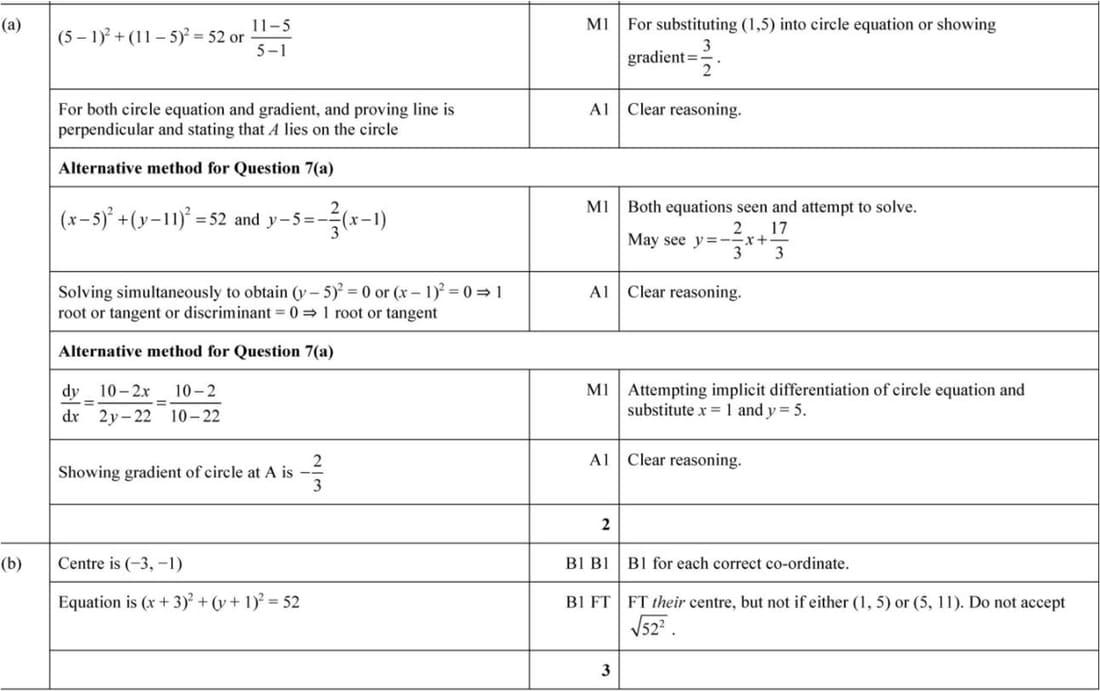
(a) To show that line l is tangent to the circle at A, we need to prove that the distance from the center of the circle to the line is equal to the radius of the circle.
The equation of the circle is \((x - 5)^2 + (y - 11)^2 = 52\).
The equation of the line is \(y - 5 = -\frac{2}{3}(x - 1)\), which simplifies to \(y = -\frac{2}{3}x + \frac{17}{3}\).
Substitute \((1, 5)\) into the circle equation: \((5 - 1)^2 + (11 - 5)^2 = 52\), which holds true, confirming A is on the circle.
The gradient of the radius at A is the negative reciprocal of the line's gradient, \(\frac{3}{2}\), confirming the line is tangent.
(b) For the other circle, the center must be such that the line is tangent at A. The center is \((-3, -1)\) because the line's perpendicular distance to this center is the radius \(\sqrt{52}\).
The equation of the circle is \((x + 3)^2 + (y + 1)^2 = 52\).