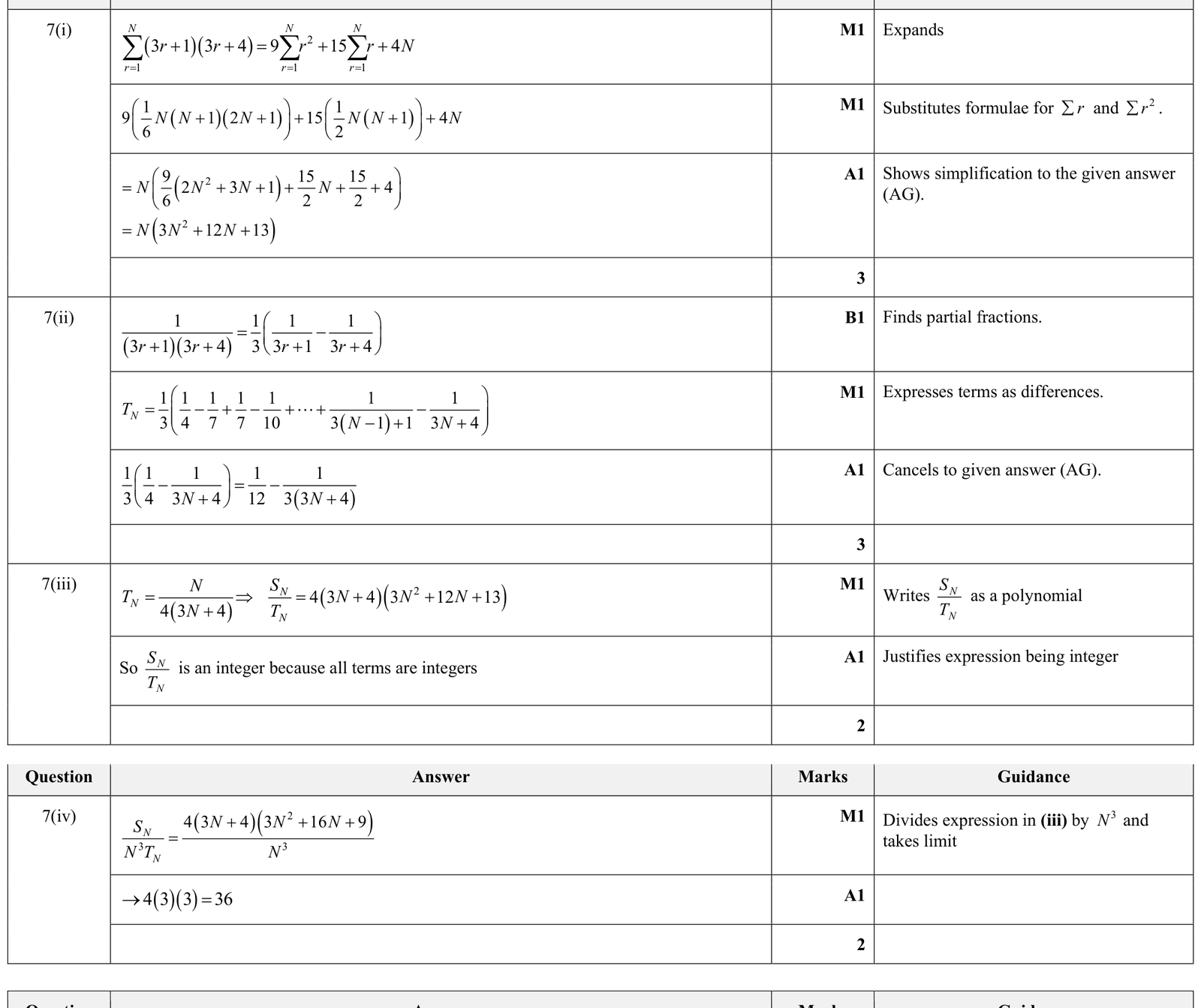
Answer: (i) \(S_N = N(3N^2+12N+13)\).
(ii) \(T_N = \frac{1}{12}-\frac{1}{3(3N+4)}\).
(iii) \(\frac{S_N}{T_N} = 4(3N+4)(3N^2+12N+13)\), so it is an integer.
(iv) \(\lim_{N\to\infty}\frac{S_N}{N^3T_N}=36\).
(i) Expand the term in the sum:
\((3r+1)(3r+4)=9r^2+15r+4\).
So
\(S_N=\sum_{r=1}^N (9r^2+15r+4)=9\sum_{r=1}^N r^2+15\sum_{r=1}^N r+4\sum_{r=1}^N 1\).
Using the standard formulae
\(\sum_{r=1}^N r=\frac{1}{2}N(N+1)\), \(\sum_{r=1}^N r^2=\frac{1}{6}N(N+1)(2N+1)\), and \(\sum_{r=1}^N 1=N\),
we get
\(S_N=9\left(\frac{1}{6}N(N+1)(2N+1)\right)+15\left(\frac{1}{2}N(N+1)\right)+4N\).
Now simplify:
\(S_N=N\left(\frac{9}{6}(N+1)(2N+1)+\frac{15}{2}(N+1)+4\right)\).
Expanding inside the bracket gives
\(S_N=N(3N^2+12N+13)\).
(ii) Use partial fractions:
\(\frac{1}{(3r+1)(3r+4)}=\frac{A}{3r+1}+\frac{B}{3r+4}\).
Solving gives \(A=\frac13\) and \(B=-\frac13\), so
\(\frac{1}{(3r+1)(3r+4)}=\frac13\left(\frac{1}{3r+1}-\frac{1}{3r+4}\right)\).
Hence
\(T_N=\frac13\sum_{r=1}^N\left(\frac{1}{3r+1}-\frac{1}{3r+4}\right)\).
Writing out the first few terms,
\(T_N=\frac13\left(\left(\frac14-\frac17\right)+\left(\frac17-\frac{1}{10}\right)+\cdots+\left(\frac{1}{3N+1}-\frac{1}{3N+4}\right)\right)\).
Everything cancels except the first positive term and the last negative term, so
\(T_N=\frac13\left(\frac14-\frac{1}{3N+4}\right)=\frac{1}{12}-\frac{1}{3(3N+4)}\).
(iii) From (ii),
\(T_N=\frac13\left(\frac14-\frac{1}{3N+4}\right)=\frac{1}{3}\cdot\frac{3N}{4(3N+4)}=\frac{N}{4(3N+4)}\).
Therefore
\(\frac{S_N}{T_N}=\frac{N(3N^2+12N+13)}{N/(4(3N+4))}=4(3N+4)(3N^2+12N+13)\).
This is a product of integers, so \(\frac{S_N}{T_N}\) is an integer.
(iv) Using the expression above,
\(\frac{S_N}{N^3T_N}=\frac{4(3N+4)(3N^2+12N+13)}{N^3}\).
As \(N\to\infty\), the leading terms dominate:
\(4(3N+4)(3N^2+12N+13)/N^3 \to 4\cdot 3\cdot 3=36\).
So the limit is \(36\).