Answer: \(I=\dfrac{289}{15}ma^2\), and the greatest speed of the centre of the sphere is \(\boxed{\dfrac{10}{17}\sqrt{ag}}\).
(i) First find the moment of inertia of each part about the axis \(l\).
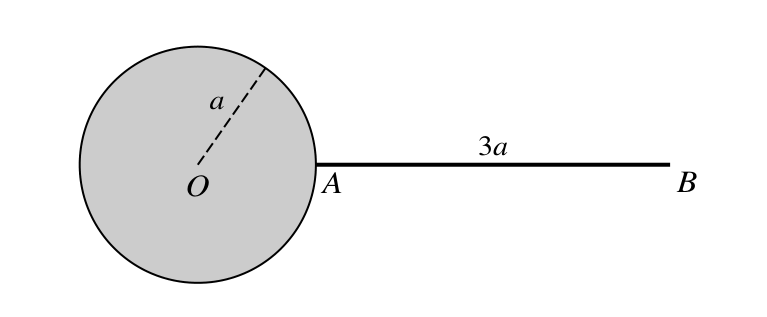
The rod has mass \(8m\) and length \(3a\). Its centre is \(\frac{3a}{2}\) from \(A\), while \(C\) is \(a\) from \(A\). So the centre of the rod is \(\frac{a}{2}\) from the axis.
Hence, using the parallel-axis theorem,
\[I_{AB}=\frac{1}{12}(8m)(3a)^2+8m\left(\frac a2\right)^2.\]
So
\[I_{AB}=6ma^2+2ma^2=8ma^2.\]
The centre of the sphere is \(2a\) from \(C\). For the thin spherical shell,
\[I_{\text{shell}}=\frac23ma^2+m(2a)^2.\]
Thus
\[I_{\text{shell}}=\frac23ma^2+4ma^2=\frac{14}{3}ma^2.\]
For the inner solid sphere, its mass is \(\frac32m\), so
\[I_{\text{sphere}}=\frac25\left(\frac32m\right)a^2+\left(\frac32m\right)(2a)^2.\]
Therefore
\[I_{\text{sphere}}=\frac35ma^2+6ma^2=\frac{33}{5}ma^2.\]
Now add the three moments of inertia:
\[I=8ma^2+\frac{14}{3}ma^2+\frac{33}{5}ma^2.\]
Using a common denominator of 15,
\[I=\left(\frac{120}{15}+\frac{70}{15}+\frac{99}{15}\right)ma^2=\frac{289}{15}ma^2.\]
This proves the required result.
(ii) The greatest speed occurs when \(CA\) is vertical, because this is the position of lowest gravitational potential energy.
The sphere, including the shell and inner solid sphere, has total mass
\[m+\frac32m=\frac52m.\]
Its centre is \(2a\) from \(C\), so as \(CA\) moves to the downward vertical, its vertical fall is
\[2a(1-\cos\alpha).\]
The rod's centre is \(\frac a2\) on the other side of \(C\), so it rises by
\[\frac a2(1-\cos\alpha).\]
Therefore the net loss of gravitational potential energy is
\[\left(\frac52mg\right)2a(1-\cos\alpha)-8mg\left(\frac a2\right)(1-\cos\alpha).\]
This simplifies to
\[mga(1-\cos\alpha).\]
Using \(\cos\alpha=\frac16\), the loss of potential energy is
\[mga\left(1-\frac16\right)=\frac56mga.\]
This becomes rotational kinetic energy:
\[\frac12I\omega^2=\frac56mga.\]
Substitute \(I=\frac{289}{15}ma^2\):
\[\frac12\cdot\frac{289}{15}ma^2\omega^2=\frac56mga.\]
Solving gives
\[\omega^2=\frac{25g}{289a}.\]
The centre of the sphere is \(2a\) from the axis, so its speed is
\[v=2a\omega.\]
Hence
\[v=2a\sqrt{\frac{25g}{289a}}=\boxed{\frac{10}{17}\sqrt{ag}}.\]