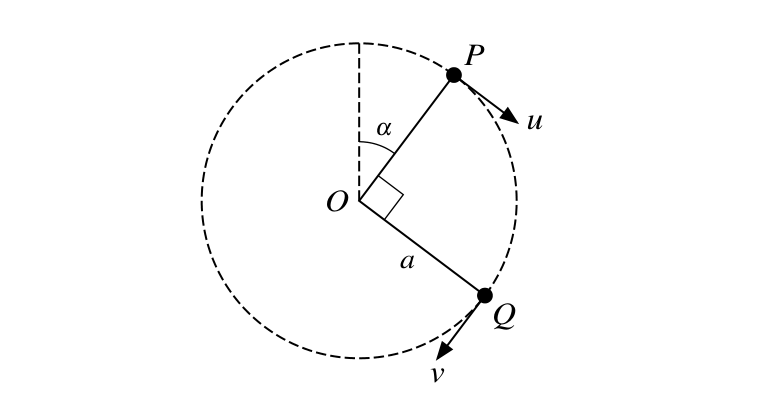
Answer: \(v^2=u^2+\dfrac{14}{5}ag\), \(u=\boxed{\sqrt{5ag}}\), and \(T_{\min}=\boxed{\dfrac{18}{5}mg}\).
Since \(\cos\alpha=\frac45\), the diagram gives
\[\sin\alpha=\frac35.\]
(i) Use conservation of energy between \(P\) and \(Q\). The change in height gives a gain in kinetic energy equal to
\[mga(\cos\alpha+\sin\alpha).\]
Therefore
\[\frac12mv^2=\frac12mu^2+mga(\cos\alpha+\sin\alpha).\]
Cancel \(\frac12m\):
\[v^2=u^2+2ag(\cos\alpha+\sin\alpha).\]
Substitute \(\cos\alpha=\frac45\) and \(\sin\alpha=\frac35\):
\[v^2=u^2+2ag\left(\frac45+\frac35\right).\]
Hence
\[v^2=u^2+\frac{14}{5}ag,\]
as required.
(ii) At \(P\), resolving radially towards \(O\), the component of the weight towards \(O\) is \(mg\cos\alpha\), so
\[T_P+mg\cos\alpha=\frac{mu^2}{a}.\]
Therefore
\[T_P=\frac{mu^2}{a}-mg\cos\alpha.\]
At \(Q\), the component of the weight is opposite to the inward direction, so
\[T_Q-mg\sin\alpha=\frac{mv^2}{a}.\]
Therefore
\[T_Q=\frac{mv^2}{a}+mg\sin\alpha.\]
The question says \(T_Q=2T_P\), so
\[\frac{mv^2}{a}+mg\sin\alpha=2\left(\frac{mu^2}{a}-mg\cos\alpha\right).\]
Divide by \(m\) and multiply by \(a\):
\[v^2+ag\sin\alpha=2u^2-2ag\cos\alpha.\]
Therefore
\[v^2=2u^2-ag(2\cos\alpha+\sin\alpha).\]
Substitute the sine and cosine values:
\[v^2=2u^2-ag\left(2\cdot\frac45+\frac35\right)=2u^2-\frac{11}{5}ag.\]
Now use the result from part (i):
\[u^2+\frac{14}{5}ag=2u^2-\frac{11}{5}ag.\]
Hence
\[u^2=5ag,\]
so
\[\boxed{u=\sqrt{5ag}}.\]
(iii) The least tension occurs at the top of the circle. Let the speed there be \(V\).
Use conservation of energy from \(P\) to the top:
\[\frac12mV^2=\frac12mu^2-mga(1-\cos\alpha).\]
So
\[V^2=u^2-2ag(1-\cos\alpha).\]
Using \(u^2=5ag\) and \(\cos\alpha=\frac45\),
\[V^2=5ag-2ag\left(\frac15\right)=\frac{23}{5}ag.\]
At the top, both tension and weight act towards the centre, so
\[T_{\min}+mg=\frac{mV^2}{a}.\]
Therefore
\[T_{\min}+mg=\frac{m}{a}\cdot\frac{23}{5}ag=\frac{23}{5}mg.\]
Thus
\[T_{\min}=\frac{23}{5}mg-mg=\boxed{\frac{18}{5}mg}.\]