9231 P21 - Nov 2019 - Q5 - 12 marks
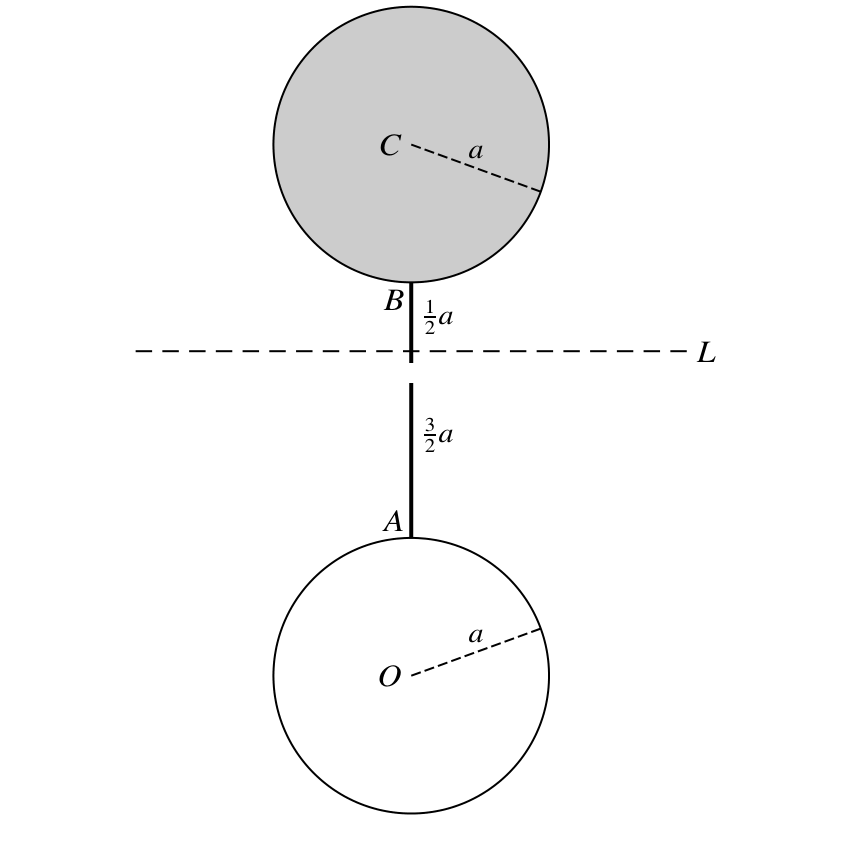
A thin uniform \(\operatorname{rod} A B\) has mass \(\lambda M\) and length \(2 a\). The end \(A\) of the rod is rigidly attached to the surface of a uniform hollow sphere (spherical shell) with centre \(O\), mass \(3 M\) and radius \(a\). The end \(B\) of the rod is rigidly attached to the surface of a uniform solid sphere with centre \(C\), mass \(5 M\) and radius \(a\). The rod lies along the line joining the centres of the spheres, so that \(C B A O\) is a straight line. The horizontal axis \(L\) is perpendicular to the rod and passes through the point of the rod that is a distance \(\frac{1}{2} a\) from \(B\) (see diagram). The object consisting of the rod and the two spheres can rotate freely about \(L\).
(i) Show that the moment of inertia of the object about \(L\) is \(\left(\frac{408+7 \lambda}{12}\right) M a^{2}\).
The period of small oscillations of the object about \(L\) is \(5 \pi \sqrt{ }\left(\frac{2 a}{g}\right)\).
(ii) Find the value of \(\lambda\).