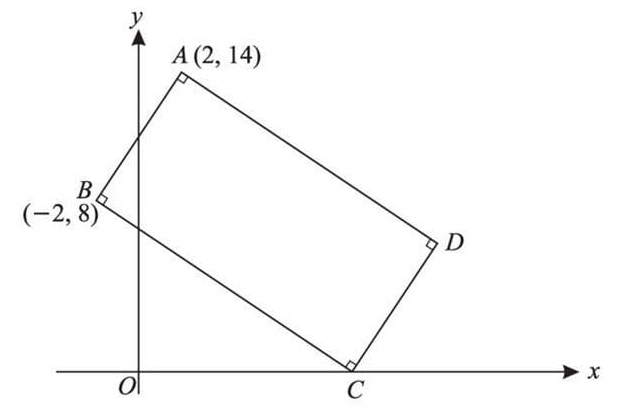
(i) To find the equation of BC, first calculate the slope of AB. The slope \(m\) of AB is given by:
\(m = \frac{14 - 8}{2 - (-2)} = \frac{6}{4} = \frac{3}{2}\)
Since BC is perpendicular to AB, the slope of BC is the negative reciprocal of \(\frac{3}{2}\), which is \(-\frac{2}{3}\).
Using point B (-2, 8) and the slope \(-\frac{2}{3}\), the equation of line BC is:
\(y - 8 = -\frac{2}{3}(x + 2)\)
Simplifying, we get:
\(3y + 2x = 20\)
(ii) Since C lies on the x-axis, its y-coordinate is 0. Substitute \(y = 0\) into the equation of BC:
\(3(0) + 2x = 20\)
\(2x = 20\)
\(x = 10\)
Thus, the coordinates of C are (10, 0).
To find D, use the vector move from B to C and apply it to A. The vector from B to C is:
\((10 - (-2), 0 - 8) = (12, -8)\)
Apply this vector to A (2, 14):
\((2 + 12, 14 - 8) = (14, 6)\)
Thus, the coordinates of D are (14, 6).