Browsing as Guest. Progress, bookmarks and attempts are disabled.
Log in to track your work.
June 2008 p1 q11
605
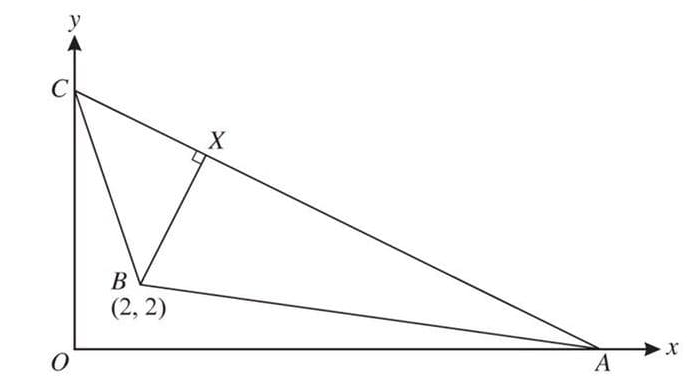
In the diagram, the points A and C lie on the x- and y-axes respectively and the equation of AC is \(2y + x = 16\). The point B has coordinates \((2, 2)\). The perpendicular from B to AC meets AC at the point X.
(i) Find the coordinates of X.
The point D is such that the quadrilateral ABCD has AC as a line of symmetry.
(ii) Find the coordinates of D.
(iii) Find, correct to 1 decimal place, the perimeter of ABCD.
Solution
(i) The gradient of AC is \(-\frac{1}{2}\). The perpendicular gradient is 2. The equation of line BX is \(y - 2 = 2(x - 2)\), which simplifies to \(y = 2x - 2\). Solving the equations \(2y + x = 16\) and \(y = 2x - 2\) simultaneously gives the coordinates of X as \((4, 6)\).
(ii) Since X is the midpoint of BD, and using the coordinates of X \((4, 6)\), we find D as \((6, 10)\).
(iii) Using the distance formula, \(AB = \sqrt{(14)^2 + (2)^2} = \sqrt{200}\) and \(BC = \sqrt{(2)^2 + (6)^2} = \sqrt{40}\). The perimeter is \(2\sqrt{200} + 2\sqrt{40} = 40.9\).