Browsing as Guest. Progress, bookmarks and attempts are disabled.
Log in to track your work.
9709 P12 - Nov 2009 - Q9
603
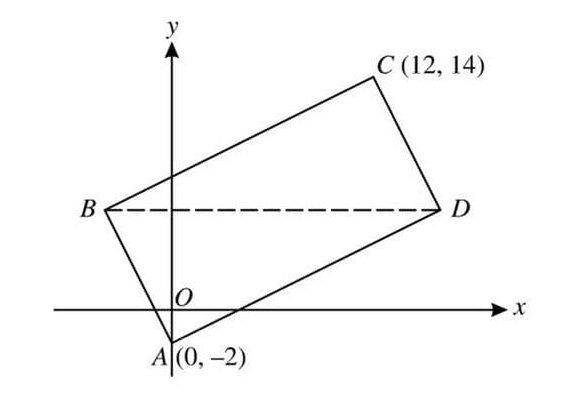
The diagram shows a rectangle ABCD. The point A is (0, -2) and C is (12, 14). The diagonal BD is parallel to the x-axis.
Explain why the y-coordinate of D is 6.
The x-coordinate of D is h. Express the gradients of AD and CD in terms of h.
Calculate the x-coordinates of D and B.
Calculate the area of the rectangle ABCD.
Solution
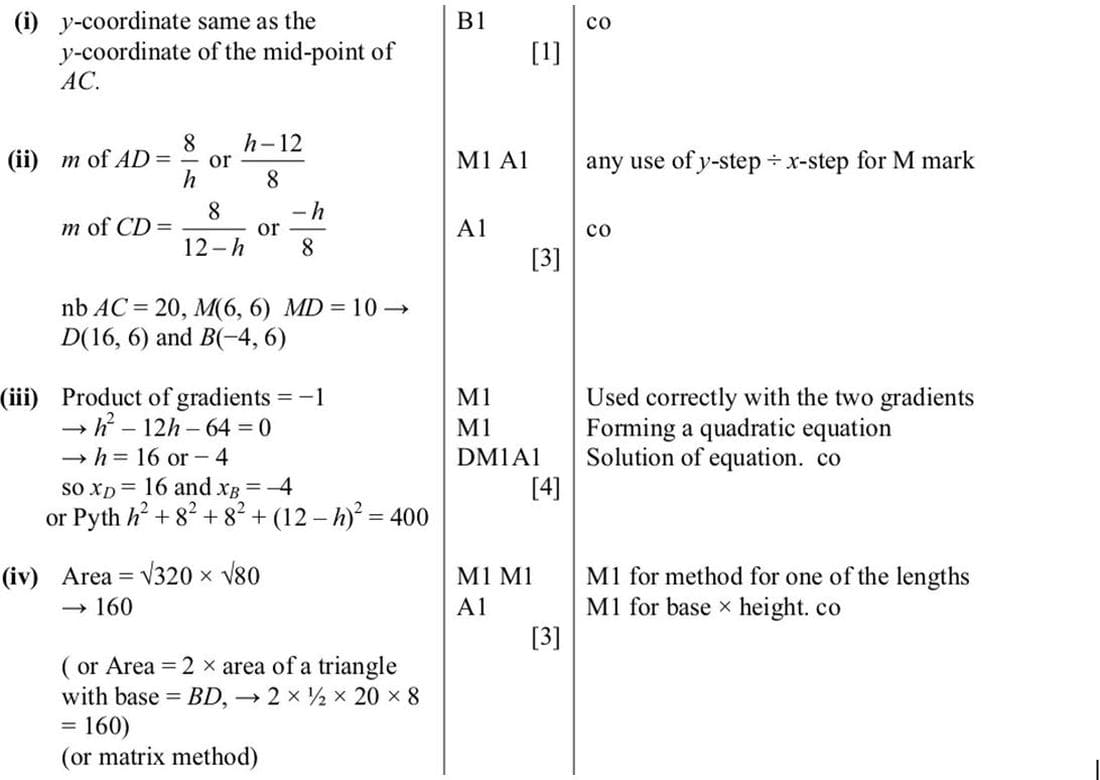
(i) The y-coordinate of D is the same as the y-coordinate of the midpoint of AC. The midpoint of AC is \(\left( \frac{0+12}{2}, \frac{-2+14}{2} \right) = (6, 6)\). Therefore, the y-coordinate of D is 6.
(ii) The gradient of AD is calculated as \(\frac{y_2 - y_1}{x_2 - x_1} = \frac{6 - (-2)}{h - 0} = \frac{8}{h}\) or \(\frac{h-12}{8}\). The gradient of CD is \(\frac{6 - 14}{h - 12} = \frac{-8}{h-12}\) or \(\frac{-h}{8}\).
(iii) Since BD is parallel to the x-axis, the product of the gradients of AD and CD is -1. Solving \(\frac{8}{h} \times \frac{-8}{h-12} = -1\) gives \(h^2 - 12h - 64 = 0\). Solving this quadratic equation, we find \(h = 16\) or \(h = -4\). Thus, \(x_D = 16\) and \(x_B = -4\).
(iv) The area of rectangle ABCD can be calculated using the lengths of the sides. The length of AC is \(\sqrt{(12-0)^2 + (14-(-2))^2} = 20\). The length of BD is \(\sqrt{(16-(-4))^2 + (6-6)^2} = 20\). The area is \(20 \times 8 = 160\).