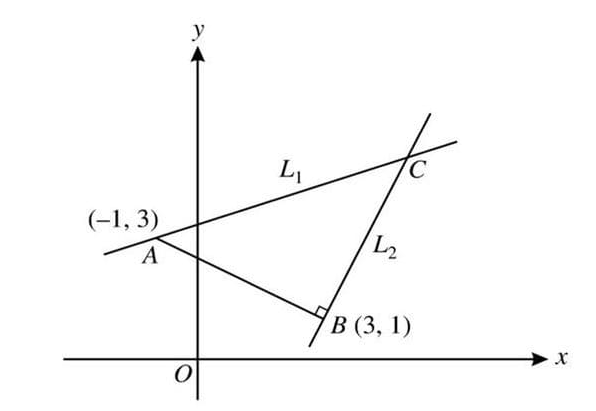
The gradient of OB is calculated as follows:
Gradient of OB = \(\frac{1 - 0}{3 - 0} = \frac{1}{3}\).
Since L1 is parallel to OB, it has the same gradient: \(\frac{1}{3}\).
The equation of L1 passing through A (-1, 3) is:
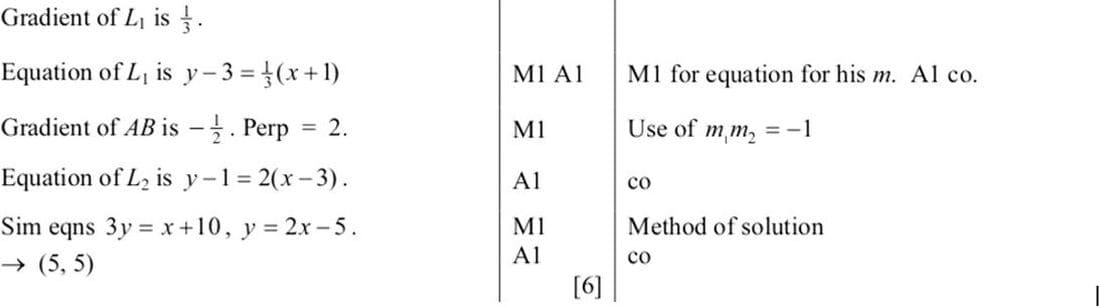
\(y - 3 = \frac{1}{3}(x + 1)\).
The gradient of AB is:
Gradient of AB = \(\frac{1 - 3}{3 + 1} = -\frac{1}{2}\).
The gradient of L2, being perpendicular to AB, is the negative reciprocal:
\(Gradient of L2 = 2.\)
The equation of L2 passing through B (3, 1) is:
\(y - 1 = 2(x - 3)\).
Solving the simultaneous equations:
1. \(y = \frac{1}{3}x + \frac{10}{3}\)
2. \(y = 2x - 5\)
Equating the two expressions for \(y\):
\(\frac{1}{3}x + \frac{10}{3} = 2x - 5\)
Multiply through by 3 to clear the fraction:
\(x + 10 = 6x - 15\)
Rearrange to solve for \(x\):
\(5x = 25\)
\(x = 5\)
Substitute \(x = 5\) back into one of the equations to find \(y\):
\(y = 2(5) - 5 = 5\)
Thus, the coordinates of C are (5, 5).