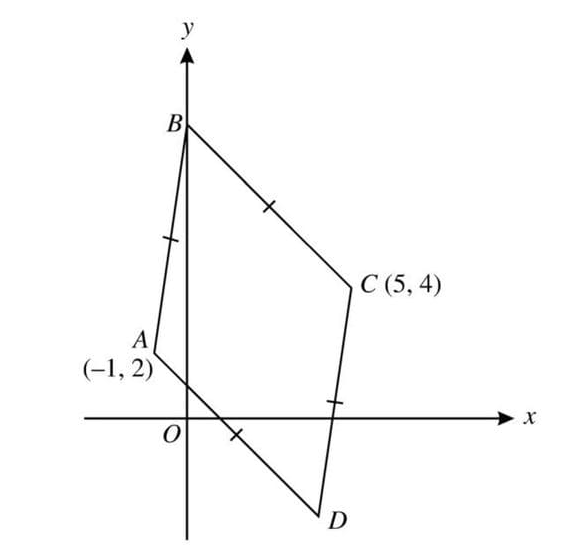
(i) To find the equation of the perpendicular bisector of AC:
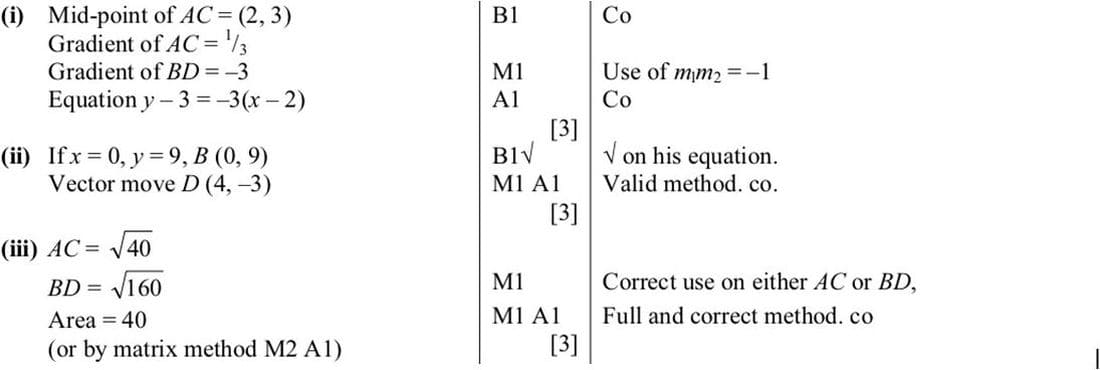
The midpoint of AC is \(\left( \frac{-1 + 5}{2}, \frac{2 + 4}{2} \right) = (2, 3)\).
The gradient of AC is \(\frac{4 - 2}{5 + 1} = \frac{1}{3}\).
The gradient of the perpendicular bisector is the negative reciprocal, \(-3\).
Using the point-slope form, the equation is \(y - 3 = -3(x - 2)\).
(ii) To find the coordinates of B and D:
Since B lies on the y-axis, its x-coordinate is 0. Using the perpendicular bisector equation, \(y - 3 = -3(0 - 2)\), we find \(y = 9\). Thus, \(B(0, 9)\).
To find D, use the vector move from A to C, which is \((5 - (-1), 4 - 2) = (6, 2)\).
Since D is opposite B, apply the vector move to B: \((0 + 4, 9 - 12) = (4, -3)\). Thus, \(D(4, -3)\).
(iii) To find the area of the rhombus:
The length of AC is \(\sqrt{(5 - (-1))^2 + (4 - 2)^2} = \sqrt{40}\).
The length of BD is \(\sqrt{(4 - 0)^2 + (-3 - 9)^2} = \sqrt{160}\).
The area of the rhombus is \(\frac{1}{2} \times \sqrt{40} \times \sqrt{160} = 40\).