Browsing as Guest. Progress, bookmarks and attempts are disabled.
Log in to track your work.
9709 P11 - Jun 2019 - Q4
599
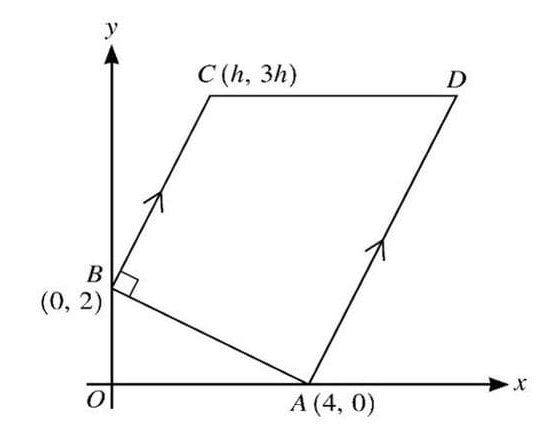
The diagram shows a trapezium ABCD in which the coordinates of A, B, and C are (4, 0), (0, 2), and (h, 3h) respectively. The lines BC and AD are parallel, angle ∠ABC = 90° and CD is parallel to the x-axis.
(i) Find, by calculation, the value of h.
(ii) Hence find the coordinates of D.
Solution
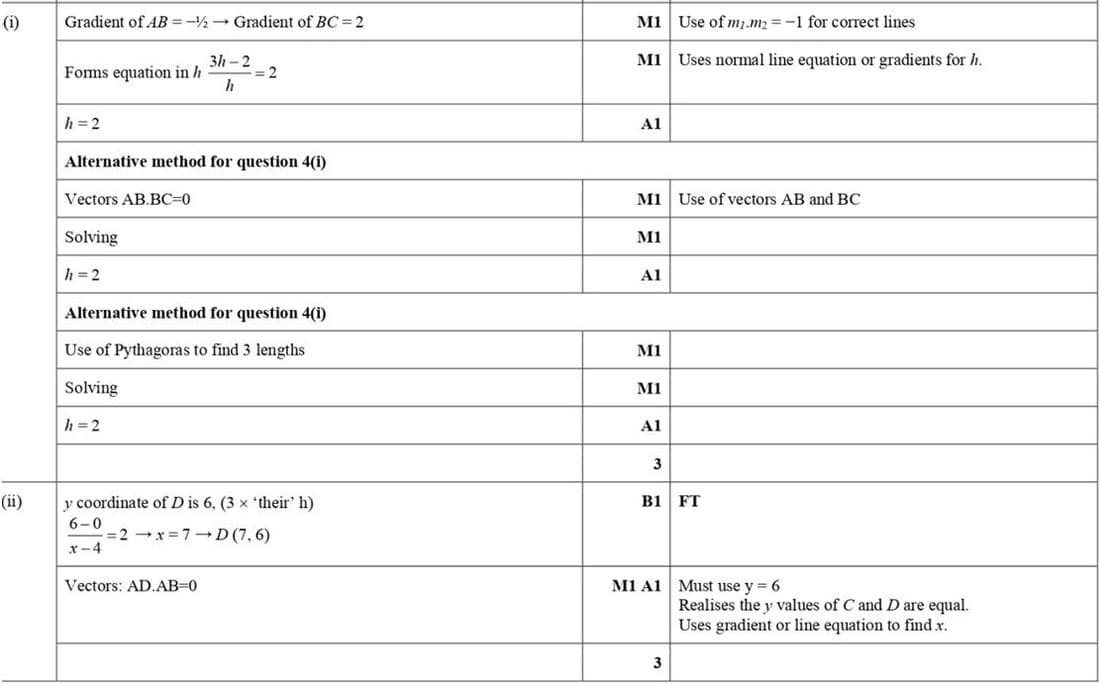
(i) To find the value of h, we use the fact that ∠ABC = 90° and lines BC and AD are parallel. The gradient of AB is \(-\frac{1}{2}\) and the gradient of BC is \(\frac{3h - 2}{h}\). Since BC is perpendicular to AB, the product of their gradients is \(-1\):
(ii) With h = 2, the coordinates of C are (2, 6). Since CD is parallel to the x-axis, the y-coordinate of D is the same as C, which is 6. The x-coordinate of D can be found using the fact that AD is parallel to BC, so the gradient of AD is also 2: