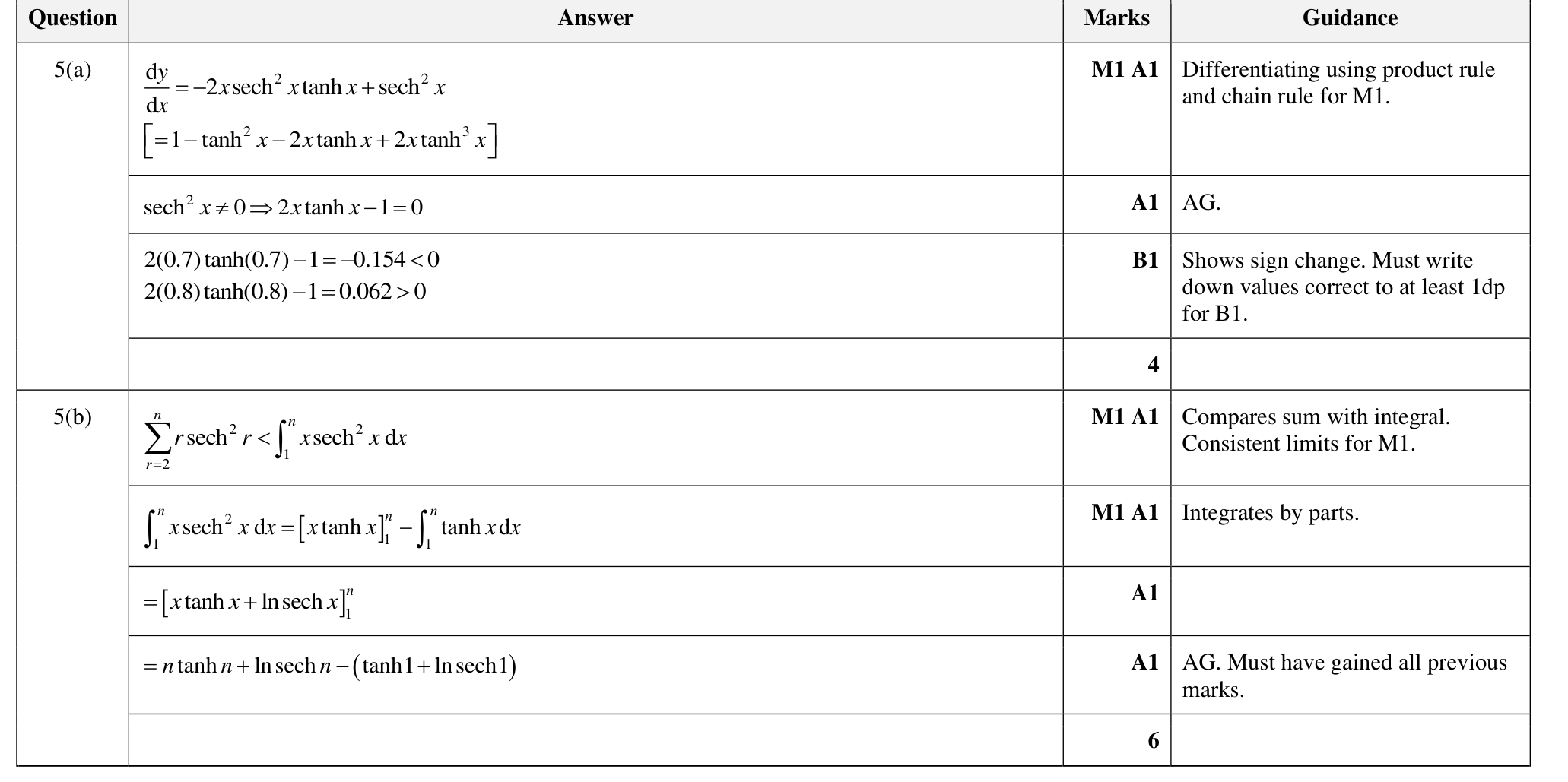
Answer: (a) At the maximum point, \(\frac{dy}{dx}=0\). Since \(y=x\operatorname{sech}^2x\),
\(\frac{dy}{dx}=\operatorname{sech}^2x+x\bigl(-2\operatorname{sech}^2x\tanh x\bigr)=\operatorname{sech}^2x-2x\operatorname{sech}^2x\tanh x.\)
So
\(\frac{dy}{dx}=\operatorname{sech}^2x(1-2x\tanh x).\)
At \(M\), \(\frac{dy}{dx}=0\). Since \(\operatorname{sech}^2x\neq 0\), it follows that
\(2x\tanh x-1=0.\)
Also,
\(2(0.7)\tanh(0.7)-1\approx -0.154\lt 0,\)
\(2(0.8)\tanh(0.8)-1\approx 0.062\gt 0.\)
So the equation has a root between \(0.7\) and \(0.8\).
(b) Using right-endpoint rectangles of width 1 under the decreasing curve for \(x\ge 1\),
\(\displaystyle \sum_{r=2}^{n} r\operatorname{sech}^2 r\lt \int_1^n x\operatorname{sech}^2x\,dx.\)
Integrating by parts with \(u=x\) and \(dv=\operatorname{sech}^2x\,dx\),
\(\displaystyle \int_1^n x\operatorname{sech}^2x\,dx=[x\tanh x]_1^n-\int_1^n \tanh x\,dx.\)
Since \(\int \tanh x\,dx=-\ln(\operatorname{sech}x)\),
\(\displaystyle \int_1^n x\operatorname{sech}^2x\,dx=[x\tanh x+\ln(\operatorname{sech}x)]_1^n.\)
Hence
\(\displaystyle \int_1^n x\operatorname{sech}^2x\,dx=n\tanh n+\ln(\operatorname{sech}n)-\tanh 1-\ln(\operatorname{sech}1).\)
Therefore
\(\displaystyle \sum_{r=2}^{n} r\operatorname{sech}^{2} r\lt n\tanh n+\ln \operatorname{sech} n-\tanh 1-\ln \operatorname{sech} 1.\)
(a) We have
\(y=x\operatorname{sech}^2x.\)
Differentiate using the product rule:
\(\frac{dy}{dx}=1\cdot \operatorname{sech}^2x+x\cdot \frac{d}{dx}(\operatorname{sech}^2x).\)
Now
\(\frac{d}{dx}(\operatorname{sech}^2x)=2\operatorname{sech}x\cdot(-\operatorname{sech}x\tanh x)=-2\operatorname{sech}^2x\tanh x,\)
so
\(\frac{dy}{dx}=\operatorname{sech}^2x-2x\operatorname{sech}^2x\tanh x=\operatorname{sech}^2x(1-2x\tanh x).\)
At the maximum point \(M\), \(\frac{dy}{dx}=0\). Since \(\operatorname{sech}^2x\neq 0\), we must have
\(1-2x\tanh x=0,\)
that is,
\(2x\tanh x-1=0.\)
To verify a root between \(0.7\) and \(0.8\), let \(f(x)=2x\tanh x-1\). Then
\(f(0.7)=2(0.7)\tanh(0.7)-1\approx -0.154\lt 0,\)
\(f(0.8)=2(0.8)\tanh(0.8)-1\approx 0.062\gt 0.\)
Since the sign changes, there is a root in \((0.7,0.8)\).
(b) For \(x\ge 1\), the curve lies on its decreasing branch, so right-endpoint rectangles of width 1 lie below the curve. Their total area is
\(\sum_{r=2}^{n} r\operatorname{sech}^2r,\)
hence
\(\sum_{r=2}^{n} r\operatorname{sech}^2 r\lt \int_1^n x\operatorname{sech}^2x\,dx.\)
Now integrate by parts, taking
\(u=x,\quad dv=\operatorname{sech}^2x\,dx,\)
so that
\(du=dx,\quad v=\tanh x.\)
Therefore
\(\int_1^n x\operatorname{sech}^2x\,dx=[x\tanh x]_1^n-\int_1^n \tanh x\,dx.\)
Also, since
\(\frac{d}{dx}\bigl(\ln(\operatorname{sech}x)\bigr)=-\tanh x,\)
we have
\(\int \tanh x\,dx=-\ln(\operatorname{sech}x).\)
So
\(\int_1^n x\operatorname{sech}^2x\,dx=[x\tanh x+\ln(\operatorname{sech}x)]_1^n.\)
Evaluating the limits gives
\(\int_1^n x\operatorname{sech}^2x\,dx=n\tanh n+\ln(\operatorname{sech}n)-\tanh 1-\ln(\operatorname{sech}1).\)
Hence
\(\sum_{r=2}^{n} r\operatorname{sech}^{2} r\lt n\tanh n+\ln \operatorname{sech} n-\tanh 1-\ln \operatorname{sech} 1.\)