Browsing as Guest. Progress, bookmarks and attempts are disabled.
Log in to track your work.
June 2019 p12 q6
596
The equation of a curve is \(y = 3 \cos 2x\) and the equation of a line is \(2y + \frac{3x}{\pi} = 5\).
(i) State the smallest and largest values of \(y\) for both the curve and the line for \(0 \leq x \leq 2\pi\).
(ii) Sketch, on the same diagram, the graphs of \(y = 3 \cos 2x\) and \(2y + \frac{3x}{\pi} = 5\) for \(0 \leq x \leq 2\pi\).
(iii) State the number of solutions of the equation \(6 \cos 2x = 5 - \frac{3x}{\pi}\) for \(0 \leq x \leq 2\pi\).
Solution
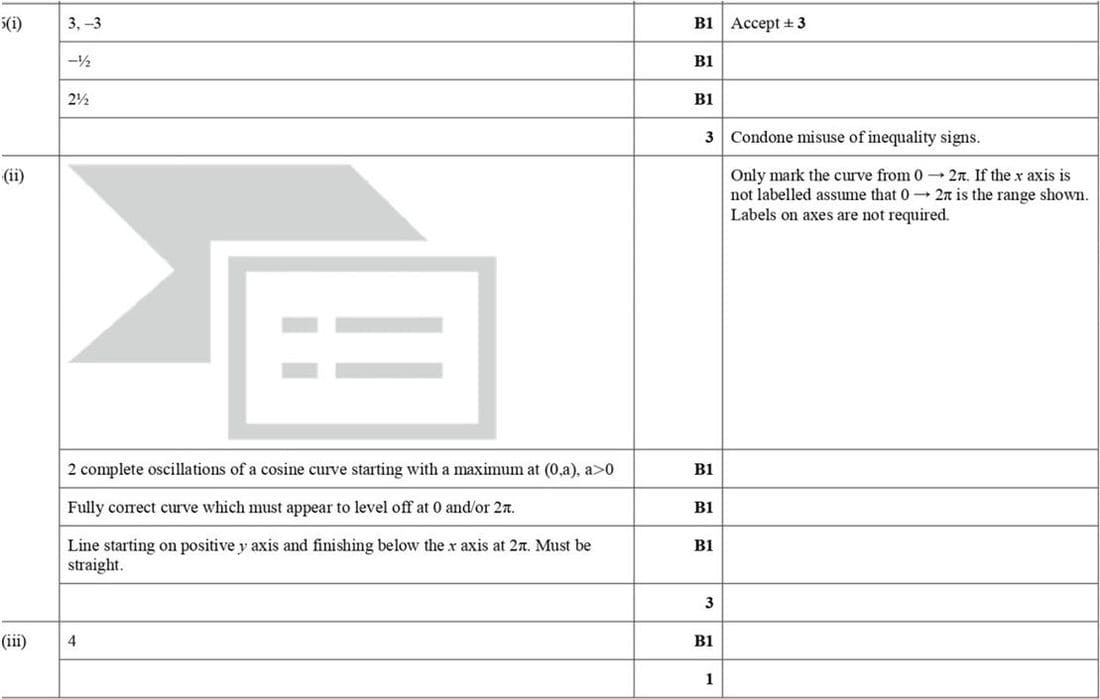
(i) For the curve \(y = 3 \cos 2x\), the maximum value of \(\cos 2x\) is 1 and the minimum is -1. Therefore, the largest value of \(y\) is 3 and the smallest is -3.
For the line \(2y + \frac{3x}{\pi} = 5\), rearrange to find \(y = \frac{5}{2} - \frac{3x}{2\pi}\). The smallest value of \(y\) occurs when \(x = 2\pi\), giving \(y = -\frac{1}{2}\), and the largest value occurs when \(x = 0\), giving \(y = \frac{5}{2}\).
(ii) The sketch should show two complete oscillations of the cosine curve starting with a maximum at \((0, 3)\) and leveling off at \(0\) and \(2\pi\). The line should start on the positive \(y\)-axis and finish below the \(x\)-axis at \(2\pi\).
(iii) The number of solutions of the equation \(6 \cos 2x = 5 - \frac{3x}{\pi}\) for \(0 \leq x \leq 2\pi\) is 4.