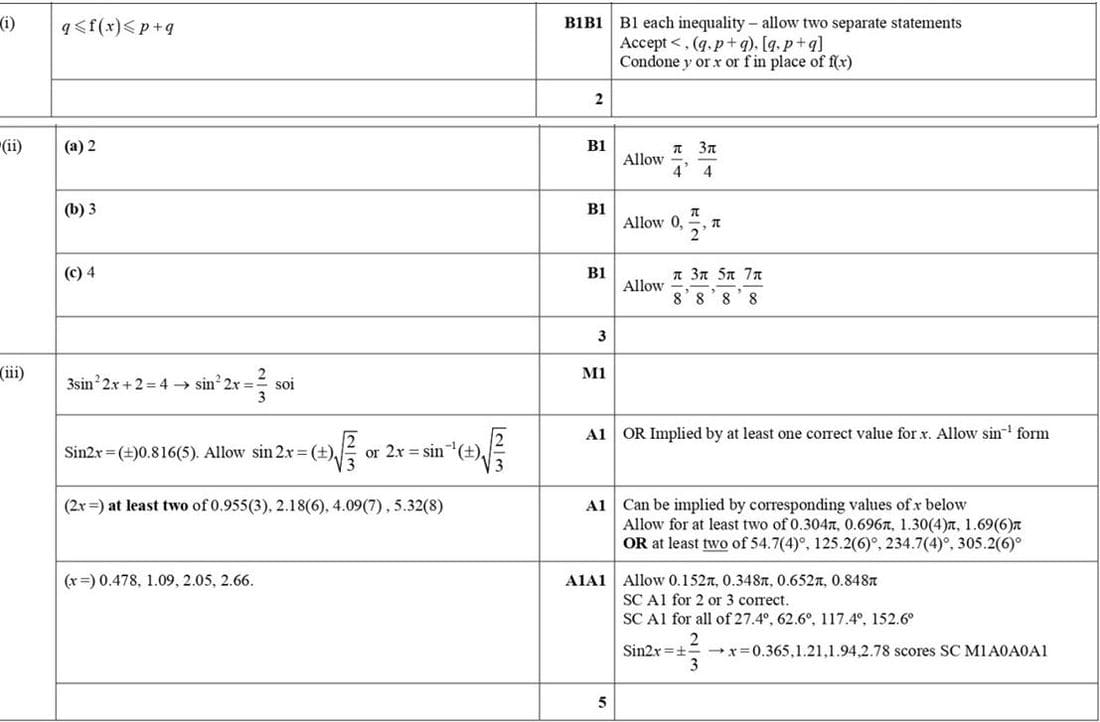
(i) The function \(f(x) = p \sin^2 2x + q\) has a range determined by the values of \(\sin^2 2x\), which vary from 0 to 1. Therefore, the minimum value of \(f(x)\) is \(q\) and the maximum value is \(p + q\). Thus, the range is \(q \leq f(x) \leq p + q\).
(ii) (a) For \(f(x) = p + q\), \(\sin^2 2x = 1\). This occurs at two points within the interval \(0 \leq x \leq \pi\), so there are 2 solutions.
(b) For \(f(x) = q\), \(\sin^2 2x = 0\). This occurs at three points within the interval \(0 \leq x \leq \pi\), so there are 3 solutions.
(c) For \(f(x) = \frac{1}{2}p + q\), \(\sin^2 2x = \frac{1}{2}\). This occurs at four points within the interval \(0 \leq x \leq \pi\), so there are 4 solutions.
(iii) Given \(p = 3\) and \(q = 2\), solve \(3 \sin^2 2x + 2 = 4\) which simplifies to \(\sin^2 2x = \frac{2}{3}\).
\(\sin 2x = \pm \sqrt{\frac{2}{3}}\). Solving for \(2x\), we find \(2x = \sin^{-1}(\pm \sqrt{\frac{2}{3}})\).
Using a calculator, \(2x \approx 0.955, 2.18, 4.09, 5.32\).
Thus, \(x \approx 0.478, 1.09, 2.05, 2.66\).