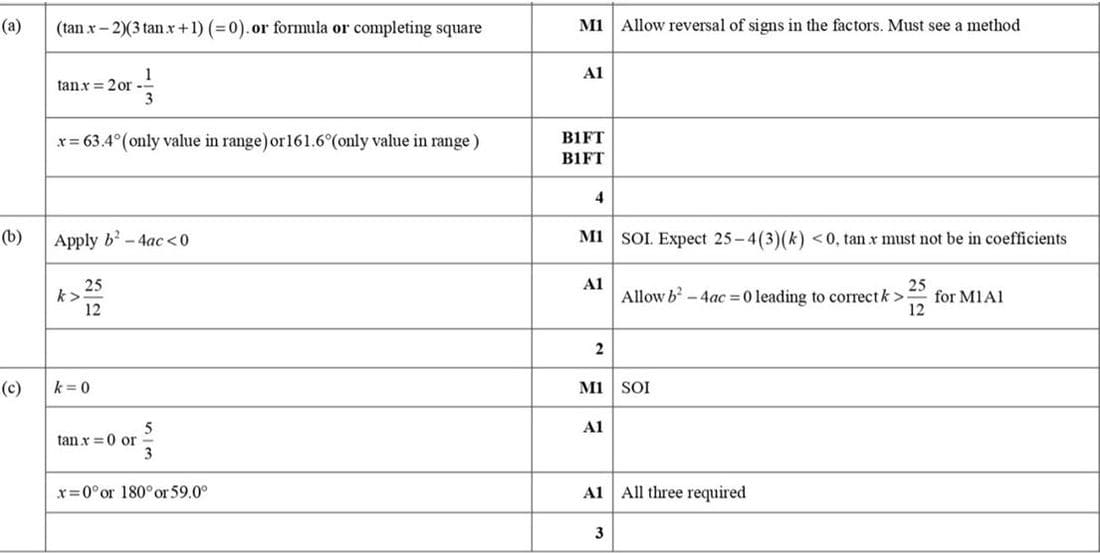
(a) The equation \(3 \tan^2 x - 5 \tan x - 2 = 0\) can be factored as \((\tan x - 2)(3 \tan x + 1) = 0\). This gives \(\tan x = 2\) or \(\tan x = -\frac{1}{3}\).
For \(\tan x = 2\), \(x = 63.4^\circ\) (only value in range).
For \(\tan x = -\frac{1}{3}\), \(x = 161.6^\circ\) (only value in range).
(b) For the equation \(3 \tan^2 x - 5 \tan x + k = 0\) to have no solutions, the discriminant must be negative: \(b^2 - 4ac < 0\).
Here, \(b = -5\), \(a = 3\), \(c = k\). So, \((-5)^2 - 4(3)(k) < 0\) simplifies to \(25 - 12k < 0\), leading to \(k > \frac{25}{12}\).
(c) For three solutions, the discriminant must be zero, and \(k = 0\).
Substitute \(k = 0\) into the equation: \(3 \tan^2 x - 5 \tan x = 0\).
Factor to get \(\tan x (3 \tan x - 5) = 0\), giving \(\tan x = 0\) or \(\tan x = \frac{5}{3}\).
For \(\tan x = 0\), \(x = 0^\circ\) or \(x = 180^\circ\).
For \(\tan x = \frac{5}{3}\), \(x = 59.0^\circ\).