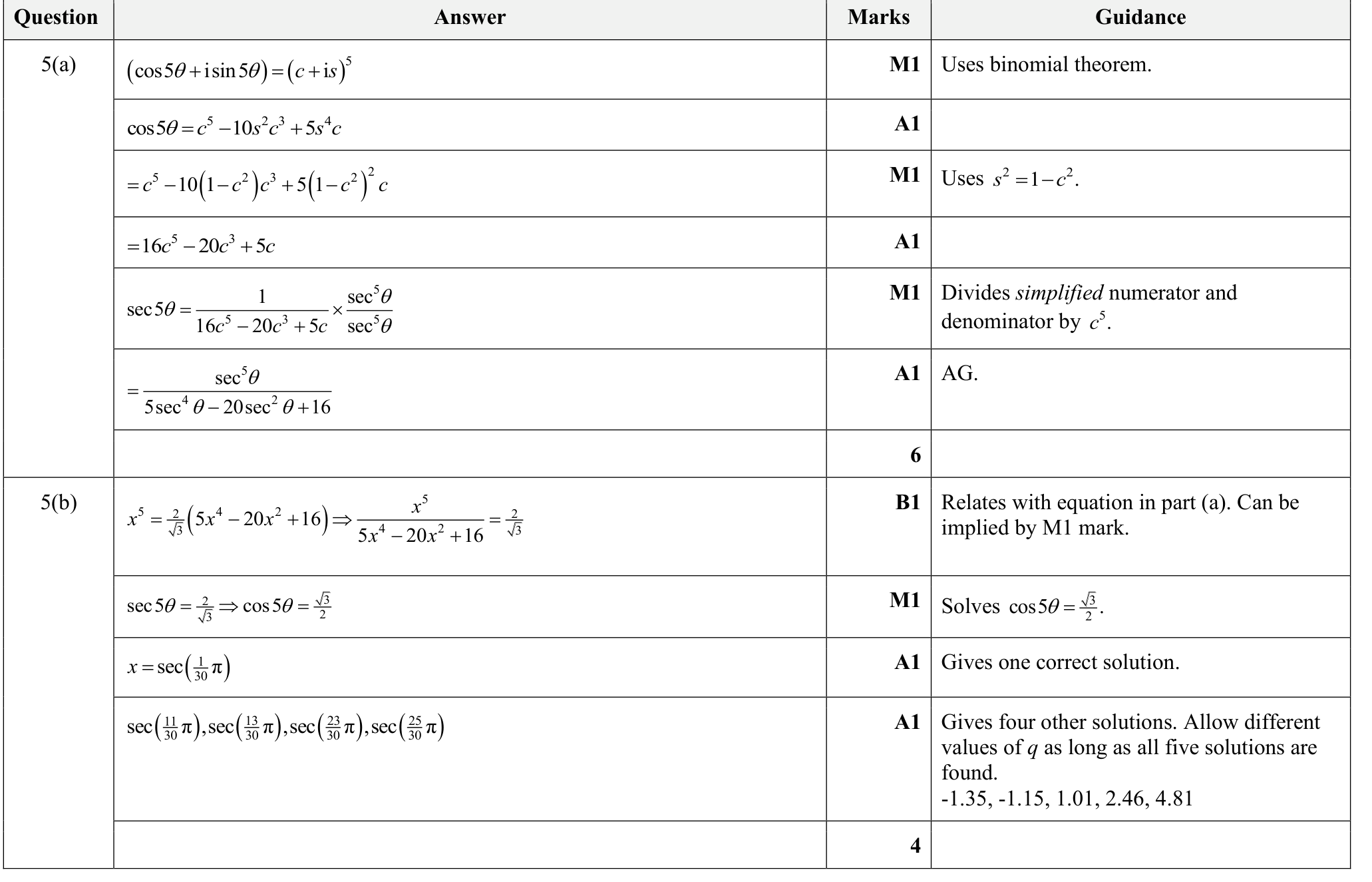
Answer: (a) \(\sec 5\theta=\dfrac{\sec^5\theta}{5\sec^4\theta-20\sec^2\theta+16}\).
(b) The roots are
\(x=\sec\left(\dfrac{\pi}{30}\right),\ \sec\left(\dfrac{11\pi}{30}\right),\ \sec\left(\dfrac{13\pi}{30}\right),\ \sec\left(\dfrac{23\pi}{30}\right),\ \sec\left(\dfrac{25\pi}{30}\right).\)
(a) Let \(c=\cos\theta\) and \(s=\sin\theta\).
By de Moivre's theorem,
\((\cos 5\theta+i\sin 5\theta)=(c+is)^5.\)
Expanding and taking real parts,
\(\cos 5\theta=c^5-10c^3s^2+5cs^4.\)
Using \(s^2=1-c^2\),
\(\cos 5\theta=c^5-10c^3(1-c^2)+5c(1-c^2)^2.\)
Now simplify:
\(\cos 5\theta=c^5-10c^3+10c^5+5c-10c^3+5c^5=16c^5-20c^3+5c.\)
Hence
\(\sec 5\theta=\dfrac{1}{16c^5-20c^3+5c}.\)
Multiply numerator and denominator by \(\sec^5\theta=\dfrac{1}{c^5}\):
\(\sec 5\theta=\dfrac{\sec^5\theta}{16-20\sec^2\theta+5\sec^4\theta}.\)
So
\(\sec 5\theta=\dfrac{\sec^5\theta}{5\sec^4\theta-20\sec^2\theta+16}.\)
(b) Rearrange the equation
\(\sqrt3x^5-10x^4+40x^2-32=0\)
to get
\(\sqrt3x^5=10x^4-40x^2+32=2(5x^4-20x^2+16),\)
so
\(\dfrac{x^5}{5x^4-20x^2+16}=\dfrac{2}{\sqrt3}.\)
From part (a), if \(x=\sec\theta\), then
\(\dfrac{x^5}{5x^4-20x^2+16}=\sec 5\theta.\)
Therefore
\(\sec 5\theta=\dfrac{2}{\sqrt3},\qquad \cos 5\theta=\dfrac{\sqrt3}{2}.\)
So
\(5\theta=2k\pi\pm\dfrac{\pi}{6}.\)
Hence
\(\theta=\dfrac{2k\pi}{5}\pm\dfrac{\pi}{30}.\)
Taking five distinct values modulo \(2\pi\):
\(\theta=\dfrac{\pi}{30},\ \dfrac{11\pi}{30},\ \dfrac{13\pi}{30},\ \dfrac{23\pi}{30},\ \dfrac{25\pi}{30}.\)
Therefore the roots are
\(x=\sec\left(\dfrac{\pi}{30}\right),\ \sec\left(\dfrac{11\pi}{30}\right),\ \sec\left(\dfrac{13\pi}{30}\right),\ \sec\left(\dfrac{23\pi}{30}\right),\ \sec\left(\dfrac{25\pi}{30}\right).\)