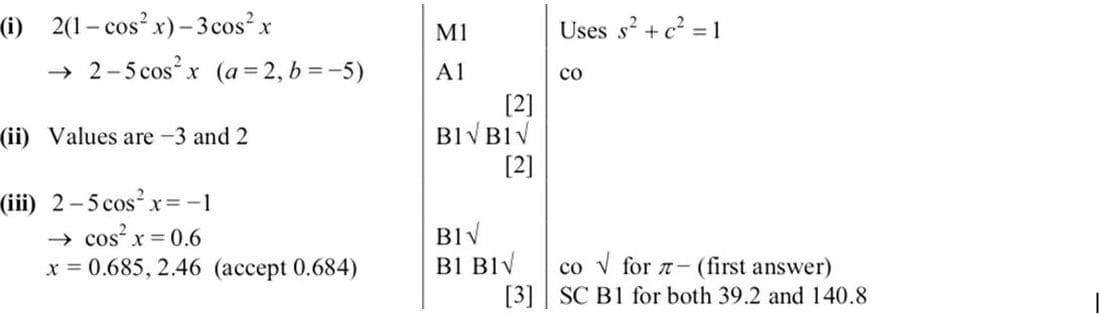
(i) Start with \(f(x) = 2 \sin^2 x - 3 \cos^2 x\).
Using the identity \(\sin^2 x = 1 - \cos^2 x\), substitute to get:
\(f(x) = 2(1 - \cos^2 x) - 3 \cos^2 x\).
Simplify to \(f(x) = 2 - 2 \cos^2 x - 3 \cos^2 x = 2 - 5 \cos^2 x\).
Thus, \(a = 2\) and \(b = -5\).
(ii) The expression \(f(x) = 2 - 5 \cos^2 x\) has its maximum value when \(\cos^2 x = 0\), giving \(f(x) = 2\).
The minimum value occurs when \(\cos^2 x = 1\), giving \(f(x) = 2 - 5 = -3\).
(iii) Solve \(f(x) + 1 = 0\):
\(2 - 5 \cos^2 x + 1 = 0\) simplifies to \(2 - 5 \cos^2 x = -1\).
Thus, \(\cos^2 x = 0.6\).
Solving for \(x\), we find \(x = \cos^{-1}(\pm \sqrt{0.6})\).
This gives \(x \approx 0.685\) and \(x \approx 2.46\).