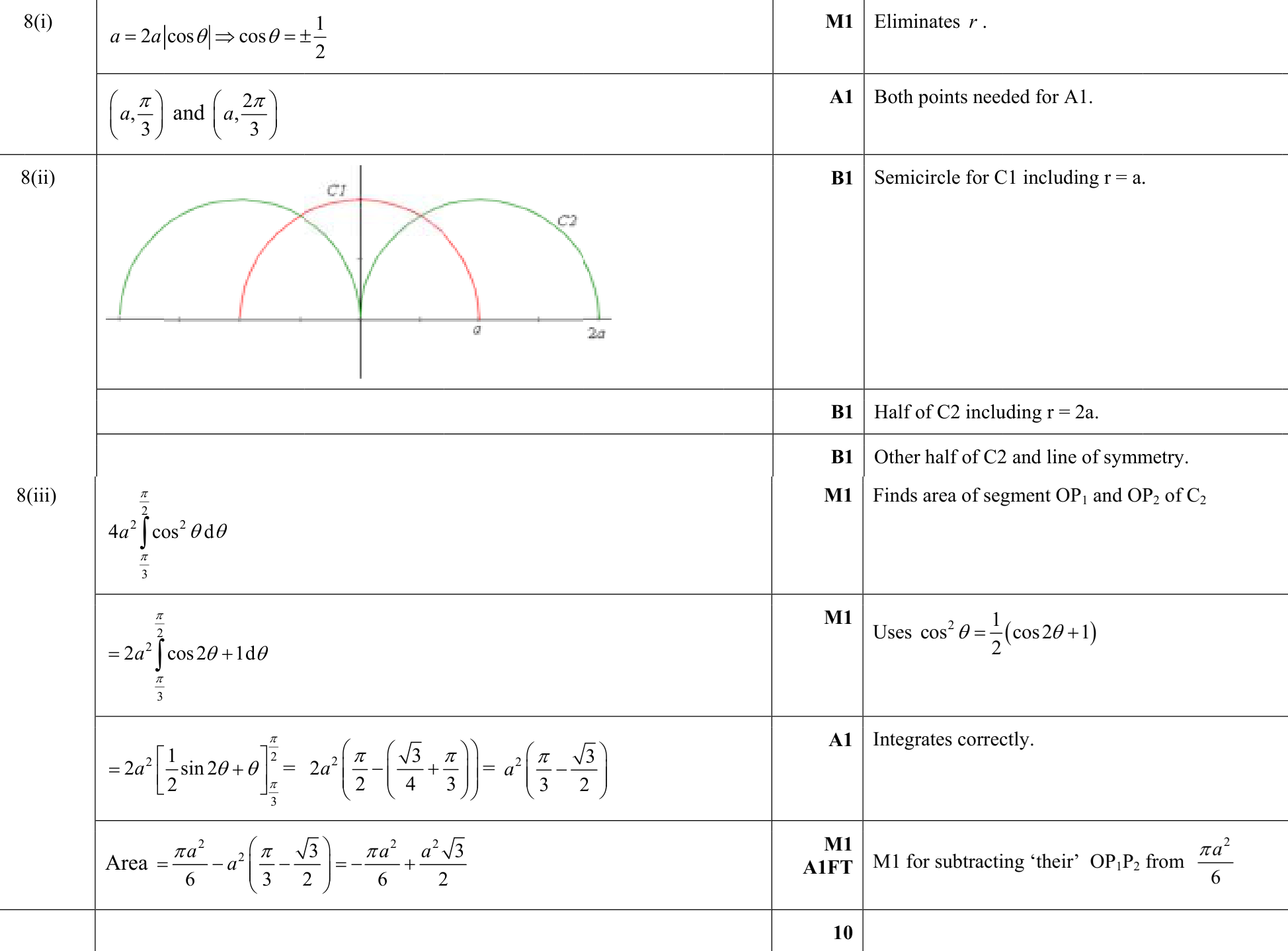
Answer: (i) The intersections satisfy both polar equations, so
\(a = 2a|\cos\theta|\), hence \(|\cos\theta| = \tfrac12\).
For \(0 \le \theta \le \pi\), this gives \(\theta = \tfrac{\pi}{3}\) or \(\tfrac{2\pi}{3}\).
So the points are
\(P_1\!:\left(a,\tfrac{\pi}{3}\right)\), \(P_2\!:\left(a,\tfrac{2\pi}{3}\right)\).
(ii) \(C_1\) is the circle \(r=a\), centred at the pole with radius \(a\). \(C_2\) is the loop of the curve \(r=2a|\cos\theta|\), which is symmetric about the line \(\theta=0\) (the polar axis). The line of symmetry is therefore the polar axis.
(iii) The required region \(R\) is inside the circle \(r=a\) but outside the curve \(r=2a|\cos\theta|\), between the two intersection angles.
By symmetry about the polar axis, the area can be found as twice the area in the upper half-plane:
\(A=2\cdot \frac12\int_{\pi/3}^{\pi/2}\big(a^2-(2a\cos\theta)^2\big)\,d\theta.\)
So
\(A=\int_{\pi/3}^{\pi/2}\left(a^2-4a^2\cos^2\theta\right)d\theta = a^2\int_{\pi/3}^{\pi/2}(1-4\cos^2\theta)\,d\theta.\)
Use \(\cos^2\theta=\tfrac12(1+\cos2\theta)\):
\(1-4\cos^2\theta=1-2(1+\cos2\theta)=-1-2\cos2\theta.\)
Hence
\(A=a^2\int_{\pi/3}^{\pi/2}(-1-2\cos2\theta)\,d\theta = a^2\left[-\theta-\sin2\theta\right]_{\pi/3}^{\pi/2}.\)
Now
\(A=a^2\left(\left(-\frac\pi2-\sin\pi\right)-\left(-\frac\pi3-\sin\frac{2\pi}{3}\right)\right) = a^2\left(-\frac\pi2+\frac\pi3+\frac{\sqrt3}{2}\right).\)
Therefore
\(A= a^2\left(\frac{\sqrt3}{2}-\frac{\pi}{6}\right) = \frac{a^2}{6}(3\sqrt3-\pi).\)
We solve the three parts in turn.
(i) At an intersection, the same point must satisfy both equations, so
\(a=2a|\cos\theta|.\)
Since \(a>0\), divide by \(a\):
\(1=2|\cos\theta|\quad\Rightarrow\quad |\cos\theta|=\frac12.\)
For \(0\le \theta\le \pi\), this happens when
\(\theta=\frac\pi3\quad\text{or}\quad \theta=\frac{2\pi}{3}.\)
Because \(r=a\) at the intersection, the points are
\(P_1=\left(a,\frac\pi3\right),\qquad P_2=\left(a,\frac{2\pi}{3}\right).\)
(ii) The curve \(C_1:r=a\) is a circle of radius \(a\) centred at the pole.
The curve \(C_2:r=2a|\cos\theta|\) has the same shape as \(r=2a\cos\theta\) for \(-\tfrac\pi2\le\theta\le\tfrac\pi2\), reflected to keep \(r\ge 0\). It is symmetric about the polar axis \((\theta=0)\).
So the sketch should show:
- the circle \(r=a\),
- the curve \(r=2a|\cos\theta|\), passing through the pole and intersecting the circle at angles \(\theta=\pi/3\) and \(2\pi/3\),
- the line of symmetry: the polar axis.
(iii) The region \(R\) is enclosed by the arc of the circle from \(P_1\) to \(P_2\) and the corresponding arc of \(C_2\) from \(P_1\) to \(P_2\), together with the pole. Since the figure is symmetric about the polar axis, we can find the area in the upper half and double it.
For \(0\le \theta\le \pi/2\), we have \(|\cos\theta|=\cos\theta\), so the relevant branch of \(C_2\) is \(r=2a\cos\theta\). The area between the curves from \(\theta=\pi/3\) to \(\theta=\pi/2\) is
\(\frac12\int_{\pi/3}^{\pi/2}\Big(a^2-(2a\cos\theta)^2\Big)\,d\theta.\)
Doubling this gives
\(A=\int_{\pi/3}^{\pi/2}\left(a^2-4a^2\cos^2\theta\right)d\theta = a^2\int_{\pi/3}^{\pi/2}(1-4\cos^2\theta)\,d\theta.\)
Now use \(\cos^2\theta=\frac12(1+\cos2\theta)\):
\(1-4\cos^2\theta=1-2(1+\cos2\theta)=-1-2\cos2\theta.\)
So
\(A=a^2\int_{\pi/3}^{\pi/2}(-1-2\cos2\theta)\,d\theta = a^2\left[-\theta-\sin2\theta\right]_{\pi/3}^{\pi/2}.\)
Evaluate the bracket:
\(A=a^2\left(\left(-\frac\pi2-\sin\pi\right)-\left(-\frac\pi3-\sin\frac{2\pi}{3}\right)\right).\)
Since \(\sin\pi=0\) and \(\sin\tfrac{2\pi}{3}=\tfrac{\sqrt3}{2}\),
\(A=a^2\left(-\frac\pi2+\frac\pi3+\frac{\sqrt3}{2}\right) = a^2\left(\frac{\sqrt3}{2}-\frac\pi6\right).\)
Hence
\(\boxed{A=\frac{a^2}{6}(3\sqrt3-\pi)}.\)