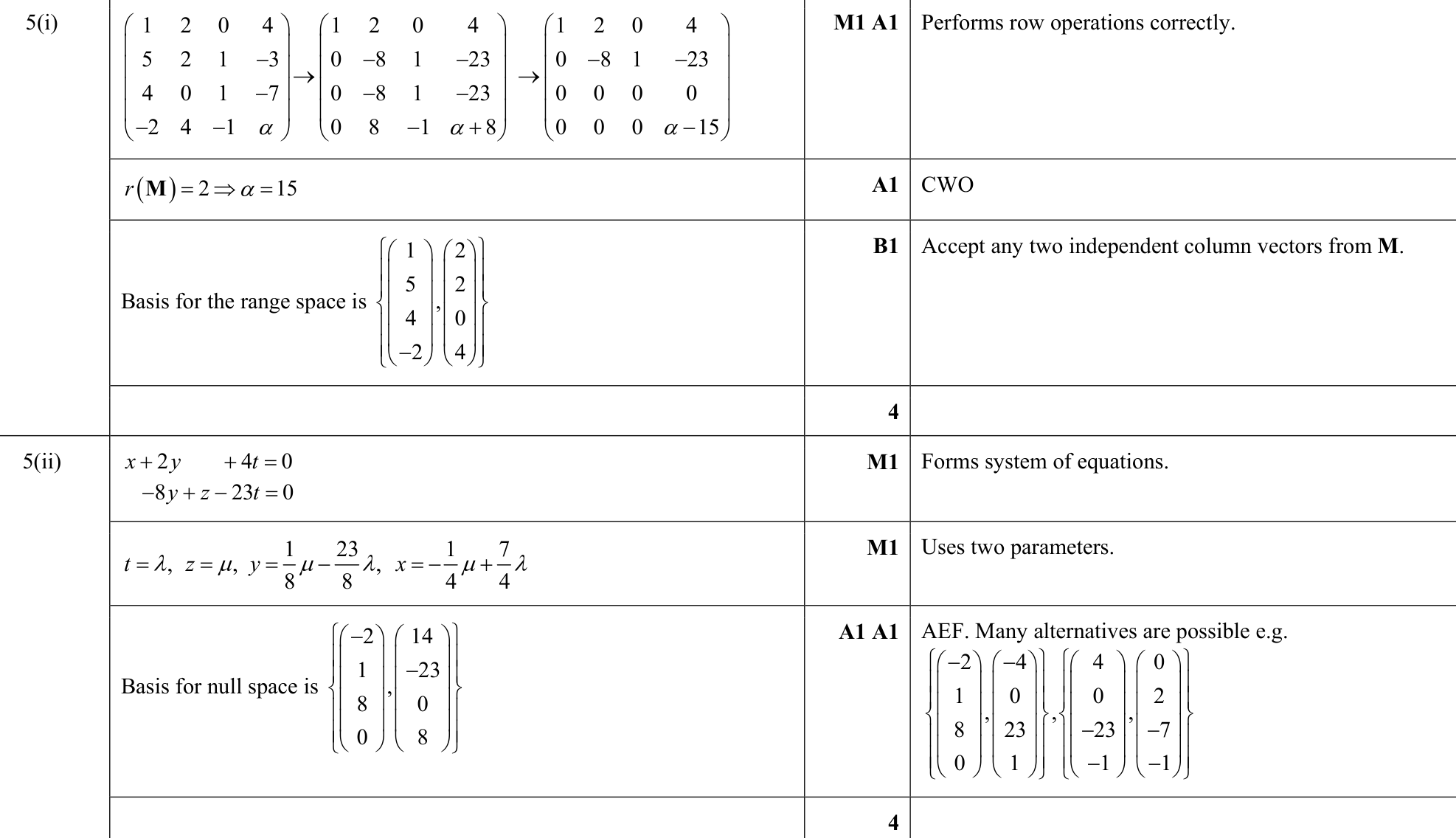
Answer: (i) \(\alpha=15\). A basis for the range space is \(\left\{\begin{pmatrix}1\\5\\4\\-2\end{pmatrix},\begin{pmatrix}2\\2\\0\\4\end{pmatrix}\right\}\).
(ii) A basis for the null space is \(\left\{\begin{pmatrix}-2\\1\\8\\0\end{pmatrix},\begin{pmatrix}14\\-23\\0\\8\end{pmatrix}\right\}\).
Reduce the matrix \(M\):
\(\begin{pmatrix}1&2&0&4\\5&2&1&-3\\4&0&1&-7\\-2&4&-1&\alpha\end{pmatrix}\to\begin{pmatrix}1&2&0&4\\0&-8&1&-23\\0&-8&1&-23\\0&8&-1&\alpha+8\end{pmatrix}\to\begin{pmatrix}1&2&0&4\\0&-8&1&-23\\0&0&0&0\\0&0&0&\alpha-15\end{pmatrix}\).
Since the rank is \(2\), the last row must be zero. Hence
\(\alpha-15=0\), so \(\alpha=15\).
With \(\alpha=15\), two independent columns of \(M\) are the first two columns, so a basis for the range space is
\(\left\{\begin{pmatrix}1\\5\\4\\-2\end{pmatrix},\begin{pmatrix}2\\2\\0\\4\end{pmatrix}\right\}\).
For the null space, solve \(M\begin{pmatrix}x\\y\\z\\t\end{pmatrix}=0\). The reduced equations are
\(x+2y+4t=0\),
\(-8y+z-23t=0\).
Let \(t=\lambda\) and \(z=\mu\). Then
\(y=\dfrac18\mu-\dfrac{23}{8}\lambda\),
and
\(x=-2y-4t=-\dfrac14\mu+\dfrac74\lambda\).
Choosing \((\mu,\lambda)=(8,0)\) and \((0,8)\), a basis for the null space is
\(\left\{\begin{pmatrix}-2\\1\\8\\0\end{pmatrix},\begin{pmatrix}14\\-23\\0\\8\end{pmatrix}\right\}\).