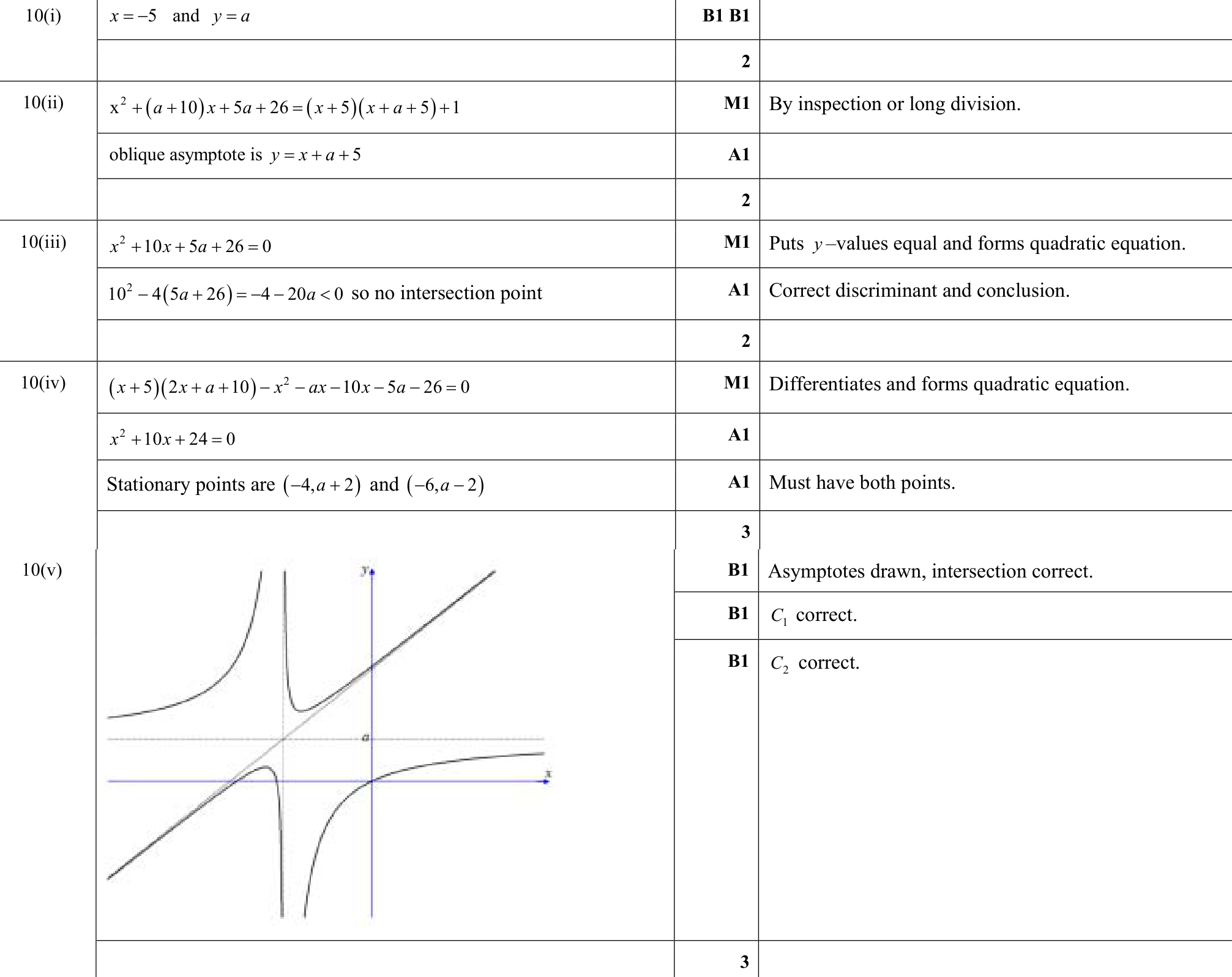
Answer: (i) The asymptotes of \(C_1\) are \(x=-5\) and \(y=a\).
(ii) The oblique asymptote of \(C_2\) is \(y=x+a+5\).
(iii) The curves do not intersect.
(iv) The stationary points of \(C_2\) are \((-5,-2)\) and \((-1,a+1)\).
(v) A suitable sketch shows \(C_1\) with asymptotes \(x=-5\), \(y=a\), and a horizontal branch passing through \((0,0)\), and \(C_2\) with vertical asymptote \(x=-5\), oblique asymptote \(y=x+a+5\), stationary points at \((-5,-2)\) and \((-1,a+1)\), and no intersections with \(C_1\).
(i) For \(C_1\),
\(y=\dfrac{ax}{x+5}\).
As \(x\to -5\), the denominator tends to \(0\), so there is a vertical asymptote
\(x=-5\).
Also, dividing numerator and denominator by \(x\),
\(y=\dfrac{a}{1+5/x}\),
so as \(x\to \pm\infty\), \(y\to a\). Hence the horizontal asymptote is
\(y=a\).
(ii) For \(C_2\), divide the numerator by \(x+5\):
\(x^2+(a+10)x+5a+26 = (x+5)(x+a+5)+1\).
So
\(y=\dfrac{(x+5)(x+a+5)+1}{x+5}=x+a+5+\dfrac{1}{x+5}.\)
Therefore the oblique asymptote is
\(y=x+a+5\).
(iii) To find intersections, set the two expressions for \(y\) equal:
\(\dfrac{ax}{x+5}=\dfrac{x^2+(a+10)x+5a+26}{x+5}.\)
Since both have the same denominator, multiply through by \(x+5\):
\(ax=x^2+(a+10)x+5a+26.\)
Rearranging gives
\(0=x^2+10x+5a+26.\)
The discriminant is
\(\Delta=10^2-4(1)(5a+26)=100-20a-104=-20a-4.\)
Because \(a>2\), we have \(-20a-4<0\). So there are no real solutions, and hence \(C_1\) and \(C_2\) do not intersect.
(iv) Write \(C_2\) as
\(y=x+a+5+\dfrac{1}{x+5}.\)
Differentiate:
\(\dfrac{dy}{dx}=1-\dfrac{1}{(x+5)^2}.\)
Set this equal to zero for stationary points:
\(1-\dfrac{1}{(x+5)^2}=0\)
\(\Rightarrow (x+5)^2=1\)
\(\Rightarrow x=-4 \text{ or } x=-6.\)
Now find the corresponding \(y\)-values.
When \(x=-4\),
\(y=-4+a+5+\dfrac{1}{1}=a+2.\)
When \(x=-6\),
\(y=-6+a+5+\dfrac{1}{-1}=a-2.\)
So the stationary points are \((-4,a+2)\) and \((-6,a-2)\).
(v) For the sketch:
- \(C_1\) has vertical asymptote \(x=-5\) and horizontal asymptote \(y=a\).
- Since \(y=\dfrac{ax}{x+5}\), it passes through \((0,0)\).
- For \(x>-5\), the curve goes through the origin and approaches \(y=a\) as \(x\to\infty\), and \(y\to +\infty\) as \(x\to -5^+\).
- For \(x<-5\), the branch lies above \(y=a\) and tends to \(-\infty\) as \(x\to -5^-\).
- \(C_2\) has vertical asymptote \(x=-5\) and oblique asymptote \(y=x+a+5\).
- It has stationary points at \((-6,a-2)\) and \((-4,a+2)\).
- It does not intersect \(C_1\).
This gives the required combined sketch.