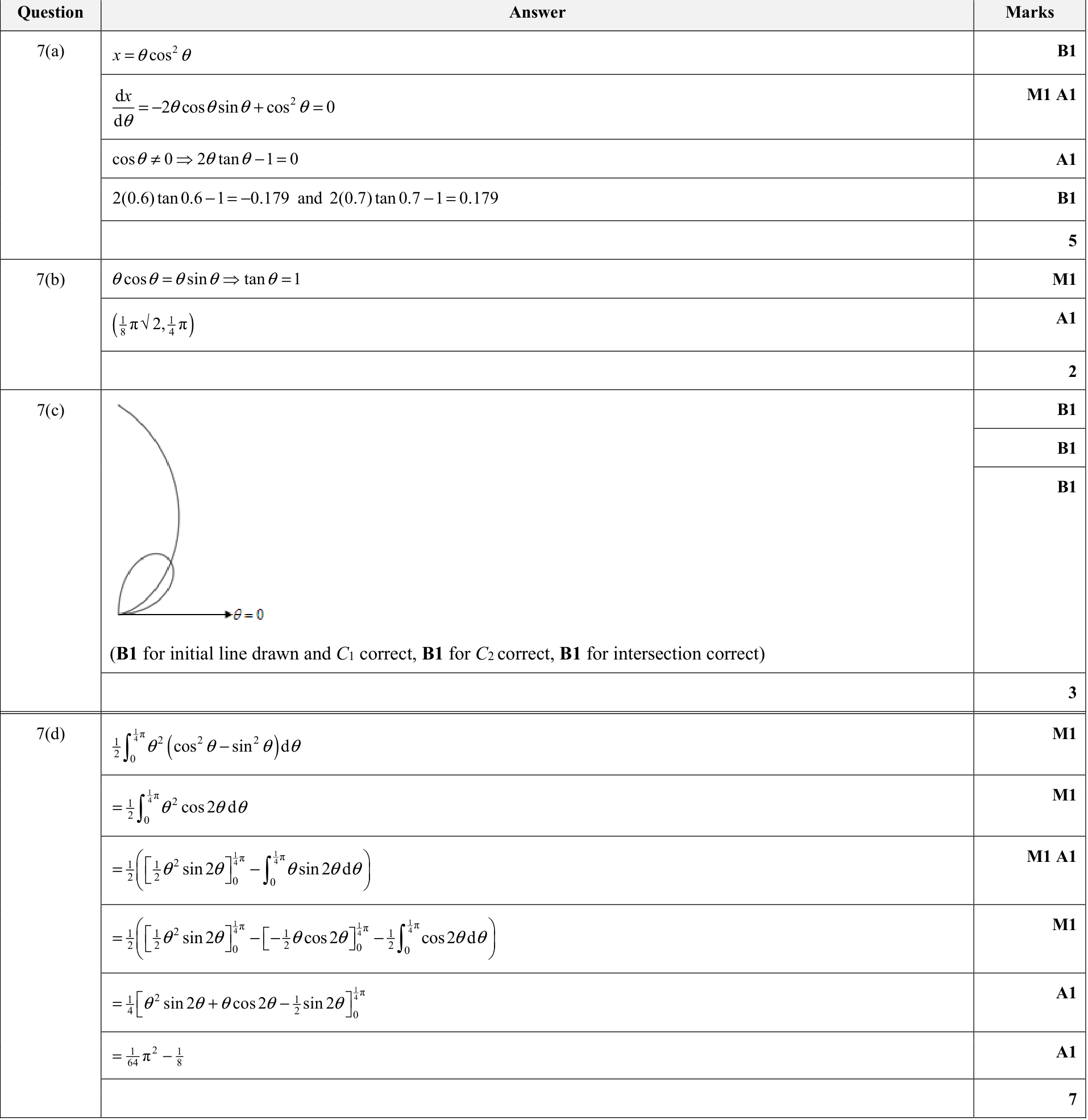
Answer:
- (a) At \(P\), \(2\theta\tan\theta-1=0\), with a root between \(0.6\) and \(0.7\).
- (b) \(Q\) has polar coordinates \(\left(\frac{\pi\sqrt{2}}{8},\frac{\pi}{4}\right)\).
- (c) The sketch should show both curves from the pole, meeting again at \(Q\), with \(C_1\) initially outside \(C_2\) for \(0<\theta<\frac{\pi}{4}\).
- (d) The required area is \(\displaystyle \frac{\pi^2}{64}-\frac{1}{8}\).
(a) The line \(\theta=\frac{\pi}{2}\) is the positive \(y\)-axis. The distance of a point from this line is its \(x\)-coordinate.
For \(C_1\), \(r=\theta\cos\theta\), so
\(x=r\cos\theta=\theta\cos^2\theta\).
To find the point furthest from the line, maximise \(x(\theta)=\theta\cos^2\theta\). Differentiate:
\(\displaystyle \frac{dx}{d\theta}=\cos^2\theta-2\theta\cos\theta\sin\theta\).
At an interior maximum, \(\frac{dx}{d\theta}=0\), so
\(\cos^2\theta-2\theta\cos\theta\sin\theta=0\).
Since \(0<\theta<\frac{\pi}{2}\), \(\cos\theta e0\), and therefore
\(\cos\theta-2\theta\sin\theta=0\).
Dividing by \(\cos\theta\) gives
\(1-2\theta\tan\theta=0\),
so \(2\theta\tan\theta-1=0\).
Let \(f(\theta)=2\theta\tan\theta-1\). Then
\(f(0.6)=2(0.6)\tan0.6-1\approx -0.179\),
and
\(f(0.7)=2(0.7)\tan0.7-1\approx 0.179\).
Since the signs are different, there is a root between \(0.6\) and \(0.7\).
(b) At the non-pole intersection,
\(\theta\cos\theta=\theta\sin\theta\).
Since \(\theta e0\), \(\cos\theta=\sin\theta\), so \(\tan\theta=1\). Hence \(\theta=\frac{\pi}{4}\).
Then
\(r=\theta\cos\theta=\frac{\pi}{4}\cdot\frac{\sqrt{2}}{2}=\frac{\pi\sqrt{2}}{8}\).
Therefore
\(Q=\left(\frac{\pi\sqrt{2}}{8},\frac{\pi}{4}\right)\).
(c) Both curves start at the pole. The curve \(C_1:r=\theta\cos\theta\) is initially outside \(C_2\) for \(0<\theta<\frac{\pi}{4}\), and the two curves meet again at \(Q\). The curve \(C_2:r=\theta\sin\theta\) continues outwards towards \(\theta=\frac{\pi}{2}\). A sketch should show this intersection and the first-quadrant polar shape.
(d) For \(0\le\theta\le\frac{\pi}{4}\), \(\cos\theta\ge\sin\theta\), so \(C_1\) is outside \(C_2\). The required area is
\(\displaystyle A=\frac{1}{2}\int_0^{\pi/4}\left[(\theta\cos\theta)^2-(\theta\sin\theta)^2\right]d\theta\).
Thus
\(\displaystyle A=\frac{1}{2}\int_0^{\pi/4}\theta^2\cos2\theta\,d\theta\).
Integrating by parts,
\(\displaystyle \int \theta^2\cos2\theta\,d\theta=\frac{\theta^2}{2}\sin2\theta+\frac{\theta}{2}\cos2\theta-\frac{1}{4}\sin2\theta+C\).
Therefore
\(\displaystyle A=\frac{1}{2}\left[\frac{\theta^2}{2}\sin2\theta+\frac{\theta}{2}\cos2\theta-\frac{1}{4}\sin2\theta\right]_0^{\pi/4}\).
At \(\theta=\frac{\pi}{4}\), \(\sin2\theta=1\) and \(\cos2\theta=0\), so
\(\displaystyle A=\frac{1}{2}\left(\frac{\pi^2}{32}-\frac{1}{4}\right)=\frac{\pi^2}{64}-\frac{1}{8}\).