Browsing as Guest. Progress, bookmarks and attempts are disabled.
Log in to track your work.
Problem 569
569
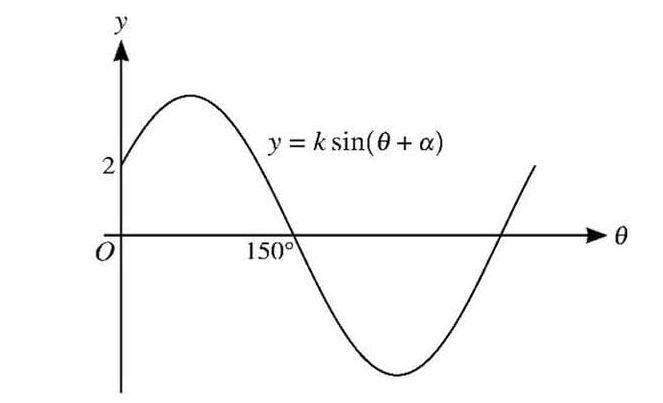
The diagram shows part of the graph of \(y = k \sin(\theta + \alpha)\), where \(k\) and \(\alpha\) are constants and \(0^\circ < \alpha < 180^\circ\). The graph has a maximum point at \(y = 2\) and \(\theta = 0^\circ\), and it crosses the \(\theta\)-axis at \(\theta = 150^\circ\). Find the value of \(\alpha\) and the value of \(k\).
Solution
The maximum value of the sine function is 1, so at \(\theta = 0^\circ\), \(y = k \sin(\alpha) = 2\). Therefore, \(k \sin(\alpha) = 2\).
At \(\theta = 150^\circ\), the graph crosses the \(\theta\)-axis, so \(y = k \sin(150^\circ + \alpha) = 0\). This implies \(150^\circ + \alpha = 180^\circ\), so \(\alpha = 30^\circ\).
Substituting \(\alpha = 30^\circ\) into \(k \sin(\alpha) = 2\), we have \(k \sin(30^\circ) = 2\).
Since \(\sin(30^\circ) = \frac{1}{2}\), we get \(k \cdot \frac{1}{2} = 2\).
