Browsing as Guest. Progress, bookmarks and attempts are disabled.
Log in to track your work.
Problem 559
559
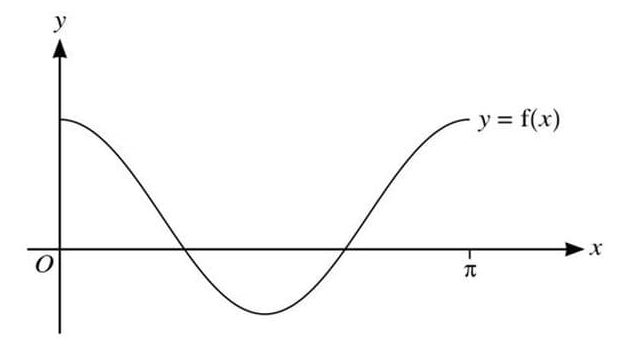
The diagram shows the graph of \(y = f(x)\), where \(f(x) = \frac{3}{2} \cos 2x + \frac{1}{2}\) for \(0 \leq x \leq \pi\).
(a) State the range of \(f\).
A function \(g\) is such that \(g(x) = f(x) + k\), where \(k\) is a positive constant. The x-axis is a tangent to the curve \(y = g(x)\).
(b) State the value of \(k\) and hence describe fully the transformation that maps the curve \(y = f(x)\) on to \(y = g(x)\).
(c) State the equation of the curve which is the reflection of \(y = f(x)\) in the x-axis. Give your answer in the form \(y = a \cos 2x + b\), where \(a\) and \(b\) are constants.
Solution
(a) The function \(f(x) = \frac{3}{2} \cos 2x + \frac{1}{2}\) has a cosine component \(\frac{3}{2} \cos 2x\) which varies between \(-\frac{3}{2}\) and \(\frac{3}{2}\). Adding \(\frac{1}{2}\) shifts this range to \(-1\) to \(2\). Thus, the range of \(f(x)\) is \(-1 < f(x) < 2\).
(b) Since the x-axis is a tangent to \(y = g(x)\), the minimum value of \(g(x)\) must be 0. Therefore, \(f(x) + k = 0\) when \(f(x)\) is at its minimum, which is \(-1\). Solving \(-1 + k = 0\) gives \(k = 1\). The transformation is a translation by 1 unit upwards parallel to the y-axis.
(c) The reflection of \(y = f(x)\) in the x-axis is given by \(y = -f(x)\). Therefore, \(y = -\left( \frac{3}{2} \cos 2x + \frac{1}{2} \right) = -\frac{3}{2} \cos 2x - \frac{1}{2}\).