Functions f, g and h are defined for \(x \in \mathbb{R}\) by
\(f(x) = 3 \cos 2x + 2\),
\(g(x) = f(2x) + 4\),
\(h(x) = 2f\left(x + \frac{1}{2}\pi\right)\).
(d) Describe fully a sequence of transformations that maps the graph of \(y = f(x)\) on to \(y = g(x)\). [2]
(e) Describe fully a sequence of transformations that maps the graph of \(y = f(x)\) on to \(y = h(x)\). [2]
Solution
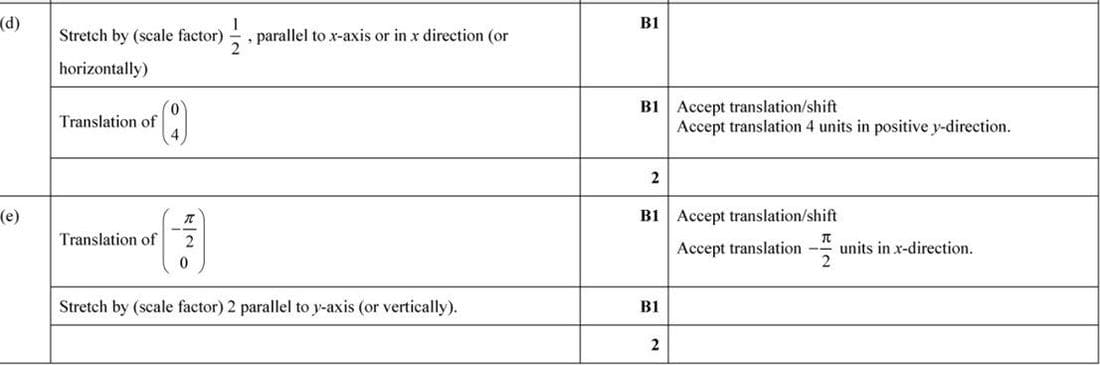
(d) To map \(y = f(x)\) to \(y = g(x)\):
- First, apply a horizontal stretch by a scale factor of \(\frac{1}{2}\) because \(g(x) = f(2x)\).
- Then, translate the graph vertically by 4 units upwards, as indicated by \(g(x) = f(2x) + 4\).
(e) To map \(y = f(x)\) to \(y = h(x)\):
- First, translate the graph horizontally by \(-\frac{\pi}{2}\) units, as indicated by \(h(x) = 2f\left(x + \frac{1}{2}\pi\right)\).
- Then, apply a vertical stretch by a scale factor of 2, as indicated by the multiplication by 2 in \(h(x) = 2f\left(x + \frac{1}{2}\pi\right)\).
Log in to record attempts.