9709 P11 - Jun 2019 - Q9 - 7 marks
545
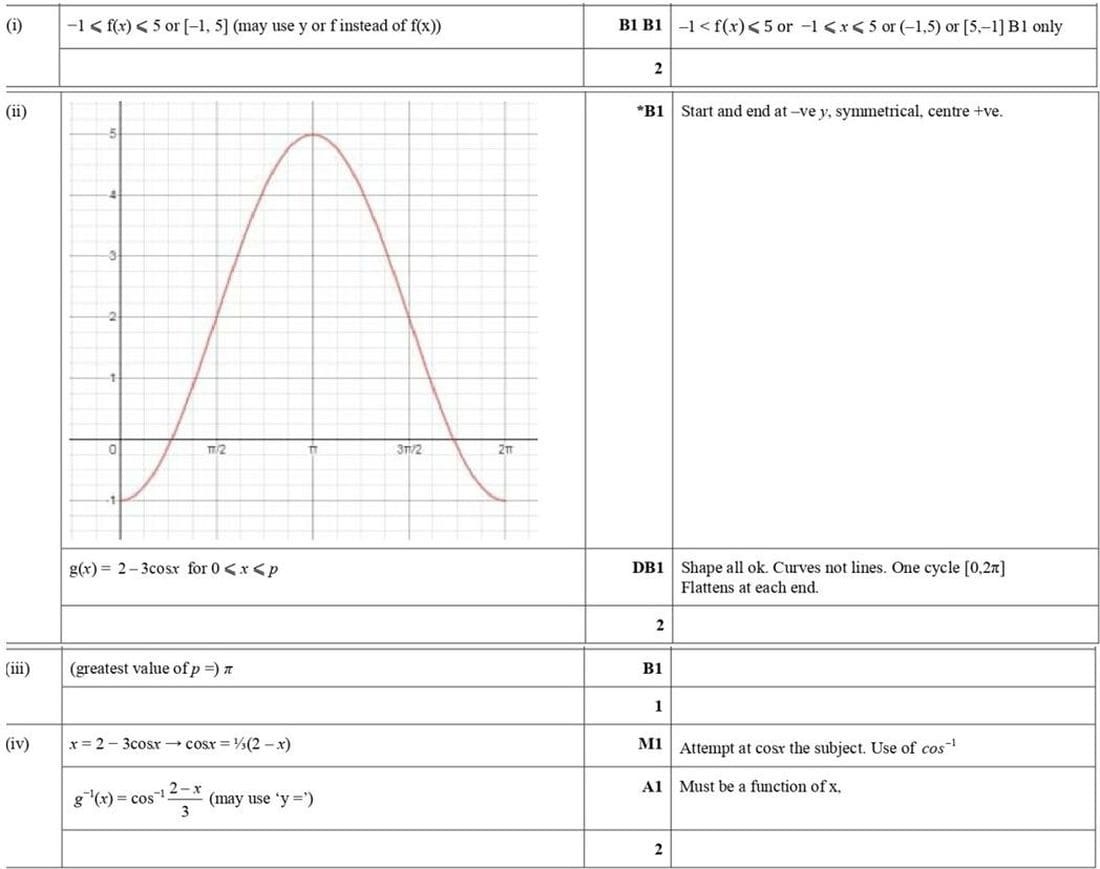
The function f is defined by \(f(x) = 2 - 3 \cos x\) for \(0 \leq x \leq 2\pi\).
- State the range of \(f\). [2]
- Sketch the graph of \(y = f(x)\). [2]
The function \(g\) is defined by \(g(x) = 2 - 3 \cos x\) for \(0 \leq x \leq p\), where \(p\) is a constant.
- State the largest value of \(p\) for which \(g\) has an inverse. [1]
- For this value of \(p\), find an expression for \(g^{-1}(x)\). [2]