Browsing as Guest. Progress, bookmarks and attempts are disabled.
Log in to track your work.
Problem 538
538
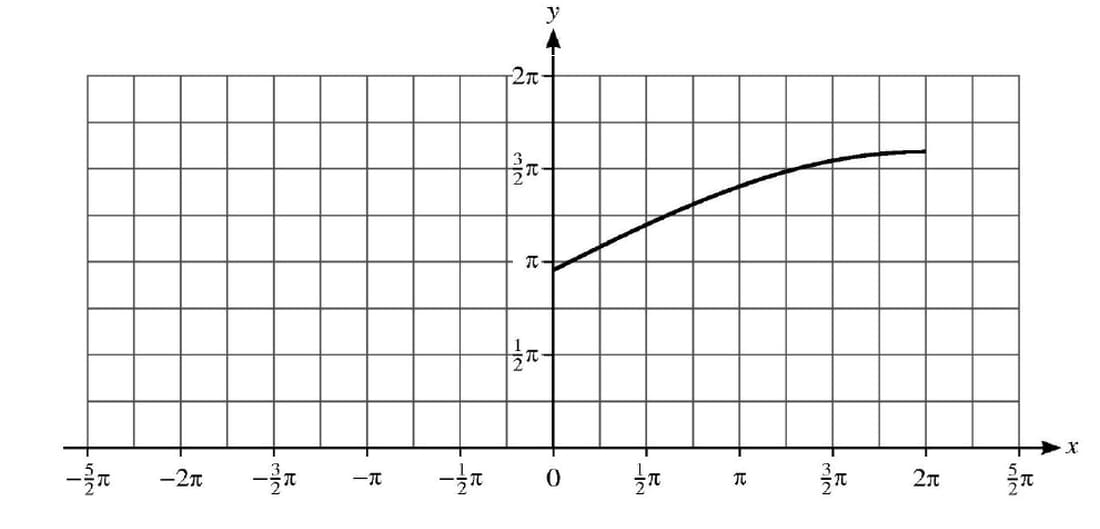
The diagram shows the graph of \(y = f(x)\) where the function \(f\) is defined by
\(f(x) = 3 + 2 \sin \frac{1}{4}x\) for \(0 \leq x \leq 2\pi\).
(a) On the diagram above, sketch the graph of \(y = f^{-1}(x)\). [2]
(b) Find an expression for \(f^{-1}(x)\). [2]
(c) The diagram above shows part of the graph of the function \(g(x) = 3 + 2 \sin \frac{1}{4}x\) for \(-2\pi \leq x \leq 2\pi\).
Complete the sketch of the graph of \(g(x)\) on the diagram above and hence explain whether the function \(g\) has an inverse. [2]
Solution
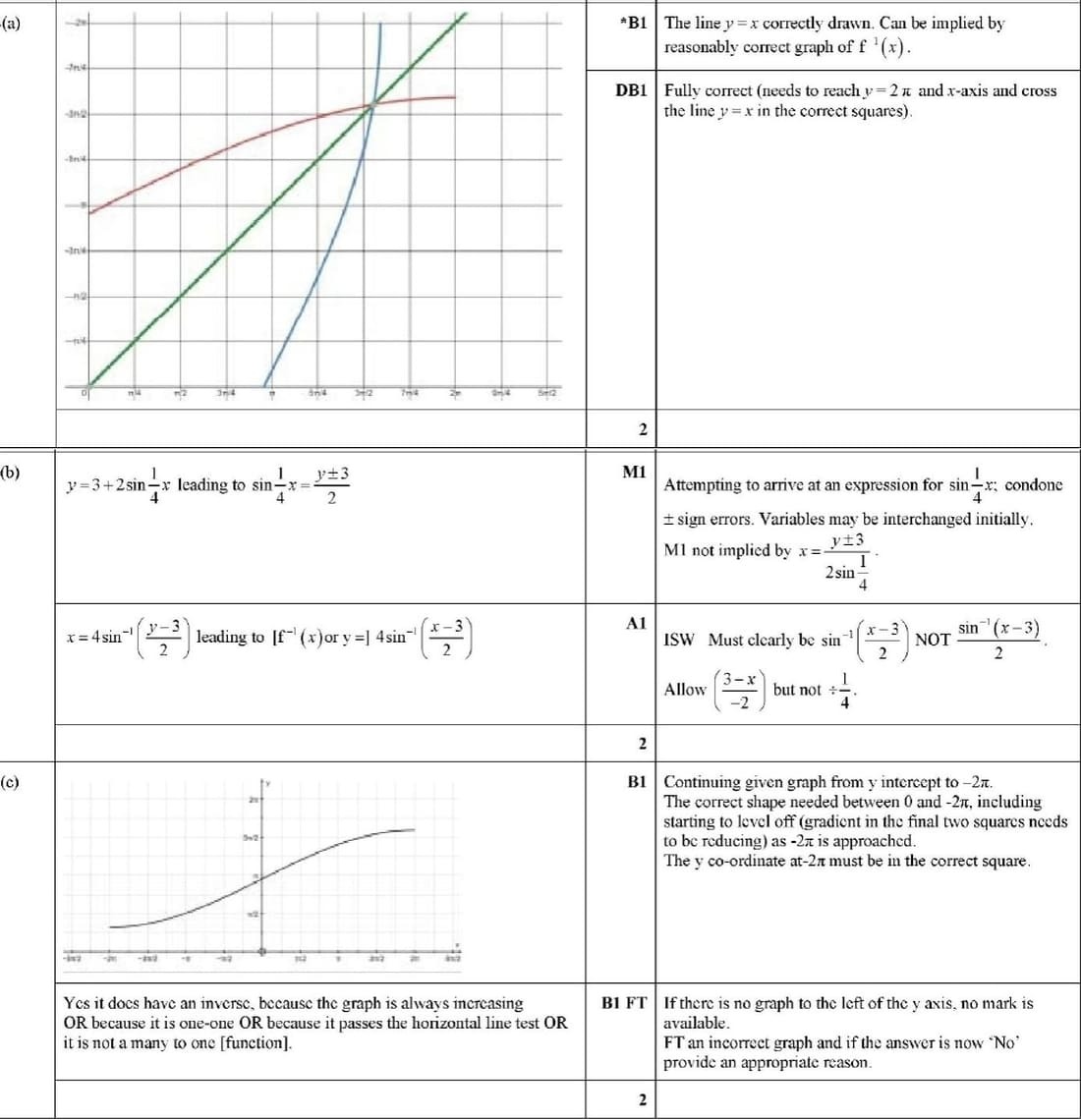
(a) To sketch the graph of \(y = f^{-1}(x)\), reflect the graph of \(y = f(x)\) across the line \(y = x\). Ensure the line \(y = x\) is drawn correctly and the inverse graph reaches \(y = 2\pi\) and \(x\)-axis, crossing the line \(y = x\) in the correct squares.
(b) Start with \(y = 3 + 2 \sin \frac{1}{4}x\). Rearrange to find \(\sin \frac{1}{4}x = \frac{y-3}{2}\). Solve for \(x\) to get \(x = 4 \sin^{-1} \left( \frac{y-3}{2} \right)\). Thus, \(f^{-1}(x) = 4 \sin^{-1} \left( \frac{x-3}{2} \right)\).
(c) Extend the graph of \(g(x)\) from \(y\)-intercept to \(-2\pi\). The graph should start to level off as \(x \to -2\pi\). The function \(g(x)\) has an inverse because it is always increasing, passing the horizontal line test.