Browsing as Guest. Progress, bookmarks and attempts are disabled.
Log in to track your work.
9709 P11 - Nov 2011 - Q3 - 5 marks
534
(i) Sketch, on a single diagram, the graphs of \(y = \cos 2\theta\) and \(y = \frac{1}{2}\) for \(0 \leq \theta \leq 2\pi\).
(ii) Write down the number of roots of the equation \(2\cos 2\theta - 1 = 0\) in the interval \(0 \leq \theta \leq 2\pi\).
(iii) Deduce the number of roots of the equation \(2\cos 2\theta - 1 = 0\) in the interval \(10\pi \leq \theta \leq 20\pi\).
Solution
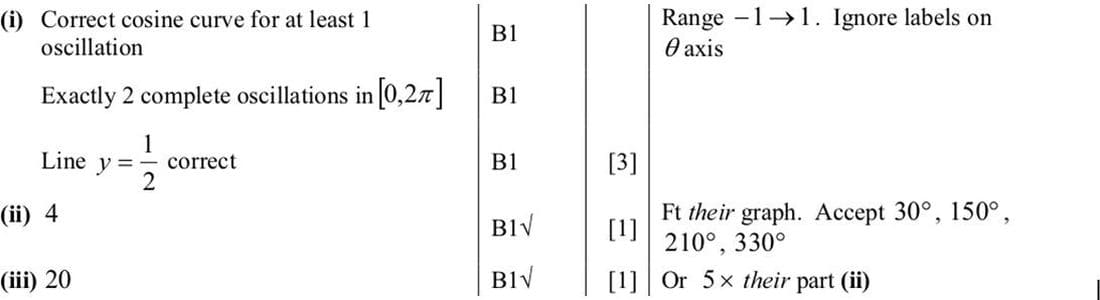
(i) The graph of \(y = \cos 2\theta\) oscillates between -1 and 1 and completes two full oscillations in the interval \([0, 2\pi]\). The line \(y = \frac{1}{2}\) is a horizontal line. The intersections of these two graphs represent the solutions to the equation \(2\cos 2\theta - 1 = 0\).
(ii) The equation \(2\cos 2\theta - 1 = 0\) simplifies to \(\cos 2\theta = \frac{1}{2}\). The solutions for \(2\theta\) are \(60^\circ, 300^\circ\) (or \(\frac{\pi}{3}, \frac{5\pi}{3}\)) within one period \([0, 2\pi]\). Since \(2\theta\) ranges from \(0\) to \(4\pi\), there are 4 solutions: \(\theta = \frac{\pi}{6}, \frac{5\pi}{6}, \frac{7\pi}{6}, \frac{11\pi}{6}\).
(iii) The interval \(10\pi \leq \theta \leq 20\pi\) is 5 times the length of \(0 \leq \theta \leq 2\pi\). Therefore, the number of roots is 5 times the number of roots in the interval \(0 \leq \theta \leq 2\pi\), which is \(5 \times 4 = 20\).