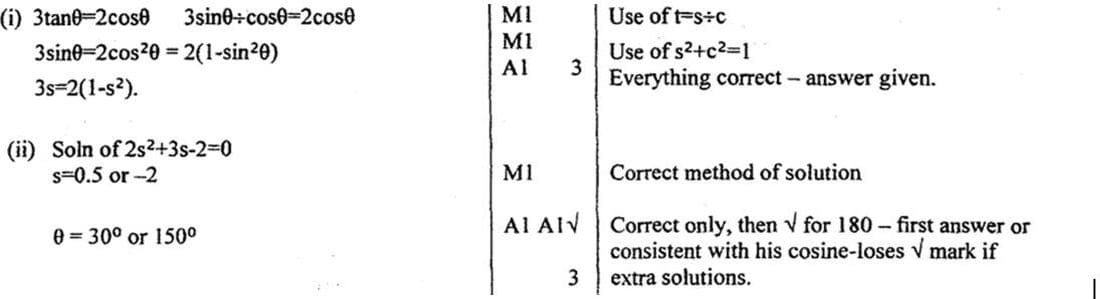
(i) Start with the equation \(3 \tan \theta = 2 \cos \theta\).
Using \(\tan \theta = \frac{\sin \theta}{\cos \theta}\), rewrite as \(3 \frac{\sin \theta}{\cos \theta} = 2 \cos \theta\).
Multiply through by \(\cos \theta\) to get \(3 \sin \theta = 2 \cos^2 \theta\).
Use the identity \(\cos^2 \theta = 1 - \sin^2 \theta\) to substitute: \(3 \sin \theta = 2(1 - \sin^2 \theta)\).
Expand and rearrange: \(3 \sin \theta = 2 - 2 \sin^2 \theta\).
Rearrange to form the quadratic: \(2 \sin^2 \theta + 3 \sin \theta - 2 = 0\).
(ii) Solve the quadratic equation \(2 \sin^2 \theta + 3 \sin \theta - 2 = 0\).
Let \(s = \sin \theta\). The equation becomes \(2s^2 + 3s - 2 = 0\).
Factorize to find \(s = 0.5\) or \(s = -2\).
Since \(-1 \leq \sin \theta \leq 1\), only \(s = 0.5\) is valid.
Thus, \(\sin \theta = 0.5\) gives \(\theta = 30^\circ\) or \(150^\circ\) within the range \(0^\circ \leq \theta \leq 360^\circ\).