9709 P1 - Jun 2008 - Q2 - 5 marks
468
(i) Show that the equation \(2 \tan^2 \theta \cos \theta = 3\) can be written in the form \(2 \cos^2 \theta + 3 \cos \theta - 2 = 0\).
(ii) Hence solve the equation \(2 \tan^2 \theta \cos \theta = 3\), for \(0^\circ \leq \theta \leq 360^\circ\).
Solution
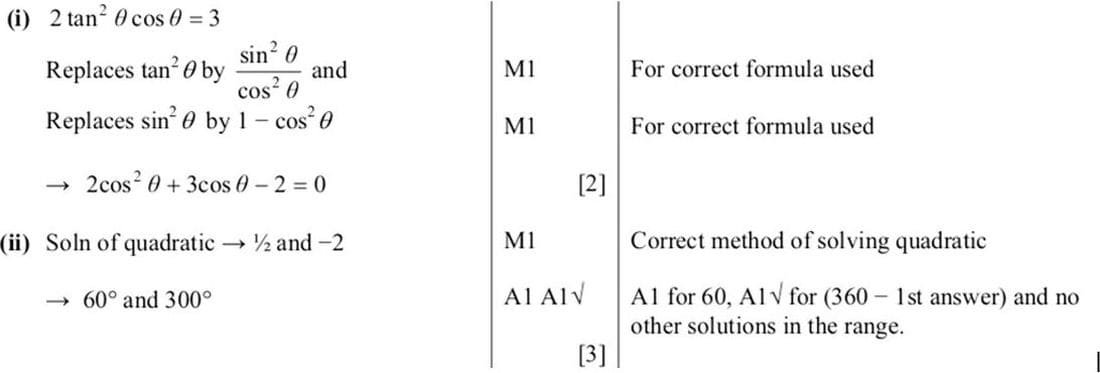
(i) Start with the equation \(2 \tan^2 \theta \cos \theta = 3\).
Replace \(\tan^2 \theta\) with \(\frac{\sin^2 \theta}{\cos^2 \theta}\).
Replace \(\sin^2 \theta\) with \(1 - \cos^2 \theta\).
The equation becomes \(2 \left(\frac{1 - \cos^2 \theta}{\cos^2 \theta}\right) \cos \theta = 3\).
Simplify to get \(2 (1 - \cos^2 \theta) \cos \theta = 3 \cos^2 \theta\).
Rearrange to form \(2 \cos^2 \theta + 3 \cos \theta - 2 = 0\).
(ii) Solve the quadratic equation \(2 \cos^2 \theta + 3 \cos \theta - 2 = 0\).
Factorize to find \(\cos \theta = \frac{1}{2}\) or \(\cos \theta = -2\).
Since \(\cos \theta = -2\) is not possible, solve \(\cos \theta = \frac{1}{2}\).
This gives \(\theta = 60^\circ\) and \(\theta = 300^\circ\) within the range \(0^\circ \leq \theta \leq 360^\circ\).