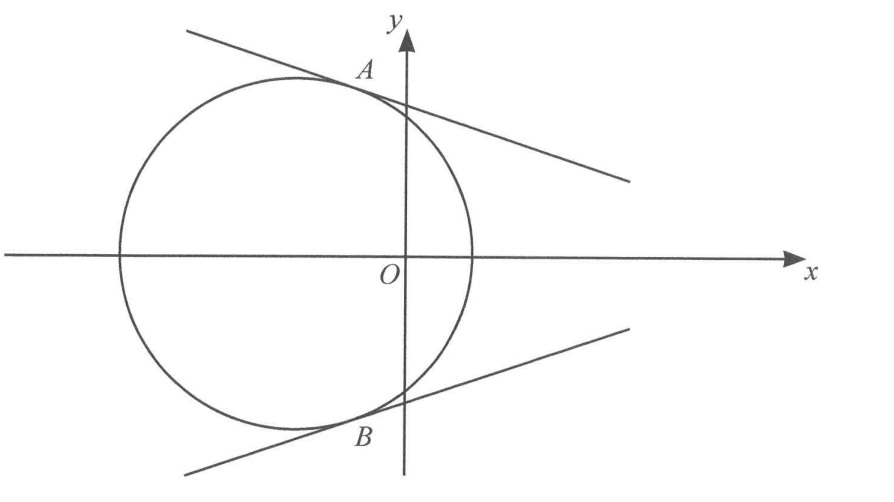
(a) The gradient of the tangent through \( (1,5) \) and \( (4,4) \) is
\( \frac{4-5}{4-1}=-\frac13 \).
Using \( (1,5) \),
\( y-5=-\frac13(x-1) \).
So
\( x+3y=16 \).
The other tangent is
\( x-3y=16 \).
Solve simultaneously:
\( x+3y=16 \),
\( x-3y=16 \).
Adding gives \(2x=32\), so \(x=16\).
Then \(y=0\).
Answer: \( (16,0) \).
(b) The tangent through \(A\) has gradient \(-\frac13\), so the normal through \(A\) has gradient \(3\).
The normal also passes through the centre \( (a,0) \).
Therefore
Answer: \( y=3(x-a) \).
(c) Consider the right-angled triangle formed by the centre of the circle, the point of contact, and the point of intersection of the two tangents.
The tangent has gradient \( -\frac13 \), so the radius to the point of contact is perpendicular to the tangent and has gradient \(3\).
Therefore, for the angle between the radius and the horizontal axis,
\[
\tan\theta=3.
\]
The radius of the circle is \( \sqrt{40} \). Hence the other perpendicular side of the right-angled triangle is
\[
3\sqrt{40}.
\]
By Pythagoras, the hypotenuse is
\[
\sqrt{(\sqrt{40})^2+(3\sqrt{40})^2}
=\sqrt{40+360}
=\sqrt{400}
=20.
\]
This hypotenuse is the distance from the centre \( (a,0) \) to the point of intersection of the tangents \( (16,0) \). Therefore
\[
16-a=20.
\]
So
\[
a=-4.
\]
The centre is \( (-4,0) \), and \(r^2=40\). Therefore the equation of the circle is
\[
(x+4)^2+y^2=40.
\]
(c) Method(Using FM formula) The centre is \( (a,0) \) and the radius is \( \sqrt{40} \).
The distance from the centre \( (a,0) \) to the tangent \(x+3y=16\) is equal to the radius:
\( \frac{|a-16|}{\sqrt{1^2+3^2}}=\sqrt{40} \).
Since \(a<0\), \( |a-16|=16-a \).
So
\( \frac{16-a}{\sqrt{10}}=\sqrt{40} \).
\( 16-a=\sqrt{400}=20 \).
Thus \(a=-4\).
The centre is \( (-4,0) \) and the radius squared is \(40\).
Answer: \( (x+4)^2+y^2=40 \).