(a) Find an equation of the plane OAB, giving your answer in the form \(\mathbf{r} \cdot \mathbf{n} = p\).
The plane \(\Pi\) has equation \(x - 3y - 2z = 1\).
(b) Find the perpendicular distance of \(\Pi\) from the origin.
(c) Find the acute angle between the planes OAB and \(\Pi\).
(d) Find an equation for the common perpendicular to the lines OC and AB.
Solution
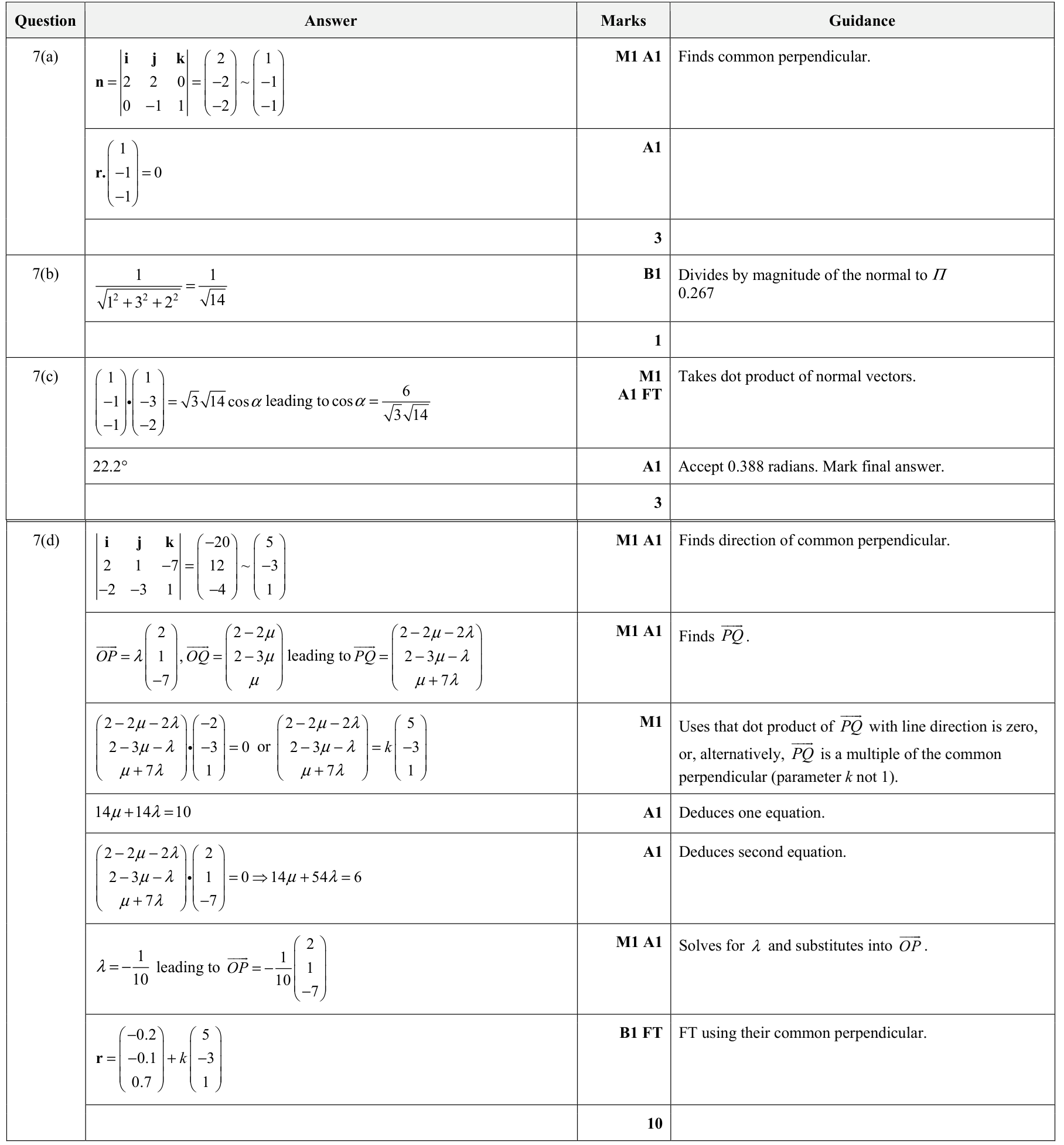
(a) To find the equation of the plane OAB, we need a normal vector. The vectors \(\overrightarrow{OA} = \begin{pmatrix} 2 \\ 2 \\ 0 \end{pmatrix}\) and \(\overrightarrow{OB} = \begin{pmatrix} 0 \\ -1 \\ 1 \end{pmatrix}\) are in the plane. The cross product \(\overrightarrow{OA} \times \overrightarrow{OB}\) gives the normal vector \(\mathbf{n} = \begin{pmatrix} 1 \\ -1 \\ -1 \end{pmatrix}\). The equation of the plane is \(\mathbf{r} \cdot \mathbf{n} = 0\).
(b) The perpendicular distance from the origin to the plane \(\Pi\) is given by \(\frac{|1|}{\sqrt{1^2 + (-3)^2 + (-2)^2}} = \frac{1}{\sqrt{14}}\).
(c) The angle between the planes is found using the dot product of their normals. The normal to OAB is \(\begin{pmatrix} 1 \\ -1 \\ -1 \end{pmatrix}\) and for \(\Pi\) is \(\begin{pmatrix} 1 \\ -3 \\ -2 \end{pmatrix}\). The cosine of the angle \(\alpha\) is \(\cos \alpha = \frac{\begin{pmatrix} 1 \\ -1 \\ -1 \end{pmatrix} \cdot \begin{pmatrix} 1 \\ -3 \\ -2 \end{pmatrix}}{\sqrt{3} \sqrt{14}} = \frac{6}{\sqrt{42}}\). The angle is \(22.2^\circ\).
(d) To find the common perpendicular, we first find the direction vector by solving the system of equations derived from the dot product conditions. The direction vector is \(\begin{pmatrix} 5 \\ -3 \\ 1 \end{pmatrix}\). The position vector is \(\begin{pmatrix} -0.1 \\ 0.7 \\ 0.3 \end{pmatrix}\). Thus, the equation is \(\mathbf{r} = \begin{pmatrix} -0.1 \\ 0.7 \\ 0.3 \end{pmatrix} + \lambda \begin{pmatrix} 5 \\ -3 \\ 1 \end{pmatrix}\).