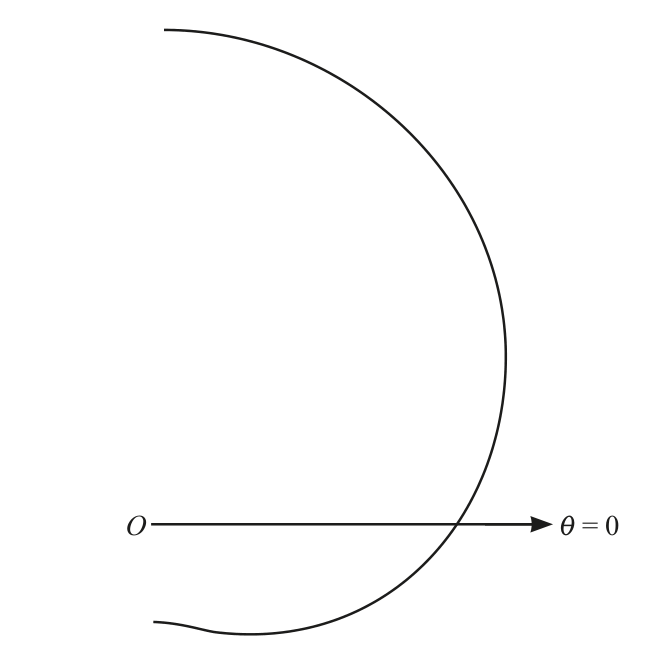
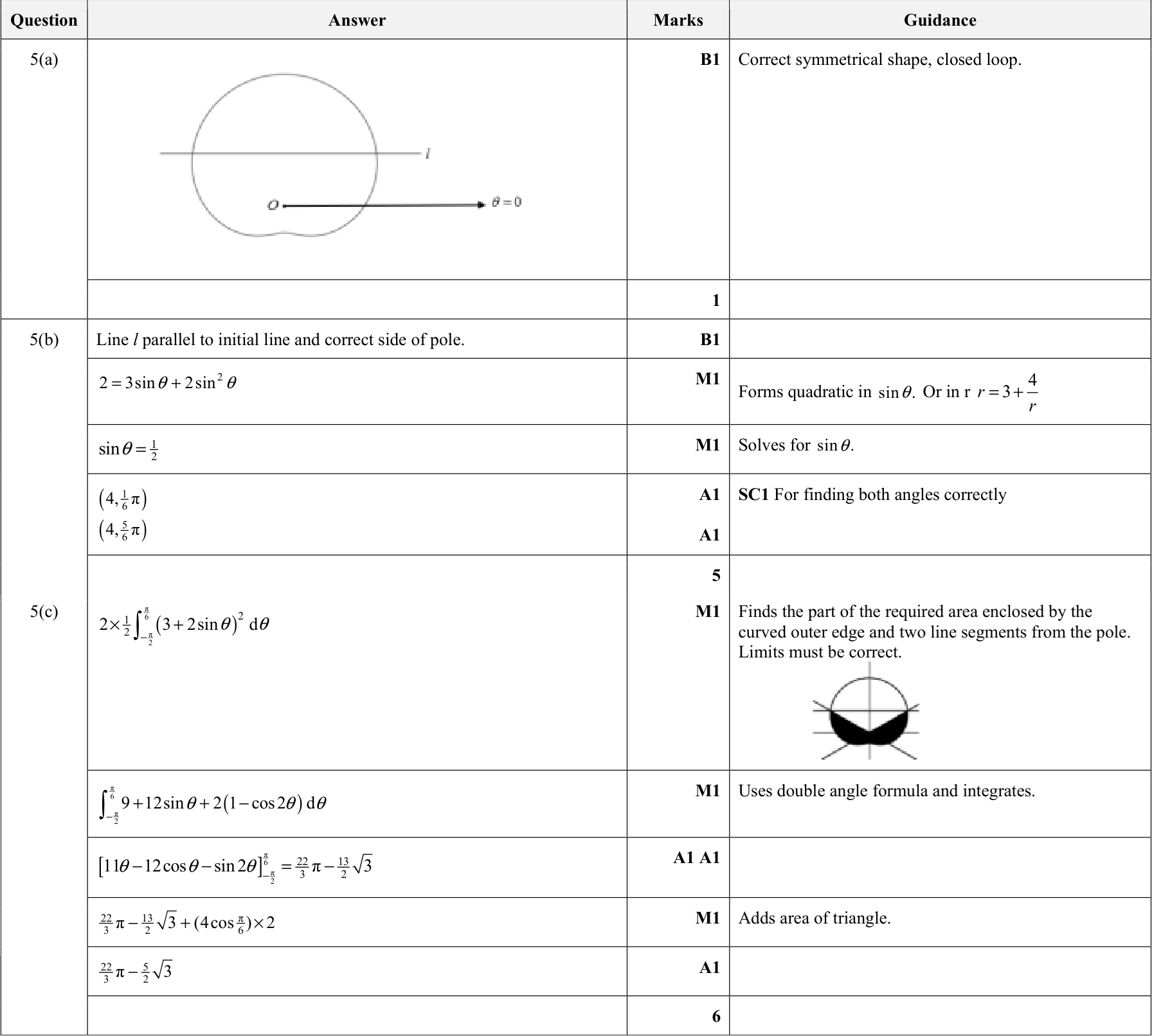
(a) The curve \(C\) has polar equation \(r = 3 + 2\sin\theta\) for \(-\pi < \theta \le \pi\).
It is a limacon, symmetric about the line \(\theta = \frac{\pi}{2}\); the completed sketch shows a single loop above the pole.
(b) The line \(l\) has polar equation
\[
r\sin\theta = 2 \quad\Rightarrow\quad r = 2\csc\theta \quad (\sin\theta \ne 0).
\]
Points of intersection satisfy
\[
3 + 2\sin\theta \;=\; 2\csc\theta.
\]
Multiplying by \(\sin\theta\),
\[
3\sin\theta + 2\sin^2\theta = 2.
\]
Let \(\sin\theta = s\). Then
\[
2s^2 + 3s - 2 = 0
\quad\Rightarrow\quad
s = \frac{-3 \pm 5}{4} \;\Rightarrow\; s = \frac12 \text{ or } s = -2.
\]
\(\sin\theta = -2\) is impossible, so \(\sin\theta = \frac12\), giving
\[
\theta = \frac{\pi}{6},\; \frac{5\pi}{6}.
\]
At these points,
\[
r = 3 + 2\sin\theta = 3 + 2\cdot\frac12 = 4.
\]
So the points of intersection are
\[
\left(4,\; \frac{\pi}{6}\right),\quad
\left(4,\; \frac{5\pi}{6}\right).
\]
(c) The region \(R\) is enclosed by \(C\) and the line \(l\), and contains the pole.
For a given \(\theta\), the boundary closest to the pole is:
- \(r = 3 + 2\sin\theta\) for \(-\pi < \theta \le \frac{\pi}{6}\) and \(\frac{5\pi}{6} \le \theta \le \pi\) (the curve is nearer than the line),
- \(r = 2\csc\theta\) for \(\frac{\pi}{6} \le \theta \le \frac{5\pi}{6}\) (the line is nearer than the curve).
Hence the area of \(R\) is
\[
\text{Area}(R)
=
\frac12 \int_{-\pi}^{\pi/6} (3 + 2\sin\theta)^2\,d\theta
+ \frac12 \int_{\pi/6}^{5\pi/6} (2\csc\theta)^2\,d\theta
+ \frac12 \int_{5\pi/6}^{\pi} (3 + 2\sin\theta)^2\,d\theta.
\]
It is convenient to rewrite this as
\[
\text{Area}(R)
=
\frac12 \int_{-\pi}^{\pi} (3 + 2\sin\theta)^2\,d\theta
\;-\;
\frac12 \int_{\pi/6}^{5\pi/6} \Bigl[(3 + 2\sin\theta)^2 - (2\csc\theta)^2\Bigr]\,d\theta.
\]
First,
\[
\int_{-\pi}^{\pi} (3 + 2\sin\theta)^2\,d\theta
= \int_{-\pi}^{\pi} \bigl(9 + 12\sin\theta + 4\sin^2\theta\bigr)\,d\theta
= 22\pi.
\]
Next,
\[
(3 + 2\sin\theta)^2 - (2\csc\theta)^2
= 9 + 12\sin\theta + 4\sin^2\theta - \frac{4}{\sin^2\theta},
\]
so
\[
\int_{\pi/6}^{5\pi/6} \Bigl[(3 + 2\sin\theta)^2 - (2\csc\theta)^2\Bigr]\,d\theta
= 5\sqrt{3} + \frac{22\pi}{3}.
\]
Therefore,
\[
\text{Area}(R)
= \frac12\left(22\pi - \left(5\sqrt{3} + \frac{22\pi}{3}\right)\right)
= \frac12\left(\frac{44\pi}{3} - 5\sqrt{3}\right)
= \frac{22}{3}\pi - \frac{5}{2}\sqrt{3}.
\]
So the exact area of \(R\) is
\[
\boxed{\displaystyle \frac{22}{3}\pi - \frac{5}{2}\sqrt{3}}.
\]