Browsing as Guest. Progress, bookmarks and attempts are disabled.
Log in to track your work.
9231 P11 - Nov 2021 - Q04 - 11 marks
4277
The matrix M is given by \(\mathbf{M} = \begin{pmatrix} \cos \theta & -\sin \theta \\ \sin \theta & \cos \theta \end{pmatrix} \begin{pmatrix} 3 & 0 \\ 0 & 1 \end{pmatrix}\).
(a) The matrix M represents a sequence of two geometrical transformations. State the type of each transformation, and make clear the order in which they are applied. [2]
(b) Find the values of \(\theta\), for \(0 \leq \theta \leq \pi\), for which the transformation represented by M has exactly one invariant line through the origin, giving your answers in terms of \(\pi\). [9]
Solution
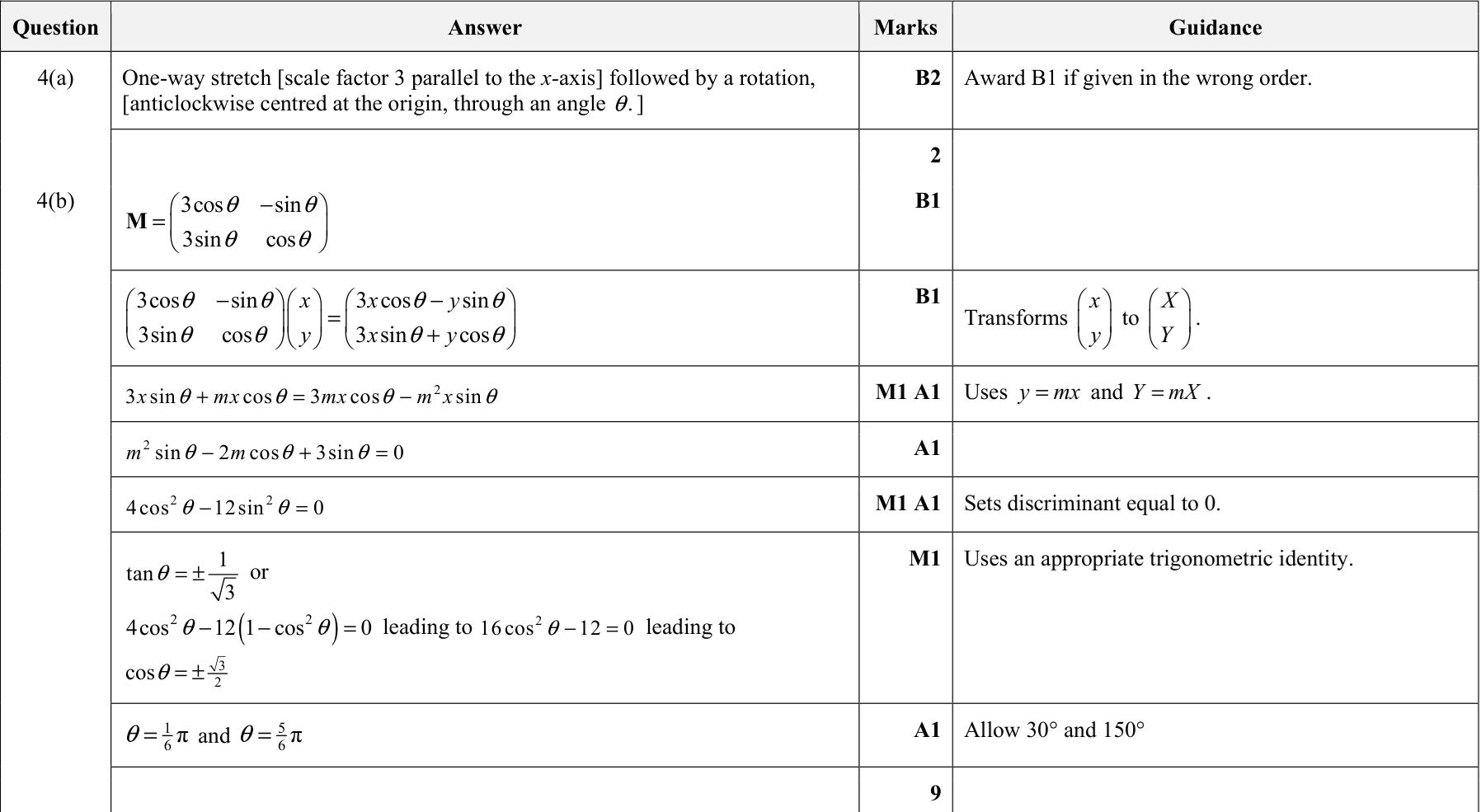
(a) The matrix \(\mathbf{M}\) can be decomposed into two transformations: a one-way stretch with scale factor 3 parallel to the x-axis, followed by a rotation anticlockwise about the origin through an angle \(\theta\).
(b) The matrix \(\mathbf{M} = \begin{pmatrix} 3\cos \theta & -\sin \theta \\ 3\sin \theta & \cos \theta \end{pmatrix}\) transforms \(\begin{pmatrix} x \\ y \end{pmatrix}\) to \(\begin{pmatrix} 3x\cos \theta - y\sin \theta \\ 3x\sin \theta + y\cos \theta \end{pmatrix}\).
For an invariant line through the origin, \(y = mx\) transforms to \(Y = mX\), leading to the equation: