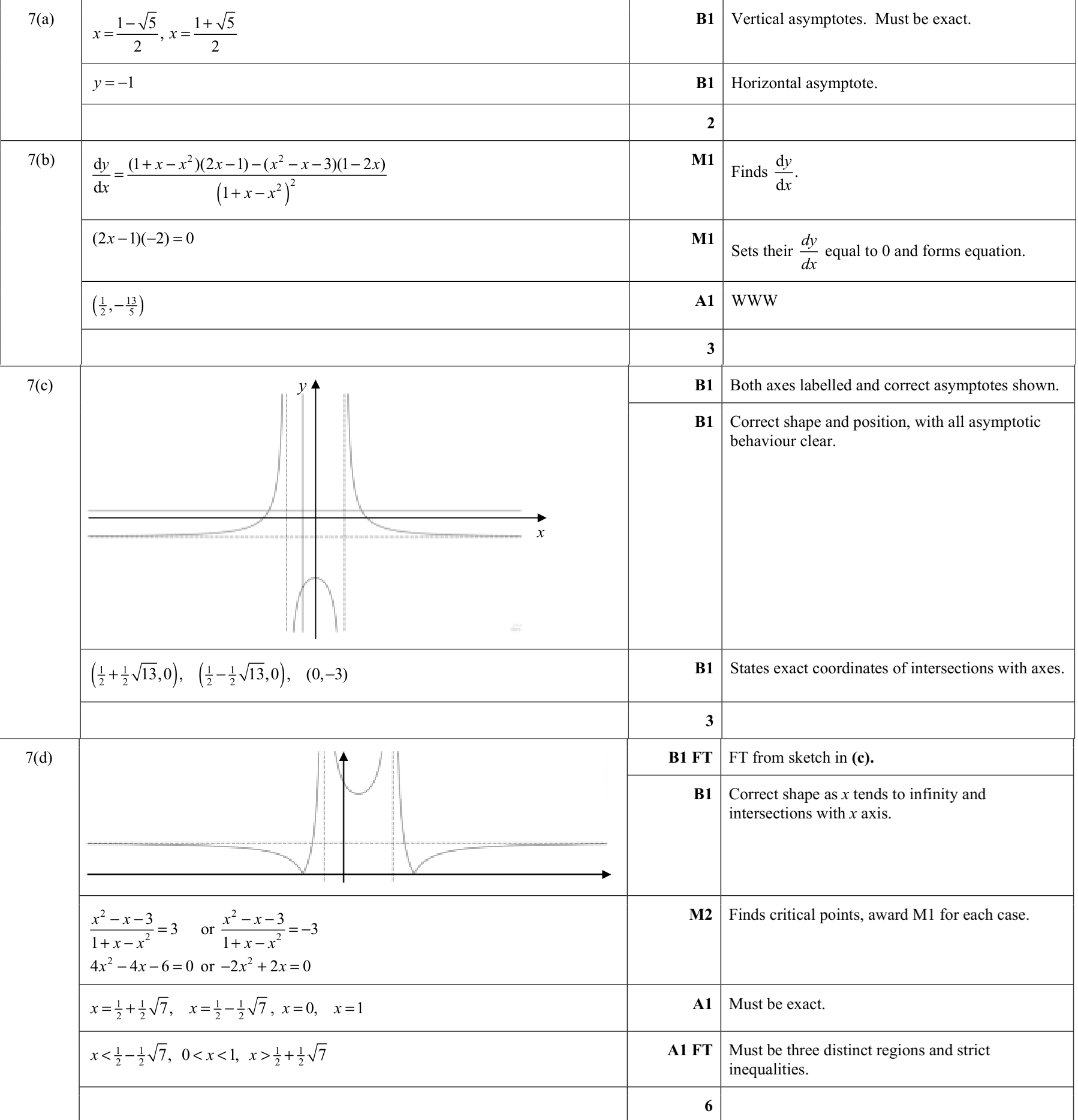
(a) The vertical asymptotes occur where the denominator is zero: \(1 + x - x^2 = 0\). Solving \(x^2 - x - 1 = 0\) gives \(x = \frac{1 \pm \sqrt{5}}{2}\). The horizontal asymptote is found by considering the limits as \(x \to \pm \infty\), giving \(y = -1\).
(b) To find stationary points, set \(\frac{dy}{dx} = 0\). Using the quotient rule, \(\frac{dy}{dx} = \frac{(1 + x - x^2)(2x - 1) - (x^2 - x - 3)(1 - 2x)}{(1 + x - x^2)^2}\). Simplifying gives \((2x - 1)(x - 2) = 0\), so \(x = \frac{1}{2}\). Substituting back, \(y = -\frac{13}{9}\), giving the point \(\left( \frac{1}{2}, -\frac{13}{9} \right)\).
(c) The intersections with the axes are found by setting \(y = 0\) and \(x = 0\). Solving \(x^2 - x - 3 = 0\) gives \(x = \frac{1}{2} \pm \frac{1}{2}\sqrt{13}\). For \(x = 0\), \(y = -3\). Thus, intersections are \(\left( \frac{1}{2} + \frac{1}{2}\sqrt{13}, 0 \right), \left( \frac{1}{2} - \frac{1}{2}\sqrt{13}, 0 \right), (0, -3)\).
(d) For \(\left| \frac{x^2 - x - 3}{1 + x - x^2} \right| < 3\), solve \(\frac{x^2 - x - 3}{1 + x - x^2} < 3\) and \(\frac{x^2 - x - 3}{1 + x - x^2} > -3\). Solving gives critical points \(x = \frac{1}{2} \pm \frac{1}{2}\sqrt{7}, x = 0, x = 1\). The solution is \(x < \frac{1}{2} - \frac{1}{2}\sqrt{7}, \; 0 < x < 1, \; x > \frac{1}{2} + \frac{1}{2}\sqrt{7}\).