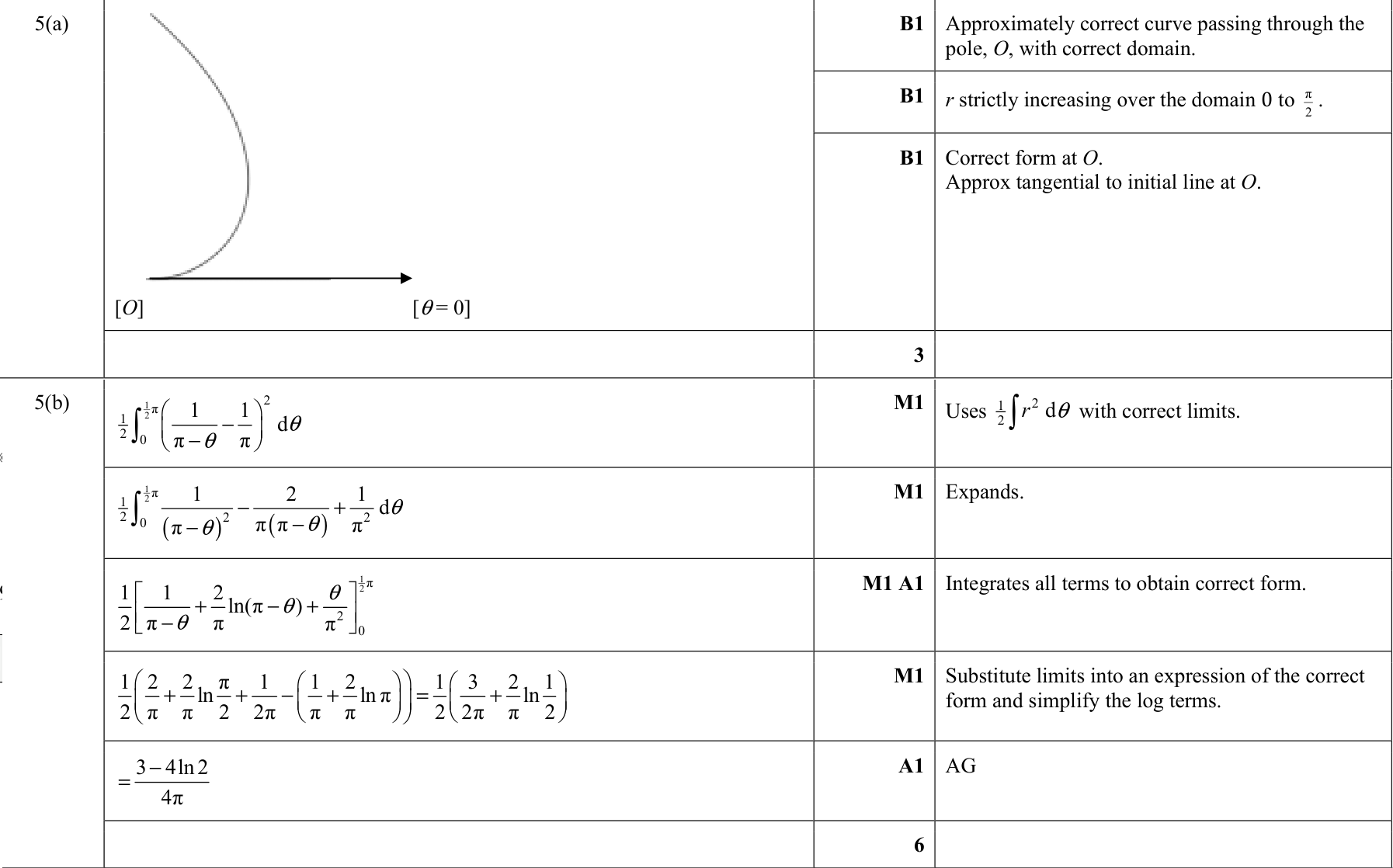
(a) The curve is approximately correct, passing through the pole, \(O\), with the correct domain. The curve \(r\) is strictly increasing over the domain \(0\) to \(\frac{\pi}{2}\). It has the correct form at \(O\) and is approximately tangential to the initial line at \(O\).
(b) To find the area, use the formula:
\(\frac{1}{2} \int_0^{\frac{1}{2}\pi} \left( \frac{1}{\pi - \theta} - \frac{1}{\pi} \right)^2 \, d\theta\)
Expanding the integrand:
\(\frac{1}{2} \int_0^{\frac{1}{2}\pi} \left( \frac{1}{(\pi - \theta)^2} - \frac{2}{\pi(\pi - \theta)} + \frac{1}{\pi^2} \right) \, d\theta\)
Integrating each term separately:
\(\frac{1}{2} \left[ \frac{1}{\pi - \theta} + \frac{2}{\pi} \ln(\pi - \theta) + \frac{\theta}{\pi^2} \right]_0^{\frac{1}{2}\pi}\)
Substituting the limits:
\(\frac{1}{2} \left( \frac{2}{\pi} - \frac{\pi}{2} + \frac{2}{\pi} \ln \frac{\pi}{2} + \frac{1}{2\pi} \right) = \frac{1}{2} \left( \frac{3}{2\pi} + \frac{2}{\pi} \ln \frac{1}{2} \right)\)
Simplifying the logarithmic terms:
\(= \frac{3 - 4 \ln 2}{4\pi}\)