Browsing as Guest. Progress, bookmarks and attempts are disabled.
Log in to track your work.
9231 P12 - Nov 2022 - Q06 - 15 marks
4258
The lines \(l_1\) and \(l_2\) have equations \(\mathbf{r} = 2\mathbf{i} + \mathbf{k} + \lambda(\mathbf{i} - \mathbf{j} + 2\mathbf{k})\) and \(\mathbf{r} = 2\mathbf{j} + 6\mathbf{k} + \mu(\mathbf{i} + 2\mathbf{j} - 2\mathbf{k})\) respectively.
The point \(P\) on \(l_1\) and the point \(Q\) on \(l_2\) are such that \(PQ\) is perpendicular to both \(l_1\) and \(l_2\).
(a) Find the length \(PQ\). [5]
The plane \(\Pi_1\) contains \(PQ\) and \(l_1\).
The plane \(\Pi_2\) contains \(PQ\) and \(l_2\).
(b) (i) Write down an equation of \(\Pi_1\), giving your answer in the form \(\mathbf{r} = \mathbf{a} + s\mathbf{b} + t\mathbf{c}\). [1]
(ii) Find an equation of \(\Pi_2\), giving your answer in the form \(ax + by + cz = d\). [4]
(c) Find the acute angle between \(\Pi_1\) and \(\Pi_2\). [5]
Solution
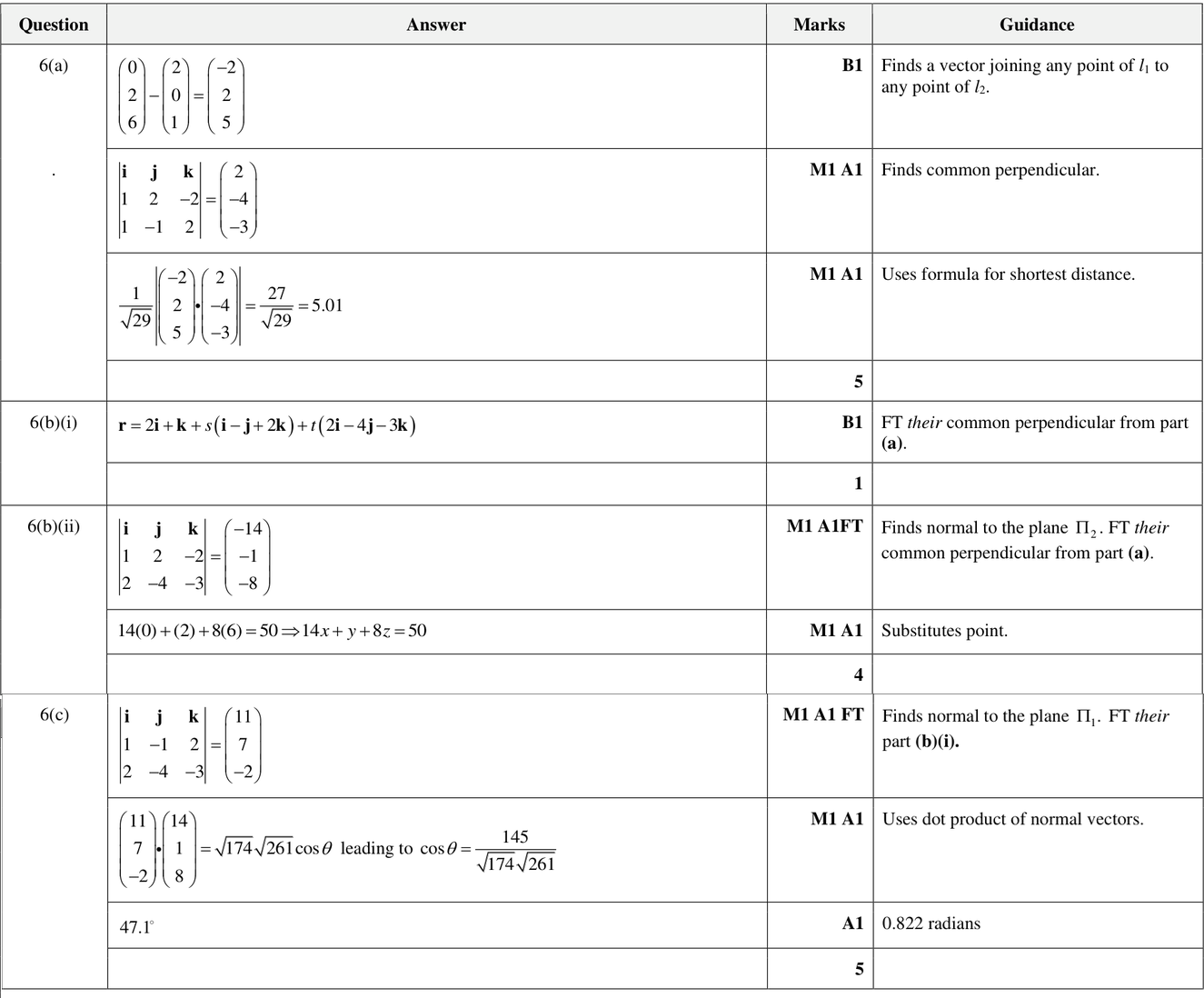
(a) To find the length \(PQ\), we first find a vector joining any point on \(l_1\) to any point on \(l_2\). The vector is \(\begin{pmatrix} 0 \\ 2 \\ 6 \end{pmatrix} - \begin{pmatrix} 2 \\ 0 \\ 1 \end{pmatrix} = \begin{pmatrix} -2 \\ 2 \\ 5 \end{pmatrix}\).
Next, find the common perpendicular using the cross product: \(\begin{vmatrix} \mathbf{i} & \mathbf{j} & \mathbf{k} \\ 1 & -1 & 2 \\ 1 & 2 & -2 \end{vmatrix} = \begin{pmatrix} 2 \\ -4 \\ -3 \end{pmatrix}\).
The length \(PQ\) is given by \(\frac{1}{\sqrt{29}} \begin{pmatrix} -2 \\ 2 \\ 5 \end{pmatrix} \cdot \begin{pmatrix} 2 \\ -4 \\ -3 \end{pmatrix} = \frac{27}{\sqrt{29}} = 5.01\).
(b)(i) The equation of \(\Pi_1\) is \(\mathbf{r} = 2\mathbf{i} + \mathbf{k} + s(\mathbf{i} - \mathbf{j} + 2\mathbf{k}) + t(2\mathbf{i} - 4\mathbf{j} - 3\mathbf{k})\).
(b)(ii) The normal to \(\Pi_2\) is found using the cross product: \(\begin{vmatrix} \mathbf{i} & \mathbf{j} & \mathbf{k} \\ 1 & 2 & -2 \\ 2 & -4 & -3 \end{vmatrix} = \begin{pmatrix} -14 \\ -1 \\ -8 \end{pmatrix}\).
Substitute a point to find the equation: \(14(0) + (2) + 8(6) = 50 \Rightarrow 14x + y + 8z = 50\).
(c) The normals to \(\Pi_1\) and \(\Pi_2\) are \(\begin{pmatrix} 11 \\ 7 \\ -2 \end{pmatrix}\) and \(\begin{pmatrix} 14 \\ 1 \\ 8 \end{pmatrix}\) respectively.
Use the dot product to find the angle: \(\cos \theta = \frac{145}{\sqrt{174} \sqrt{261}}\).