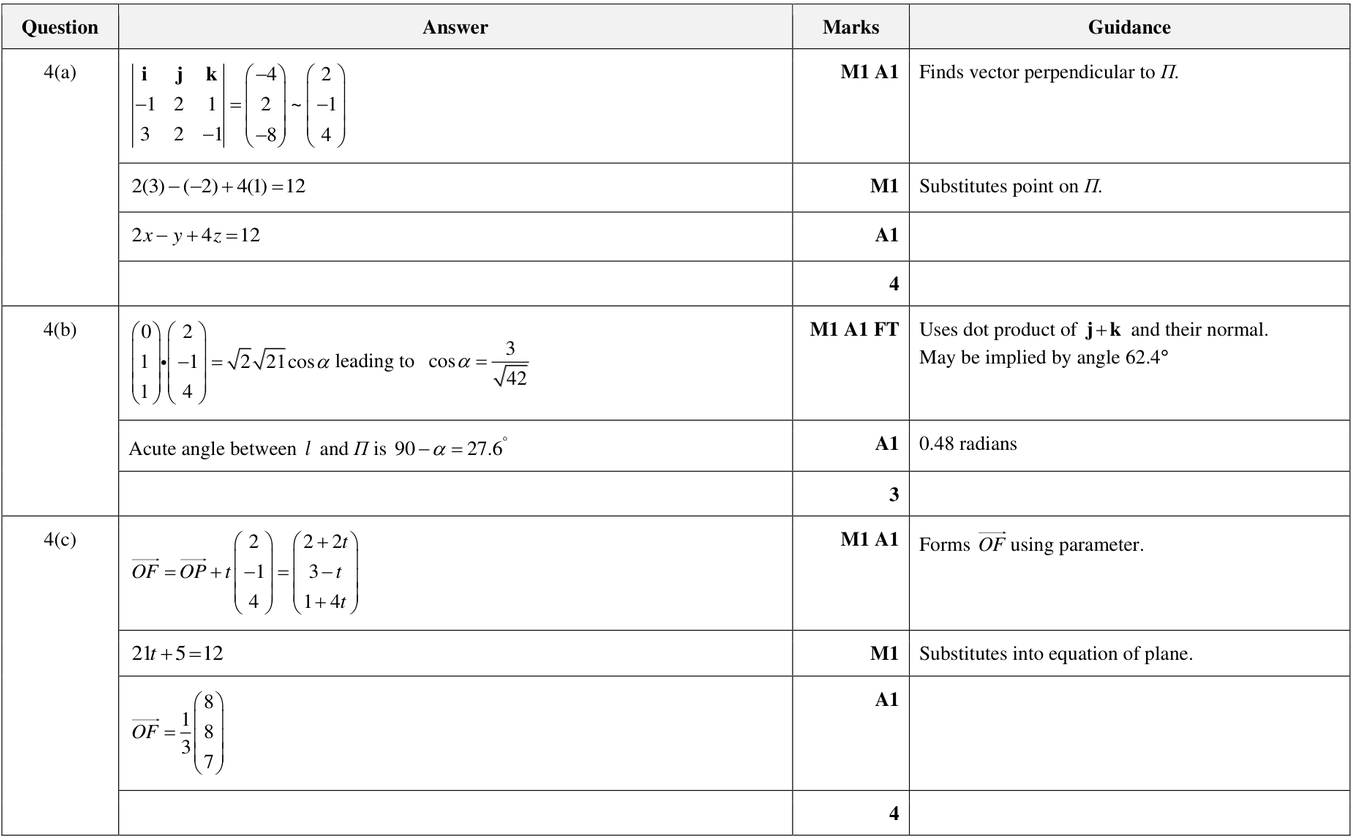
(a) To find the Cartesian equation of the plane \(\Pi\), we first find a normal vector to the plane by taking the cross product of the direction vectors of the lines:
Direction vectors: \(\begin{pmatrix} -1 \\ 2 \\ 1 \end{pmatrix}\) and \(\begin{pmatrix} 3 \\ 2 \\ -1 \end{pmatrix}\).
Cross product: \(\begin{vmatrix} \mathbf{i} & \mathbf{j} & \mathbf{k} \\ -1 & 2 & 1 \\ 3 & 2 & -1 \end{vmatrix} = \begin{pmatrix} -4 \\ 2 \\ -8 \end{pmatrix}\).
Normal vector: \(\begin{pmatrix} 2 \\ -1 \\ 4 \end{pmatrix}\).
Using point \((3, -2, 1)\) on the plane, substitute into \(2x - y + 4z = d\):
\(2(3) - (-2) + 4(1) = 12\).
Thus, the equation is \(2x - y + 4z = 12\).
(b) The line \(l\) is parallel to \(\begin{pmatrix} 0 \\ 1 \\ 1 \end{pmatrix}\). The normal to the plane is \(\begin{pmatrix} 2 \\ -1 \\ 4 \end{pmatrix}\).
Dot product: \(\begin{pmatrix} 0 \\ 1 \\ 1 \end{pmatrix} \cdot \begin{pmatrix} 2 \\ -1 \\ 4 \end{pmatrix} = \sqrt{2} \sqrt{21} \cos \alpha\).
\(\cos \alpha = \frac{3}{\sqrt{42}}\).
Acute angle: \(90^\circ - \alpha = 27.6^\circ\).
(c) The position vector of the foot of the perpendicular \(\overrightarrow{OF}\) is given by:
\(\overrightarrow{OF} = \overrightarrow{OP} + t \begin{pmatrix} 2 \\ -1 \\ 4 \end{pmatrix} = \begin{pmatrix} 2 + 2t \\ 3 - t \\ 1 + 4t \end{pmatrix}\).
Substitute into the plane equation: \(2(2 + 2t) - (3 - t) + 4(1 + 4t) = 12\).
Solve for \(t\): \(2t + 5 = 12\), \(t = \frac{7}{2}\).
\(\overrightarrow{OF} = \frac{1}{3} \begin{pmatrix} 8 \\ 8 \\ 7 \end{pmatrix}\).