Let \(\mathbf{B} = \begin{pmatrix} b & b \\ a^{-1} & a^{-1} \end{pmatrix}\), where \(b\) is a positive constant.
(c) Find the equations of the invariant lines, through the origin, of the transformation in the \(x-y\) plane represented by \(\mathbf{A}^n \mathbf{B}\). [6]
Solution
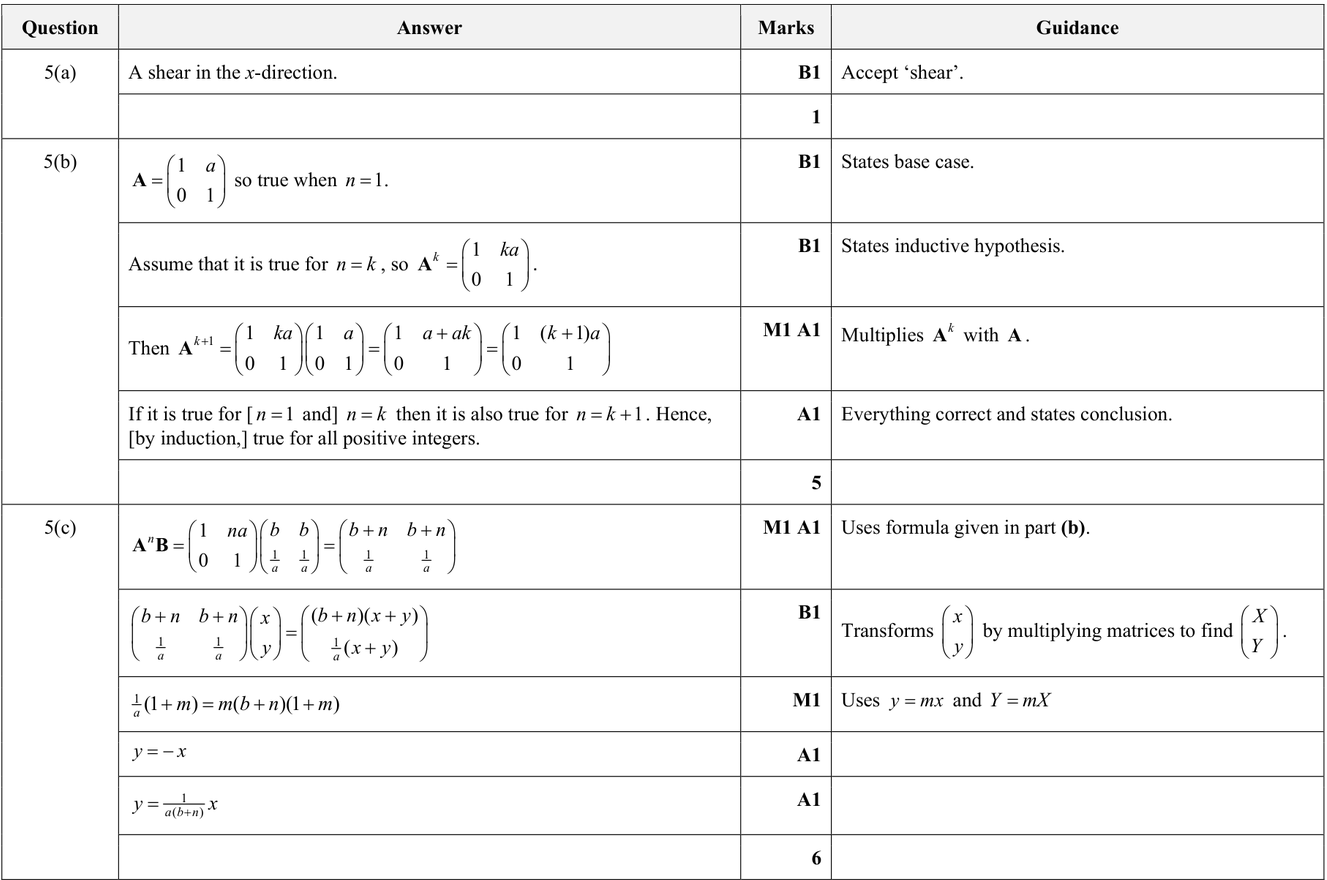
(a) The matrix \(\mathbf{A} = \begin{pmatrix} 1 & a \\ 0 & 1 \end{pmatrix}\) represents a shear in the \(x\)-direction.
(b) Base case: For \(n = 1\), \(\mathbf{A}^1 = \begin{pmatrix} 1 & a \\ 0 & 1 \end{pmatrix}\), which is true.
Inductive step: Assume true for \(n = k\), so \(\mathbf{A}^k = \begin{pmatrix} 1 & ka \\ 0 & 1 \end{pmatrix}\).
Then \(\mathbf{A}^{k+1} = \mathbf{A}^k \mathbf{A} = \begin{pmatrix} 1 & ka \\ 0 & 1 \end{pmatrix} \begin{pmatrix} 1 & a \\ 0 & 1 \end{pmatrix} = \begin{pmatrix} 1 & a + ak \\ 0 & 1 \end{pmatrix} = \begin{pmatrix} 1 & (k+1)a \\ 0 & 1 \end{pmatrix}\).
Thus, by induction, \(\mathbf{A}^n = \begin{pmatrix} 1 & na \\ 0 & 1 \end{pmatrix}\) for all positive integers \(n\).