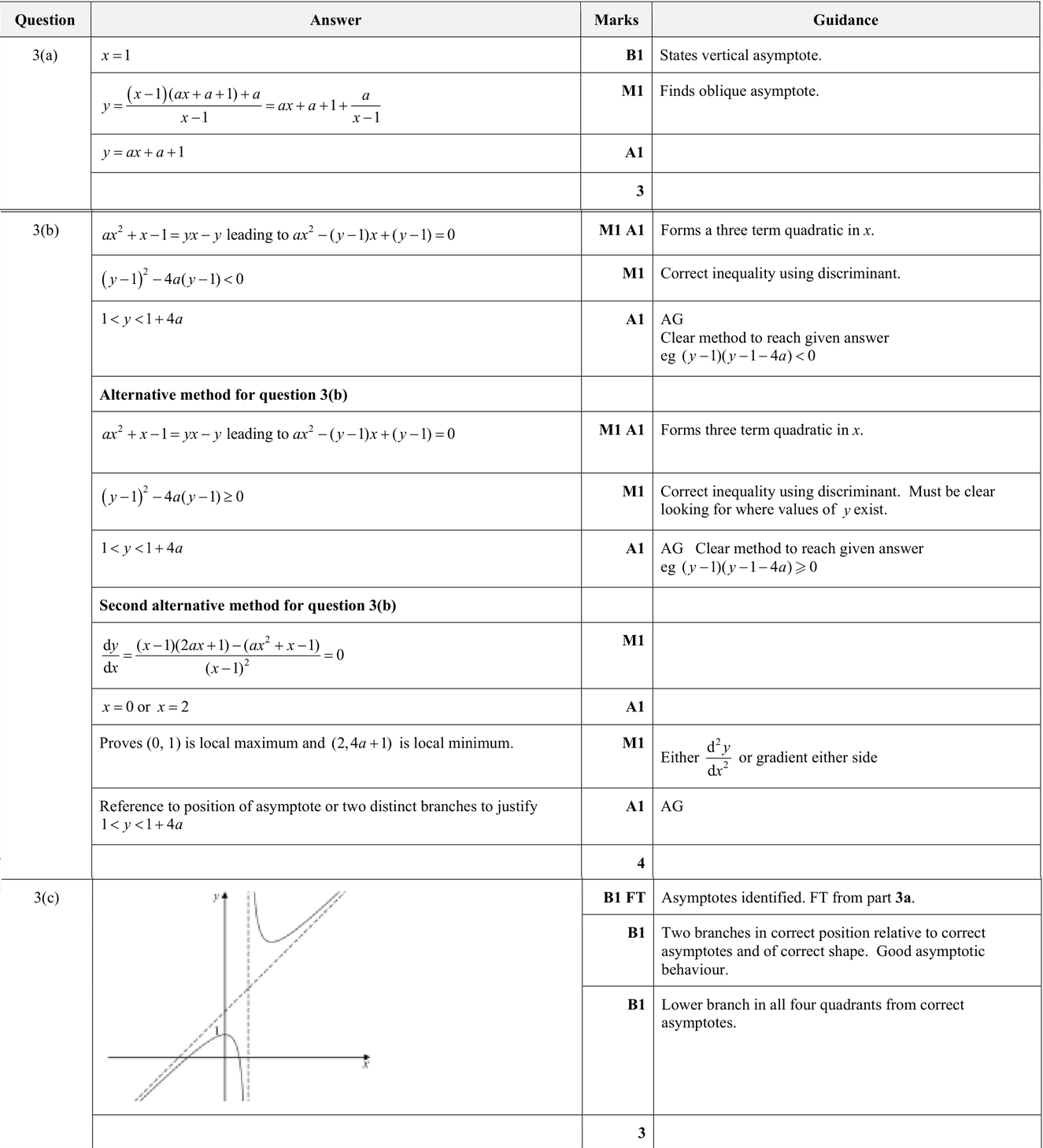
(a) The vertical asymptote occurs where the denominator is zero, so \(x = 1\).
For the oblique asymptote, perform polynomial long division on \(\frac{ax^2 + x - 1}{x - 1}\):
\(y = (x - 1)(ax + a + 1) + a\) gives \(y = ax + a + 1 + \frac{a}{x - 1}\).
Thus, the oblique asymptote is \(y = ax + a + 1\).
(b) Rewrite the equation as \(ax^2 + x - 1 = y(x - 1)\), leading to \(ax^2 + x - 1 = yx - y\).
This simplifies to \(ax^2 - (y - 1)x + (y - 1) = 0\).
The discriminant \((y - 1)^2 - 4a(y - 1)\) must be less than zero for no real roots, giving \(1 < y < 1 + 4a\).
Thus, there is no point on \(C\) for which \(1 < y < 1 + 4a\).
(c) The sketch shows the curve with the vertical asymptote at \(x = 1\) and the oblique asymptote \(y = ax + a + 1\). The curve has two branches, one in each of the regions determined by the asymptotes.