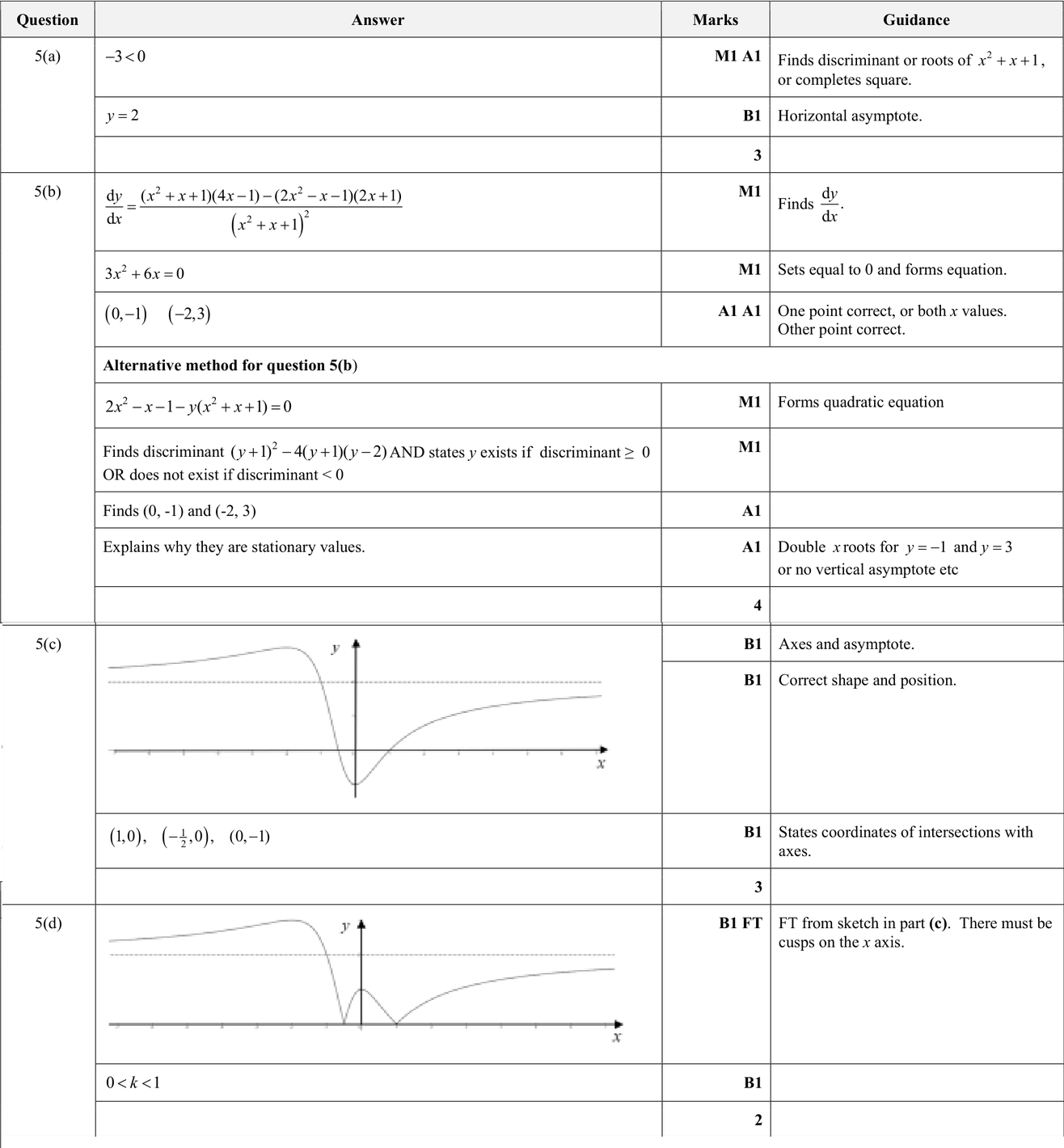
(a) To find vertical asymptotes, set the denominator equal to zero: \(x^2 + x + 1 = 0\). The discriminant is \(b^2 - 4ac = 1^2 - 4 \times 1 \times 1 = -3\), which is less than zero, so no real roots exist. Therefore, there are no vertical asymptotes. The horizontal asymptote is found by considering the degrees of the polynomials. As \(x \to \infty\), \(y \to \frac{2x^2}{x^2} = 2\). Thus, the horizontal asymptote is \(y = 2\).
(b) To find stationary points, differentiate \(y\) with respect to \(x\):
\(\frac{dy}{dx} = \frac{(x^2 + x + 1)(4x - 1) - (2x^2 - x - 1)(2x + 1)}{(x^2 + x + 1)^2}\).
Set \(\frac{dy}{dx} = 0\) to find critical points:
\(3x^2 + 6x = 0\).
Solving gives \(x = 0\) or \(x = -2\). Substituting back into the original equation gives points \((0, -1)\) and \((-2, 3)\).
(c) The curve intersects the x-axis where \(y = 0\):
\(2x^2 - x - 1 = 0\).
Solving gives \(x = 1\) and \(x = -\frac{1}{2}\). The curve intersects the y-axis where \(x = 0\), giving \((0, -1)\).
(d) For \(\left| \frac{2x^2 - x - 1}{x^2 + x + 1} \right| = k\) to have 4 distinct real solutions, the graph must intersect the line \(y = k\) at 4 points. This occurs when \(0 < k < 1\).