Browsing as Guest. Progress, bookmarks and attempts are disabled.
Log in to track your work.
FM June 2023 p12 q06
4211
The curve \(C\) has equation \(y = \frac{x^2 + 2x - 15}{x - 2}\).
Find the equations of the asymptotes of \(C\).
Show that \(C\) has no stationary points.
Sketch \(C\), stating the coordinates of the intersections with the axes.
Sketch the curve with equation \(y = \left| \frac{x^2 - 2x - 15}{x - 2} \right|\).
Find the set of values of \(x\) for which \(\left| \frac{2x^2 + 4x - 30}{x - 2} \right| < 15\).
Solution
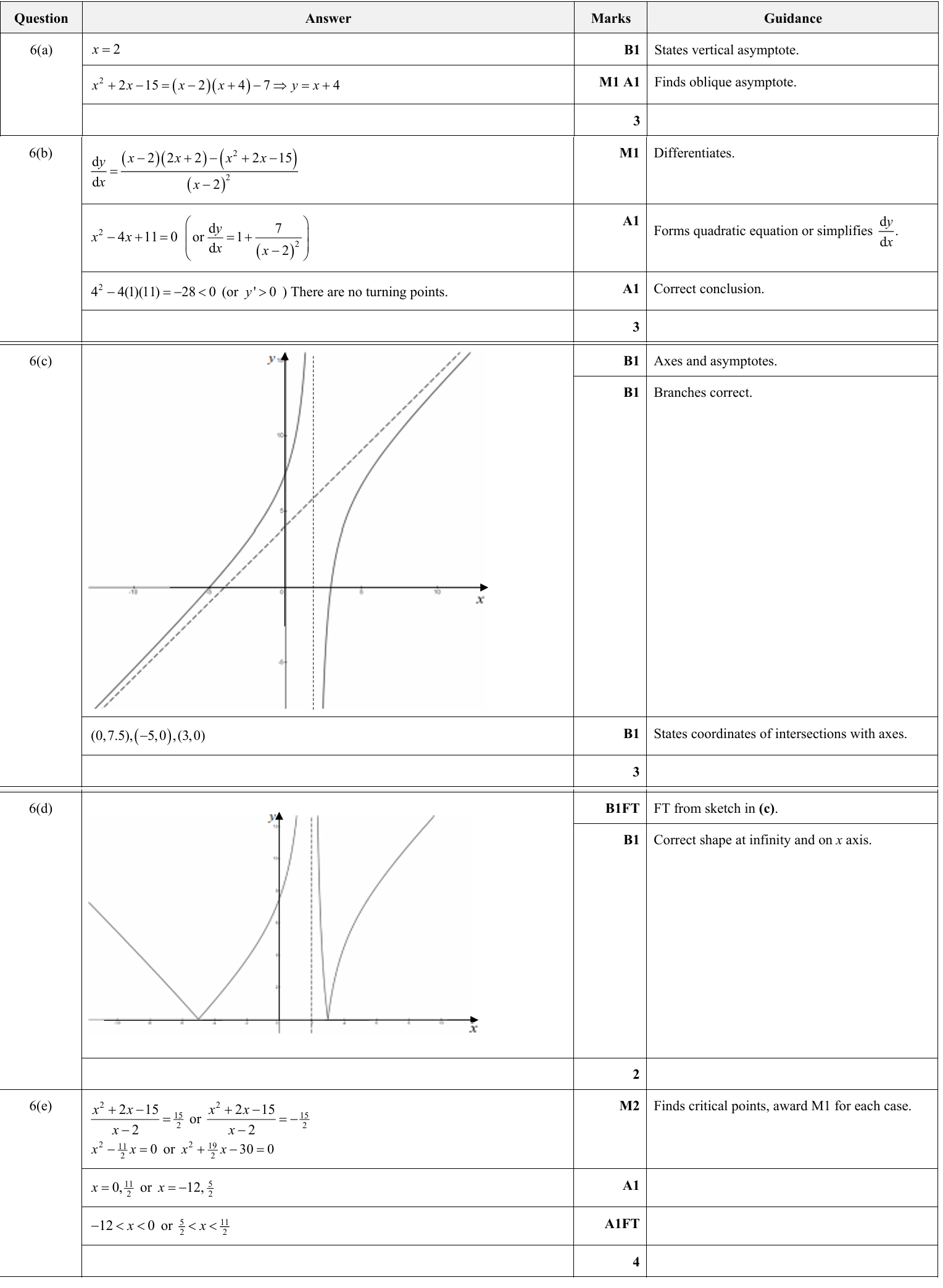
(a) The vertical asymptote occurs where the denominator is zero: \(x = 2\). For the oblique asymptote, divide the numerator by the denominator: \(x^2 + 2x - 15 = (x - 2)(x + 4) - 7\), giving \(y = x + 4\).
(b) Differentiate \(y\) to find stationary points: \(\frac{dy}{dx} = \frac{(x - 2)(2x + 2) - (x^2 + 2x - 15)}{(x - 2)^2} = \frac{x^2 - 4x + 11}{(x - 2)^2}\). The quadratic \(x^2 - 4x + 11 = 0\) has no real roots (discriminant \(4^2 - 4 \times 1 \times 11 = -28 < 0\)), so no stationary points.
(c) The curve intersects the y-axis at \(x = 0\): \(y = \frac{0^2 + 2 \times 0 - 15}{0 - 2} = 7.5\). Intersects the x-axis where \(y = 0\): \(x^2 + 2x - 15 = 0\), giving roots \(x = -5\) and \(x = 3\).
(d) Sketch the absolute value function based on the sketch from (c), reflecting the negative parts above the x-axis.
(e) Solve \(\left| \frac{2x^2 + 4x - 30}{x - 2} \right| < 15\). Critical points from \(2x^2 + 4x - 30 = 15(x - 2)\) and \(2x^2 + 4x - 30 = -15(x - 2)\) give \(x = 0, \frac{11}{2}, -12, \frac{5}{2}\). Test intervals to find \(-12 < x < 0\) or \(\frac{5}{2} < x < \frac{11}{2}\).