9231 P12 - Jun 2023 - Q02 - 8 marks
4207
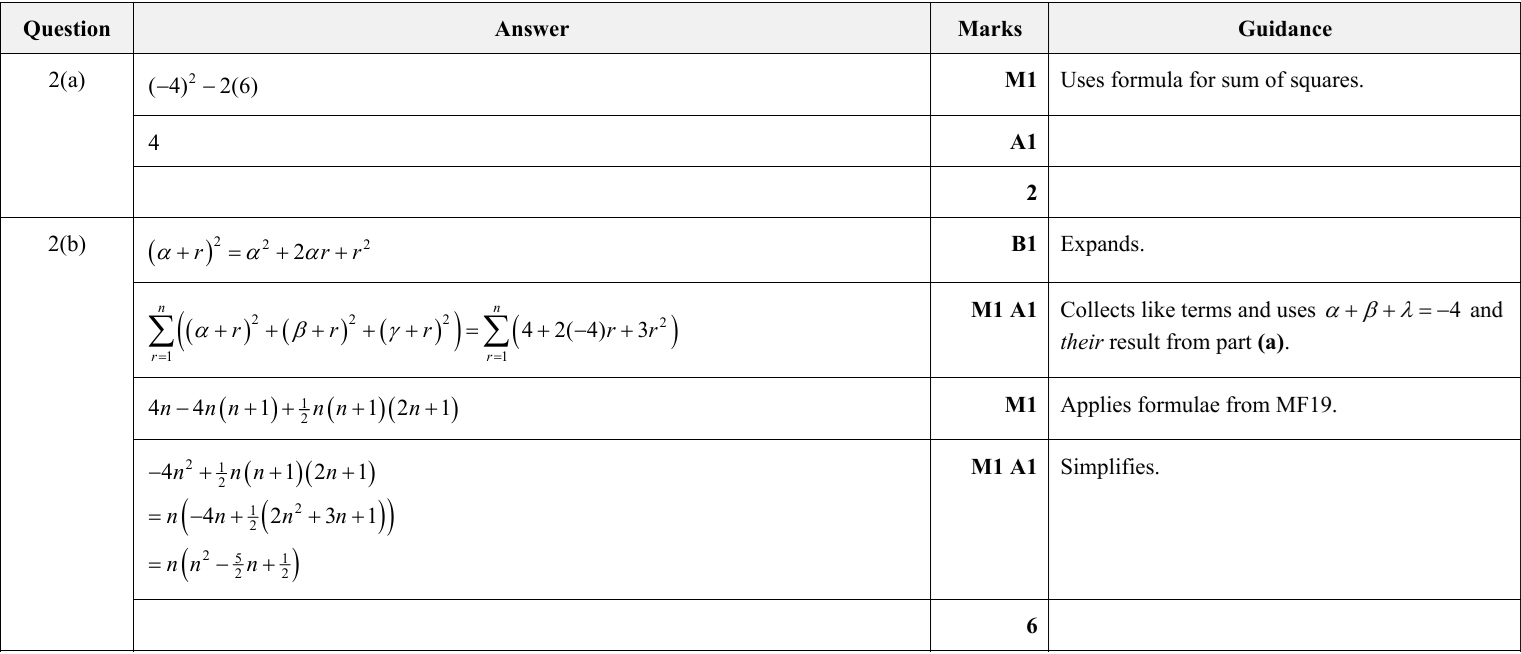
The cubic equation \(x^3 + 4x^2 + 6x + 1 = 0\) has roots \(\alpha, \beta, \gamma\).
(a) Find the value of \(\alpha^2 + \beta^2 + \gamma^2\).
(b) Use standard results from the list of formulae (MF19) to show that
\(\sum_{r=1}^{n} ((\alpha + r)^2 + (\beta + r)^2 + (\gamma + r)^2) = n(n^2 + an + b),\)
where \(a\) and \(b\) are constants to be determined.